 Reading Ants
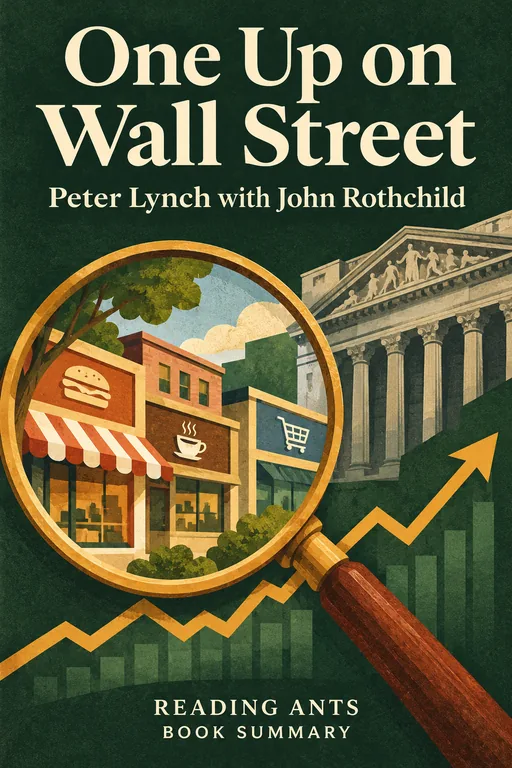
Peter Lynch, a famous mutual fund manager, argues that ordinary people can beat professional investors by buying shares in businesses they understand from daily life, and he explains how to research and judge them.
Overview
One Up on Wall Street was published in 1989 by Peter Lynch with the writer John Rothchild. Lynch managed a very successful fund at Fidelity Investments, called Magellan, in the 1970s and 1980s. The book shares his approach in an easy, humorous tone. His main idea is that amateur investors have an advantage over professionals, because they notice new stores, products and trends in their own lives long before Wall Street does. He describes how to turn those observations into research, and how to avoid common mistakes. The book is about stocks in general, and not a list of tips.
Full Summary
1. The amateur’s edge
The idea: Lynch says that people who work in a field, or shop in a certain place, see changes early. A nurse, a teacher or a mechanic can notice a new product that is spreading, or a company that is doing well, long before analysts. He tells readers to invest in what they know. At the same time, he stresses that noticing a good business is only the start of the research.
In real life: If every student at your school has started using the same new app or snack, that is a clue worth looking into.
2. Do your homework
The idea: A good story is not enough. Lynch says to check the company’s finances: how much it earns, how much debt it has, how its price compares to its earnings and whether it can keep growing. He suggests being able to explain in a couple of minutes why you own a stock, a simple test for clear thinking. Without research, investing is little better than gambling.
In real life: Before buying a used bicycle, you check the brakes, the frame and the price, and not just the paint.
3. Six kinds of stocks
The idea: Lynch sorts companies into categories, which he treats as different games with different rules. Slow growers are large, steady firms that pay dividends. Stalwarts are big companies that grow moderately. Fast growers are small firms that expand quickly, and they are his favorites. Cyclicals rise and fall with the economy. Turnarounds are firms in trouble that may recover. Asset plays have hidden value that the market overlooks. Knowing which category a stock belongs in tells you what to expect.
In real life: A sprinter and a marathon runner are both athletes, but you judge them differently.
4. Look for the big winners
The idea: Lynch is known for the idea of the “tenbagger,” a stock that rises tenfold. He says that a few big winners can make up for many mistakes, so patience with a good company is valuable. He warns against selling a winner too soon just to lock in a small profit, and against holding on to a company just because the price has fallen, in the hope that it will come back. A falling price is not itself a reason to sell, and a rising price is not itself a reason to hold: Lynch says that the company’s own story and its value should decide.
In real life: If you plant ten seeds and one grows into a huge tree, the other nine matter much less.
5. Avoid the traps
The idea: The book lists common warning signs. Lynch is wary of hot stocks in hot industries, of companies that promise to be “the next” famous firm, and of tips from people who do not know the business. He prefers dull-sounding companies in boring industries, since they are often ignored by crowds. He also warns about companies with large debts and about firms that depend on one customer.
In real life: When everyone talks about the same trendy product, the price may already include the excitement.
6. Keep your cool in the market
The idea: Lynch says that the market goes up and down, and that nobody can predict it. He advises investing only money you could lose without it upsetting your daily life, and staying calm during general panics instead of reacting to short-term swings. He expects sharp drops to come at some point, though nobody knows when, and he sees them as chances to buy good companies at lower prices. Spending a lot of time trying to forecast the economy is, in his view, less valuable than studying companies.
In real life: A farmer who plants in spring does not give up because of one rainy week.
Why It Matters
One Up on Wall Street is one of the most popular books on investing, and has introduced many readers to the idea of studying companies for themselves. Lynch’s record at Magellan made him famous, and his message that ordinary people have advantages gave readers confidence. The book’s phrases, such as “invest in what you know,” have become part of everyday talk about money. It continues to be read because it is entertaining and practical, with a human tone. It also encourages curiosity about how businesses work, which is useful even for those who never buy a stock. Although the examples are from the 1970s and 1980s, the habits of mind it teaches, such as watching, checking and being patient, are not out of date.
Key Takeaways
- Use your daily life. The places you work and shop can show you good businesses early.
- Research before you buy. A good story needs numbers to back it up.
- Know what kind of company it is. Different types of stocks need different expectations.
- Be patient with winners. A few big successes can make a portfolio.
- Ignore the noise. Market forecasts and hot tips are poor guides.
What We Can Learn
Even if you do not invest, the book teaches a way of paying attention. Notice what changes around you, and ask why. When a product or a trend catches on, think about how many people it affects and whether the business behind it is sound. Learn to read basic information about a company before you spend money on it. Keep a notebook with your reasons for any decision, and check later whether you were right. And remember that no method is a guarantee: only invest money you can afford to lose, and ask a trusted adult or a qualified adviser for help with real decisions.
Criticism and Counterpoints
Critics say that Lynch’s success was exceptional and that many people who try to copy his method will do worse than a simple index fund. The book was written in a period of generally rising markets, and some of the examples now seem dated. The idea that ordinary investors can beat professionals is questioned by researchers, who find that most individual investors do poorly after costs and mistakes. Others note that “invest in what you know” can lead people to put too much money in a single industry or company they like. Lynch himself recommends caution and research, and says that many people are better off with funds.
Who Should Read It
This book is for beginners who want a lively introduction to picking stocks, as well as experienced investors who like clear thinking and stories. It is easy to read. Those who want a purely rule-based or index-fund approach may disagree with it, and readers looking for up-to-date examples will need a more recent source.
Want the whole book?
A summary is a taste, not the meal. Here is where to find the full book.
You reached the end 🎉
Nicely done. Mark this one as read, and we will suggest what to read next.
Read this next
A Random Walk Down Wall Street
Burton G. Malkiel
Burton Malkiel argues that stock prices are so hard to predict that most investors, professional or not, are better off holding a broad, low-cost index fund than trying to beat the market.
💰 Money & Economics
The Little Book of Common Sense Investing
John C. Bogle
John Bogle, founder of the investment firm Vanguard, argues that most people should buy and hold a low-cost fund that owns the whole stock market, because costs quietly eat up the gains from active investing.
💰 Money & Economics
The Intelligent Investor
Benjamin Graham
Successful investing is less about being clever than about being disciplined: buy sound businesses at a price that leaves a margin of safety, and don't let the mood of the market push you around.
💰 Money & Economics
The Essays of Warren Buffett
Warren E. Buffett and Lawrence A. Cunningham
Law professor Lawrence Cunningham arranges Warren Buffett's yearly letters to the shareholders of Berkshire Hathaway by topic, so that readers can follow his clear and often humorous views on investing, business, accounting and ethics.
💰 Money & Economics
The Most Important Thing
Howard Marks
Howard Marks, a veteran investor, argues that successful investing depends on thinking more deeply than the crowd, understanding risk and cycles, and avoiding big mistakes, more than on finding secret formulas.
💰 Money & Economics
The Wealth of Nations
Adam Smith
A nation's true wealth is not its stock of gold but the goods and services its people produce, and that wealth grows fastest when people specialize, trade freely and compete, with government providing justice, defense and public goods.
💰 Money & EconomicsWant something different?
Pick another topic and we will show you three books to start with.