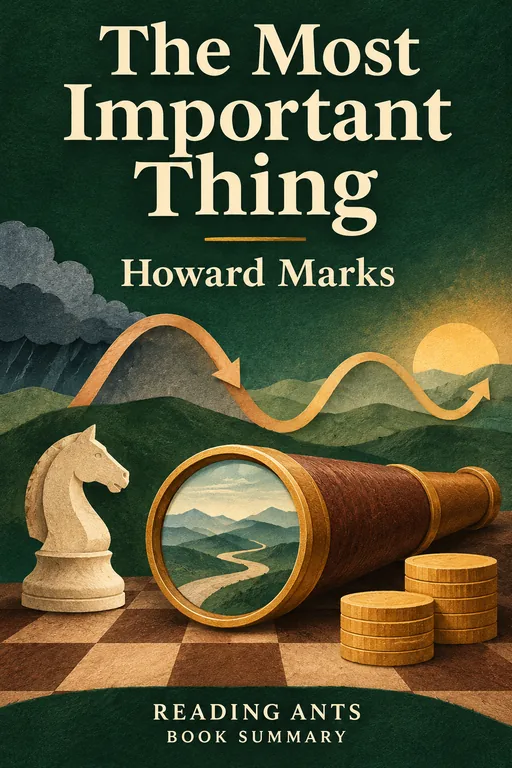
Howard Marks, a veteran investor, argues that successful investing depends on thinking more deeply than the crowd, understanding risk and cycles, and avoiding big mistakes, more than on finding secret formulas.
Overview
The Most Important Thing: Uncommon Sense for the Thoughtful Investor was published in 2011 by Howard Marks, who co-founded the investment firm Oaktree Capital Management. It draws on memos that he wrote for his clients over many years. The title comes from his habit of telling people that the most important thing is one idea and, a few minutes later, another. The book collects twenty of these ideas as short chapters, each about one theme that he considers essential. His tone is thoughtful and modest. He emphasizes judgment, humility about the future, and caution.
Full Summary
1. Second-level thinking
The idea: Marks says that to do better than others, you must think differently and more deeply. First-level thinking is simple and superficial, such as deciding that a company is good and so its shares must be a good buy. Second-level thinking asks what everyone else already believes, what is already in the price and what might happen that others do not expect. Success requires being right when most people are wrong, and that is hard.
In real life: If everyone knows that a team will probably win, the odds already reflect it, so you need a reason why they might be wrong.
2. Value, price and the efficient market
The idea: Marks believes that the central task is to estimate what an asset is worth, and then to buy it when the price is lower. He accepts that markets are often efficient, since many smart people compete, but not always. Mispricings do occur, especially when people are very fearful or excited. An investor must have a reason to think that he knows something that the market has overlooked.
In real life: A used bicycle can be a bargain if you know how much it is worth and the seller does not.
3. Understanding risk
The idea: Marks says that risk is not just the ups and downs of prices. It is the uncertainty about the future and the chance of losing money, and much of it is subjective, hidden and hard to measure. Even good assets can be risky if they are bought at too high a price, and a low price does not mean low risk. Risk tends to rise when prices are high and investors crowd in, and when everyone believes that there is none.
In real life: A very comfortable, sunny day may tempt you to leave the umbrella at home, and that is exactly when the storm may catch you.
4. Controlling risk and investing defensively
The idea: Because the future is unknowable, Marks recommends that investors focus on avoiding big losses and not just on chasing high gains. He says that good results are often achieved not by brilliant moves, but by avoiding mistakes. Defensive investing means putting the avoidance of losses ahead of chasing the biggest gains, and being able to survive a bad period. He compares this to tennis, where the player who avoids errors often beats the one who goes for spectacular winners.
In real life: A driver who keeps a safe distance may not arrive first, but is far more likely to arrive.
5. Cycles and the pendulum
The idea: Marks stresses that markets and economies move in cycles. Sentiment swings like a pendulum between too much optimism and too much fear, and rarely stays at the midpoint. Awareness of where we are in the cycle helps an investor to be cautious when others are carefree and bold when others are afraid. He says that it is not possible to predict the exact timing, but one can notice the extremes.
In real life: When every classmate is certain that an exam will be easy, it may be a good time to revise a little more.
6. Resisting emotion and the crowd
The idea: Greed, fear and the desire to fit in are enemies of good decisions, according to Marks. He says that investors should think independently and be ready to go against the crowd, even when that is uncomfortable. He calls for patient opportunism: waiting for good opportunities to come to you, instead of acting all the time, and not expecting the market to be mispriced at every moment.
In real life: A student who prepares steadily is not swayed by the panic of classmates before a test.
7. Humility, luck and knowing what you don’t know
The idea: Other chapters are about being humble. Marks says that the future is uncertain and that luck plays a part in investing results, so that a spectacular result does not prove skill. He encourages investors to recognize the limits of their knowledge, and to be doubtful of the forecasts made by experts. The final chapter pulls the lessons together, with an understanding of value as the foundation.
In real life: A good weather forecaster still says that there is a thirty percent chance of rain, and does not claim to know.
Why It Matters
The Most Important Thing has become a favorite among professional investors and serious amateurs. It is admired for its clear writing and thoughtful ideas, it carries praise from Warren Buffett, who called it a useful book, and it is often recommended as one of the best books on the psychology and judgment of investing. The concepts of second-level thinking and the pendulum of sentiment are now widely used in the investment world. The book matters because it takes a calm, honest look at the difficulty of the task, and warns against both over-confidence and complacency. It also reflects decades of experience in markets, including several booms and crashes. Many readers say that it helped them to avoid bad decisions as much as it helped them to find good ones.
Key Takeaways
- Think deeper than the crowd. You cannot beat the market by following everyone’s obvious view.
- Price matters. Even a great asset is a poor buy if you pay too much.
- Risk is the chance of loss. It is more than price swings, and it is hard to measure.
- Respect cycles. Extremes of optimism and fear tend to reverse.
- Be humble. Admit what you do not know, and prepare for surprises.
What We Can Learn
You do not need to be an investor to benefit. Whenever you form an opinion, ask whether it is already obvious to everyone, and what could prove it wrong. Notice when you feel too confident or too frightened, since these are signals to slow down. Prepare for bad outcomes, by keeping a margin of safety in your plans and finances. Be patient: not every moment calls for action. And accept that luck plays a role in life, which should make us both humble in success and kind to ourselves in failure.
Criticism and Counterpoints
Critics say that Marks’s advice is more about attitude than about precise rules, and that his ideas are not tested with numbers, so they are hard to apply and to check. Some reviewers add that the ideas are not new and that the book leans on his earlier memos, so readers who already know the classics of value investing may find little that is new. The focus on market cycles can also tempt readers to try to time the market, which most people find difficult. Marks himself acknowledges that he cannot predict the future, and stresses preparation instead.
Who Should Read It
This book is for people who invest or who are curious about how professionals think about risk, as well as for anyone who likes careful reasoning. It is easy to read, though some of the ideas need time to absorb. Complete beginners may want a more basic book first, and those looking for specific tips or formulas may be disappointed.
Want the whole book?
A summary is a taste, not the meal. Here is where to find the full book.
You reached the end 🎉
Nicely done. Mark this one as read, and we will suggest what to read next.
Read this next
Poor Charlie's Almanack
Charles T. Munger
This collection of speeches and talks by Charlie Munger, the long-time partner of Warren Buffett, shares his approach to clear thinking: use many ideas from many subjects, avoid common errors of judgment and learn from the mistakes of others.
💰 Money & Economics
The Essays of Warren Buffett
Warren E. Buffett and Lawrence A. Cunningham
Law professor Lawrence Cunningham arranges Warren Buffett's yearly letters to the shareholders of Berkshire Hathaway by topic, so that readers can follow his clear and often humorous views on investing, business, accounting and ethics.
💰 Money & Economics
A Random Walk Down Wall Street
Burton G. Malkiel
Burton Malkiel argues that stock prices are so hard to predict that most investors, professional or not, are better off holding a broad, low-cost index fund than trying to beat the market.
💰 Money & Economics
One Up on Wall Street
Peter Lynch with John Rothchild
Peter Lynch, a famous mutual fund manager, argues that ordinary people can beat professional investors by buying shares in businesses they understand from daily life, and he explains how to research and judge them.
💰 Money & Economics
The Big Short
Michael Lewis
Michael Lewis follows a handful of unusual investors who saw that the American housing boom was a bubble before the 2008 financial crisis, bet against it, and discovered how deeply the financial system had misjudged its own risks.
💼 Business
The Wealth of Nations
Adam Smith
A nation's true wealth is not its stock of gold but the goods and services its people produce, and that wealth grows fastest when people specialize, trade freely and compete, with government providing justice, defense and public goods.
💰 Money & EconomicsWant something different?
Pick another topic and we will show you three books to start with.