 Reading Ants
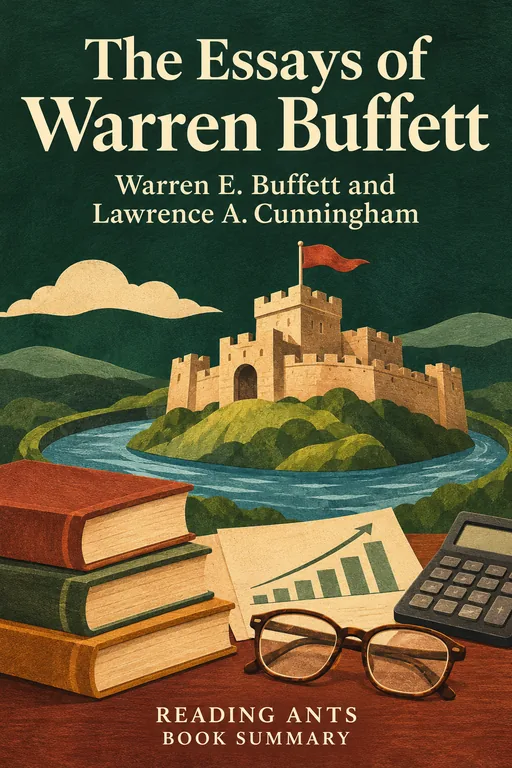
Law professor Lawrence Cunningham arranges Warren Buffett's yearly letters to the shareholders of Berkshire Hathaway by topic, so that readers can follow his clear and often humorous views on investing, business, accounting and ethics.
Overview
The Essays of Warren Buffett: Lessons for Corporate America was first published in the late 1990s by Lawrence A. Cunningham, who gathered passages from Buffett’s letters to shareholders of Berkshire Hathaway, the company that Buffett led. Instead of presenting the letters by year, Cunningham arranged them by theme, such as corporate governance, finance, investing, mergers and valuation. The result reads like a book of connected essays in Buffett’s own plain and witty voice. Later editions added more material, so editions differ. The topics also include how to value a business and how to read accounting figures. The book helps readers see the principles behind his long record.
Full Summary
1. Think like an owner
The idea: Buffett says that Berkshire’s managers and shareholders should think of themselves as partners in a business, and that buying a share means owning part of a real company, not a ticket to be traded. He explains that Berkshire aims to make money together with its shareholders, not at their expense. This owner’s attitude shapes decisions about pay, about acquisitions and about how profits are used.
In real life: A family that runs a shop does not waste money on things that do not help it, because it is their own.
2. Honest, simple accounting
The idea: Buffett argues that accounting numbers should help owners to understand how a business is truly doing. He criticizes practices that make results look better than they are, and he values plain explanations of what is going well and what is not. In the letters he often admits mistakes openly, which he says builds trust with partners.
In real life: A student who tells a parent honestly about a bad test result is more likely to get useful help than one who hides it.
3. Mr. Market and the margin of safety
The idea: Buffett borrows from his teacher, Benjamin Graham, the picture of Mr. Market, an imaginary partner who offers every day to buy or sell his share of a business at a price that changes with his mood. Sometimes the price is foolishly high, sometimes foolishly low. An investor can ignore him or take advantage, but should never be led by him. Buffett also stresses a margin of safety: buy only when the price is well below your careful estimate of the business’s worth, though he also came to favor wonderful businesses at fair prices, over mediocre ones at bargain prices, and any estimate of value remains uncertain.
In real life: If a shopkeeper offers a bicycle for half its value because he is in a hurry, you may buy it, but you do not let his mood decide what a bicycle is worth.
4. Stay within what you understand
The idea: Buffett repeats that investors should only commit to businesses they can understand, which he calls their circle of competence. The size of the circle matters less than knowing its edges. He looks for businesses with strong and lasting advantages, which he describes as a protective moat around a castle, and for able, honest managers. He prefers to hold such businesses for a long time.
In real life: A person who knows a lot about cars can judge a repair shop better than one who has never opened a hood.
5. Be careful with deals and with fashion
The idea: The letters discuss mergers and acquisitions, and Buffett warns about managers who start projects and buy other firms simply because money is available, or because a leader has a favorite plan. He describes the “institutional imperative,” the tendency of organizations to copy their peers and to resist change, even when this is foolish. He also criticizes high fees for money managers and the habit of frequent trading.
In real life: When every club in school copies the same fundraising idea because the others do, the result may be that none does well.
6. Rationality, patience and integrity
The idea: Behind the technical points, the essays express values: be rational, be patient, be honest and act with integrity. Buffett says that a long, steady approach beats frequent action: holding strong businesses and doing little is often the smart move, and an investor who would not be willing to keep a stock for many years should hesitate to buy it at all. He also describes doing business on trust, for example by promising confidentiality to people who sell their companies to Berkshire and by avoiding unfriendly takeovers.
In real life: A friend who always keeps their word becomes someone you can trust with something important.
Why It Matters
The book gives many readers an easy way to study the thinking of one of the most famous investors in history. Buffett’s letters are known for their clarity and humor, and gathering them by topic makes them useful as a course in business and investing. The book has gone through several editions, and it has helped to spread ideas such as value investing, the margin of safety and the moat. It also raised the standard for how company leaders speak to their owners: plainly, without jargon and with willingness to discuss mistakes. For anyone who wants to understand the values behind Berkshire Hathaway, it is an essential text.
Key Takeaways
- Own a business, not a ticker. A share is a piece of a real enterprise.
- Price is not value. The market’s mood changes, but the worth of a business changes more slowly.
- Know your circle. Only invest in what you truly understand.
- Honesty builds trust. Clear reporting and open admission of mistakes matter.
- Patience wins. Long-term thinking tends to beat constant activity.
What We Can Learn
You can apply Buffett’s ideas in everyday life. Before making a purchase or a choice, ask what the thing is really worth to you, apart from what others say. Be honest about the limits of your knowledge, and learn before you decide. Practice patience: some of the best results in school, sports and work come from steady effort over years. When you make a mistake, say so plainly and learn from it. Finally, protect your good name by keeping your promises. These habits are simple, but they are not easy.
Criticism and Counterpoints
Critics point out that Buffett’s results came in a particular time, with unique advantages such as access to insurance money to invest, and that his success is difficult to copy. The letters are written from his viewpoint, and they naturally present his decisions in a favorable light. Some argue that his advice to concentrate investments in a few companies is risky for ordinary people, who might do better with index funds, as Buffett himself has said. Some readers also feel that the book, as a collection, repeats ideas, and that it favors large American businesses and their culture.
Who Should Read It
This book is for people who want to understand how a famous investor thinks, and for managers who want to improve the way that they speak to owners and staff. It is clear and often funny, but some sections cover accounting and finance in detail. Beginners may like to start with a lighter book and then return to it.
Want the whole book?
A summary is a taste, not the meal. Here is where to find the full book.
You reached the end 🎉
Nicely done. Mark this one as read, and we will suggest what to read next.
Read this next
Poor Charlie's Almanack
Charles T. Munger
This collection of speeches and talks by Charlie Munger, the long-time partner of Warren Buffett, shares his approach to clear thinking: use many ideas from many subjects, avoid common errors of judgment and learn from the mistakes of others.
💰 Money & Economics
The Intelligent Investor
Benjamin Graham
Successful investing is less about being clever than about being disciplined: buy sound businesses at a price that leaves a margin of safety, and don't let the mood of the market push you around.
💰 Money & Economics
One Up on Wall Street
Peter Lynch with John Rothchild
Peter Lynch, a famous mutual fund manager, argues that ordinary people can beat professional investors by buying shares in businesses they understand from daily life, and he explains how to research and judge them.
💰 Money & Economics
The Most Important Thing
Howard Marks
Howard Marks, a veteran investor, argues that successful investing depends on thinking more deeply than the crowd, understanding risk and cycles, and avoiding big mistakes, more than on finding secret formulas.
💰 Money & Economics
The Little Book of Common Sense Investing
John C. Bogle
John Bogle, founder of the investment firm Vanguard, argues that most people should buy and hold a low-cost fund that owns the whole stock market, because costs quietly eat up the gains from active investing.
💰 Money & Economics
The Wealth of Nations
Adam Smith
A nation's true wealth is not its stock of gold but the goods and services its people produce, and that wealth grows fastest when people specialize, trade freely and compete, with government providing justice, defense and public goods.
💰 Money & EconomicsWant something different?
Pick another topic and we will show you three books to start with.