Capital
Original title: Das Kapital
Karl Marx argues that capitalism produces wealth by making workers create more value than they are paid for, and that this built-in exploitation and the system's cycle of growth and crisis push society toward change.
Overview
Capital (Das Kapital) is a vast analysis of the capitalist economy by Karl Marx, a German philosopher and economist who spent much of his life in exile in London. The first volume was published in 1867. Marx died in 1883 before finishing the work, and his friend and collaborator Friedrich Engels edited and published the second and third volumes in 1885 and 1894. Marx wanted to understand how capitalism really works, how profit is made and why wealth and poverty grow together. The book is dense, mixing economics, philosophy, history and vivid reports about factory conditions in Victorian Britain. It became one of the most influential and controversial books ever written.
Full Summary
1. The commodity
The idea: Marx starts with the simplest unit of capitalism, the commodity, something produced to be sold. A commodity has a use-value, its usefulness, and an exchange-value, what it can be traded for. He argues that the exchange-value of goods is ultimately based on the socially necessary labor time needed to produce them. This is his version of the “labor theory of value,” which he inherited from earlier economists like Adam Smith and David Ricardo.
In real life: A hand-made table and a factory-made table may be equally useful, but, in Marx’s account, their value reflects the labor time that is socially necessary to make one under prevailing conditions, so a producer who works unusually slowly does not create more value merely by taking longer.
2. Money and commodity fetishism
The idea: Marx explains how money develops as a universal way of measuring and exchanging value. He also introduces commodity fetishism, the idea that in a market society, relationships between people appear as relationships between things. We see prices and goods, not the work and social relations behind them. This makes the economy seem like a natural, impersonal force instead of a human creation.
In real life: A cheap shirt in a shop hides the labor, often far away, of the people who made it.
3. Surplus value: the source of profit
The idea: The center of the book is Marx’s explanation of profit. A worker sells their ability to work, their labor power, to a capitalist for a wage. In part of the working day, the worker produces enough value to cover their wage. For the rest of the day, they produce surplus value, which the capitalist keeps as profit. Marx calls this exploitation, even when the wages are agreed upon freely, because the worker does not receive the full value of what they produce.
In real life: If a worker’s wage is covered in four hours but they work eight, the extra four hours’ output goes to the owner.
4. The working day and the factory
The idea: Marx devotes long chapters to the struggle over the length of the working day, using reports by British factory inspectors. He describes children and adults working extreme hours in unhealthy conditions, and the long fight for laws limiting them. He also shows how machinery increases productivity but often makes work more monotonous and workers more replaceable.
From the book: His descriptions of long hours and child labor in nineteenth-century factories drew directly on official government reports, which made the book powerful.
In real life: Laws on maximum working hours and a minimum age for work exist because of struggles like those Marx describes.
5. Accumulation and the reserve army
The idea: Capitalists, Marx says, are forced by competition to reinvest their profits to grow, or be driven out by rivals. This leads to constant accumulation of capital, and, as technology replaces labor, to a pool of unemployed people he calls the industrial reserve army. The existence of the unemployed pushes wages down and strengthens employers. Wealth builds up at one end of society, and hardship at the other.
In real life: When many people are looking for work, employers can offer lower pay, because workers have less bargaining power.
6. Primitive accumulation
The idea: How did the first capital come about? Marx rejects the story that some people simply saved more. He argues that it came from violence and dispossession: driving peasants off their land through enclosures, colonial plunder and the slave trade. This created a class of people with nothing but their labor to sell, and another with property. He calls this primitive accumulation.
In real life: Historians still debate how the enclosure of common land in Britain pushed people into cities and factories.
7. Crisis and the future
The idea: In the final chapters of the first volume, Marx suggests that capitalism contains contradictions that lead to crises and to growing conflict between the owners and the workers. He expected that, in time, the working class would take control of production, ending capitalism. Later volumes, edited by Engels, explore topics such as how profit rates behave, competition and finance, and the cycle of booms and busts.
In real life: Economic crises, like the one in 2008, are still studied for signs of the instabilities Marx described.
Why It Matters
Capital is one of the most influential books of modern history. It shaped socialist and communist movements around the world, and many governments, from the Soviet Union to China, claimed Marx’s ideas as their foundation, though they often applied them in ways he might not have recognized. Scholars across economics, sociology, history and philosophy still debate his arguments.
Even critics of Marx acknowledge that he identified real features of industrial capitalism: inequality, financial crises, the power of large firms and the importance of class. His work helped create the modern study of political economy, and ideas such as exploitation, alienation and class struggle remain central to discussions about work and inequality.
Key Takeaways
- Profit comes from labor. Marx traces profit to unpaid work.
- Hidden relationships matter. Goods conceal the human work behind them.
- Capitalism needs growth. Competition forces constant accumulation.
- The system has history. Capitalism arose from specific, often violent, changes.
- Crises are built in. Marx saw instability as part of the system.
What We Can Learn
Capital encourages us to look behind prices and products. Asking who made something, under what conditions and who benefits from the price helps us understand the global economy.
It also shows the value of using evidence. Marx’s picture of working conditions was based on government reports and factory inspections, and it influenced reforms. Facts, carefully gathered, can drive change.
Finally, it reminds us that economic systems are not natural laws. They are created by people and laws, and they can be changed by them, a point of view that is helpful whatever one thinks of Marx’s conclusions.
Criticism and Counterpoints
Many economists reject the labor theory of value, arguing that prices are set by supply and demand and by how useful goods are to buyers, not by labor time alone. Marx’s predictions, such as a growing collapse of capitalism and a decline in profit rates, have not been borne out in the way he expected, since capitalist economies have adapted and living standards for many workers have risen.
Critics also hold that the societies that claimed to follow Marx became repressive and economically inefficient, though defenders say these regimes distorted his ideas. The book is also difficult: long, abstract and dense with Hegelian language. Supporters argue that, whatever its flaws, it remains a rich source for understanding inequality and power.
Who Should Read It
This book suits mature readers interested in economics, politics, history or philosophy. It is very demanding, so most people start with a guide or selected chapters, such as those on the working day. Readers new to Marx may first prefer his shorter The Communist Manifesto.
Want the whole book?
A summary is a taste, not the meal. Here is where to find the full book.
You reached the end 🎉
Nicely done. Mark this one as read, and we will suggest what to read next.
Read this next
The Communist Manifesto
Karl Marx and Friedrich Engels
Marx and Engels declare that all history is the history of class struggle, that capitalism has created a working class that will overthrow it, and that communism will end class divisions.
⚖️ Politics & Society
The Wealth of Nations
Adam Smith
A nation's true wealth is not its stock of gold but the goods and services its people produce, and that wealth grows fastest when people specialize, trade freely and compete, with government providing justice, defense and public goods.
💰 Money & Economics
Capital in the Twenty-First Century
Thomas Piketty
Thomas Piketty argues that when the return on wealth grows faster than the economy as a whole, wealth naturally concentrates in fewer hands, and that only policy choices such as progressive taxes can keep inequality in check.
💰 Money & Economics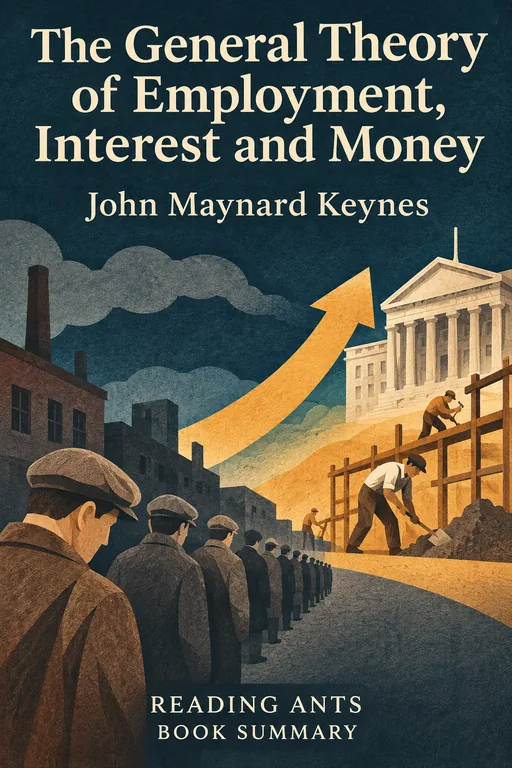
The General Theory of Employment, Interest and Money
John Maynard Keynes
Keynes argues that an economy can get stuck with high unemployment because total spending is too low, and that governments can and should act to raise demand when private spending falls short.
💰 Money & Economics
Rich Dad Poor Dad
Robert T. Kiyosaki
Schools teach people to work for money, but the rich learn to make money work for them by understanding the difference between assets and liabilities and by building businesses and investments.
💰 Money & Economics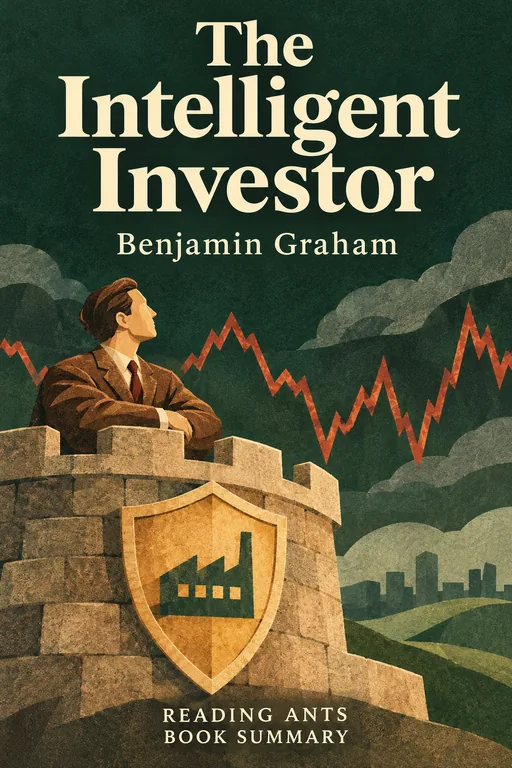
The Intelligent Investor
Benjamin Graham
Successful investing is less about being clever than about being disciplined: buy sound businesses at a price that leaves a margin of safety, and don't let the mood of the market push you around.
💰 Money & EconomicsWant something different?
Pick another topic and we will show you three books to start with.