 Reading Ants
The Communist Manifesto
Original title: Manifest der Kommunistischen Partei
Marx and Engels declare that all history is the history of class struggle, that capitalism has created a working class that will overthrow it, and that communism will end class divisions.
Overview
The Communist Manifesto, originally titled Manifesto of the Communist Party, is a short political pamphlet written by Karl Marx and Friedrich Engels and published in London in German in February 1848. It was commissioned by the Communist League, a small group of workers and intellectuals. Marx did most of the writing, with Engels contributing ideas and an earlier draft. The text is only about twelve thousand words but is among the most influential political documents ever written. Published as revolutions were breaking out across Europe, it combines a theory of history, an analysis of capitalism and a program of action.
Full Summary
1. Bourgeois and proletarians
The idea: Part I of the Manifesto, “Bourgeois and Proletarians”, opens with the claim that the history of all hitherto existing society is the history of class struggles: freeman and slave, lord and serf, guild master and journeyman. In the modern age, society splits into two great classes: the bourgeoisie, who own the factories, land and capital, and the proletariat, the wage workers who have only their labor to sell. Marx and Engels describe the bourgeoisie as a revolutionary force that has swept away old feudal ties, created enormous productive power and built a world market.
In real life: Today’s debates about owners, workers and wages still use the language of class that this text helped to popularize.
2. The growth and crisis of capitalism
The idea: Later in Part I, the authors argue that capitalism constantly revolutionizes production, spreads across the globe and turns everything into a commodity. But it also produces crises, as it creates more than the market can absorb, and it creates its own “gravediggers” in the working class, which grows in number and is organized by factory life. As the workers unite in unions and political action, they begin to challenge the system. The bourgeoisie, they say, cannot continue to rule because it cannot guarantee even its workers’ existence.
In real life: Economic downturns, when factories close and workers lose jobs, are often cited as examples of the instability they describe.
3. Proletarians and communists
The idea: In Part II, “Proletarians and Communists”, Marx and Engels explain what communists stand for. Communists do not form a separate party opposed to others, they say, but they represent the common interests of the whole working class. Their main aim is the abolition of private property in the means of production, meaning the factories and land that allow some to live from the labor of others, though not personal belongings. They respond to criticisms, including that communism would destroy the family, freedom and nations.
In real life: A common confusion is to think that communists want to take away personal possessions, while the text is about ownership of productive property.
4. Ten measures
The idea: Near the end of Part II, the authors propose a set of immediate measures that they believe would apply in the most advanced countries once the workers have won political power. They list ten: abolishing property in land; a heavily progressive income tax; abolishing the right of inheritance; confiscating the property of emigrants and rebels; centralizing credit in the hands of the state; placing communication and transport in state hands; expanding state-owned factories and farmland, including bringing waste land into cultivation; making everyone liable to work; combining agriculture with industry to narrow the gap between town and country; and free public education for all children, together with an end to children’s factory labor in its present form. They argue that, as class differences disappear, public power would lose its political character.
In real life: Several of these ideas, such as progressive taxation and free public schooling, are now ordinary in many countries.
5. Other socialisms and the party’s position
The idea: The third of the Manifesto’s four parts criticizes other types of socialism that the authors regard as reactionary, utopian or merely reformist, such as feudal socialism, petty-bourgeois socialism and the utopian visions of thinkers like Fourier and Owen. They see these as either looking backward or lacking a realistic understanding of class struggle. The fourth and final part explains that communists should support all revolutionary movements against the existing social order, while always highlighting the property question.
In real life: Disagreements about whether to reform capitalism or replace it are still central to left-wing politics.
6. The closing call
The idea: The Manifesto ends with a bold statement that communists openly declare that their ends can be attained only by the forcible overthrow of all existing social conditions. It says that the ruling classes may tremble at a communist revolution, because the workers, in its view, have little to lose from such a change except the conditions that bind them, and have a world to gain. The final line urges workers of all countries to unite, a phrase that became a famous slogan.
In real life: The call for international solidarity among workers has been echoed in labor movements around the world.
Why It Matters
The Manifesto has been translated into dozens of languages and has been read by millions. It helped inspire socialist and communist movements and revolutions in the twentieth century, including in Russia and China, and has also shaped trade unions, social democratic parties and political debates. Many governments that claimed to follow it, however, acted in ways that critics say contradicted its ideals.
Even people who reject its conclusions often recognize its power as a piece of writing and its role in introducing the idea that economic structure shapes politics, law and culture. It remains one of the most cited texts in political history.
Key Takeaways
- History as class struggle. Conflicts between groups drive change.
- Capitalism is dynamic. It creates wealth and also crises.
- Workers can unite. Shared interests lead to collective power.
- Property in production is central. The aim is to end private ownership of the means of production.
- Ideas follow interests. Social conditions shape beliefs.
What We Can Learn
The text reminds us to ask who benefits from an economic arrangement. Looking at who owns what, and who works for whom, can reveal power relationships that are easy to overlook.
It also shows the force of a short, clear message. In a few pages, the authors gave millions of people a way to understand their situation, which is a lesson about the power of writing.
Finally, it can be read as a prompt to think critically about both its claims and its consequences. Studying its arguments alongside the history of states that adopted communism helps us understand how ideas can be changed in practice.
Criticism and Counterpoints
Critics argue that the Manifesto’s predictions were wrong. Capitalist societies did not collapse into proletarian revolutions in the way they expected, and living standards for many workers rose. A large middle class grew, and the working class did not become uniformly poorer. Others argue that the theory ignores the role of ideas, religion, nationalism and individual choice.
Historians also note that regimes that claimed the Manifesto’s legacy often became authoritarian, with severe human costs, though defenders say these departed from Marx’s vision. Some find its language of inevitability and violent revolution troubling. It is best read as a historical document and a starting point for debate.
Who Should Read It
This short pamphlet suits older teenagers and adults interested in politics, history and economics. It can be read in an hour or two, but the language is dense, so a version with notes helps. It is best read alongside criticism and history.
Want the whole book?
A summary is a taste, not the meal. Here is where to find the full book.
You reached the end 🎉
Nicely done. Mark this one as read, and we will suggest what to read next.
Read this next
Capital
Karl Marx
Karl Marx argues that capitalism produces wealth by making workers create more value than they are paid for, and that this built-in exploitation and the system's cycle of growth and crisis push society toward change.
💰 Money & Economics
The Wealth of Nations
Adam Smith
A nation's true wealth is not its stock of gold but the goods and services its people produce, and that wealth grows fastest when people specialize, trade freely and compete, with government providing justice, defense and public goods.
💰 Money & Economics
Animal Farm
George Orwell
The animals of an English farm overthrow their cruel human owner to create a fair society, but the clever pigs who lead them slowly become just as tyrannical as the humans they replaced.
📜 Classics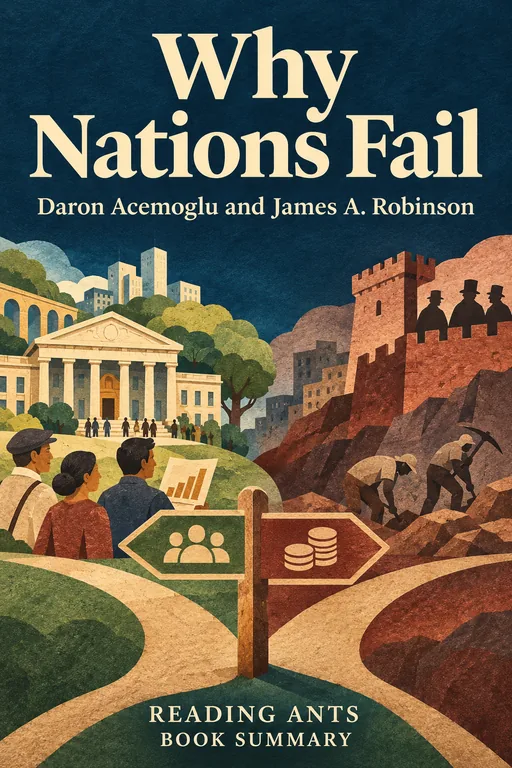
Why Nations Fail
Daron Acemoglu and James A. Robinson
Nations become rich or stay poor mainly because of their institutions: countries that share power and reward ordinary people's effort prosper, while those run by narrow elites for their own benefit stay poor.
💰 Money & Economics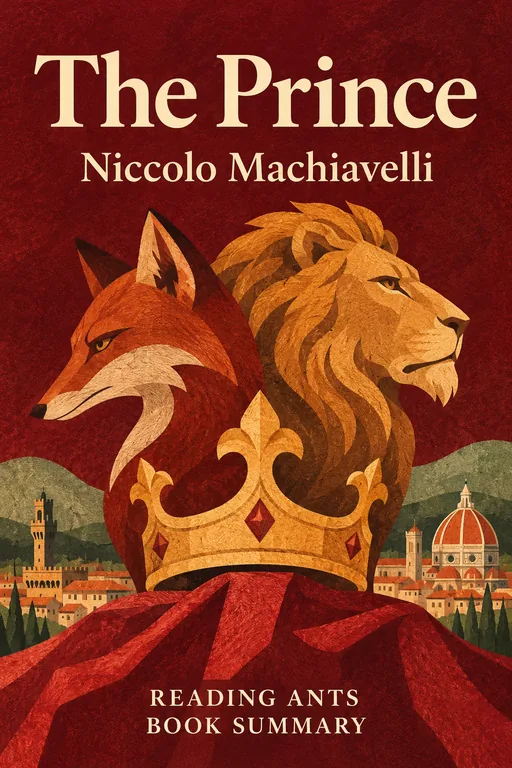
The Prince
Niccolo Machiavelli
A Renaissance diplomat advises rulers to judge their actions by results rather than morality, arguing that a successful leader must sometimes be cunning and ruthless to win and keep power.
⚖️ Politics & Society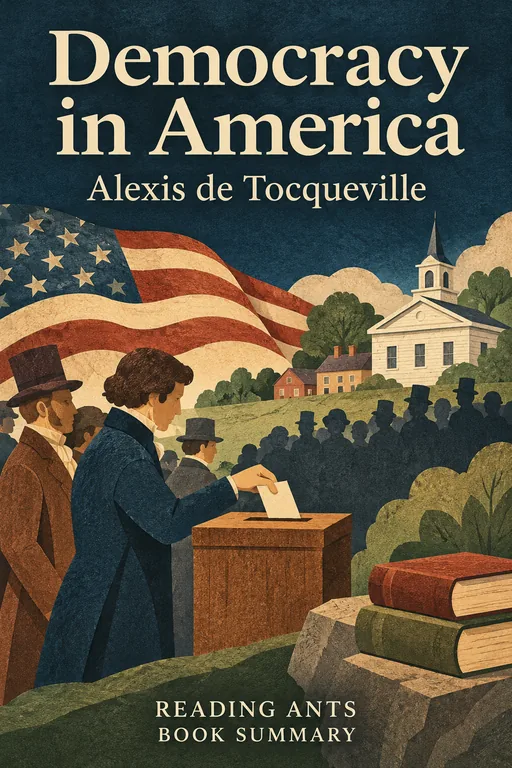
Democracy in America
Alexis de Tocqueville
After touring the United States in the 1830s, the young Frenchman Alexis de Tocqueville wrote a penetrating study of American democracy, praising its energy and liberty, and warning about its dangers, such as the tyranny of the majority and a retreat into private life.
⚖️ Politics & SocietyWant something different?
Pick another topic and we will show you three books to start with.