 Reading Ants
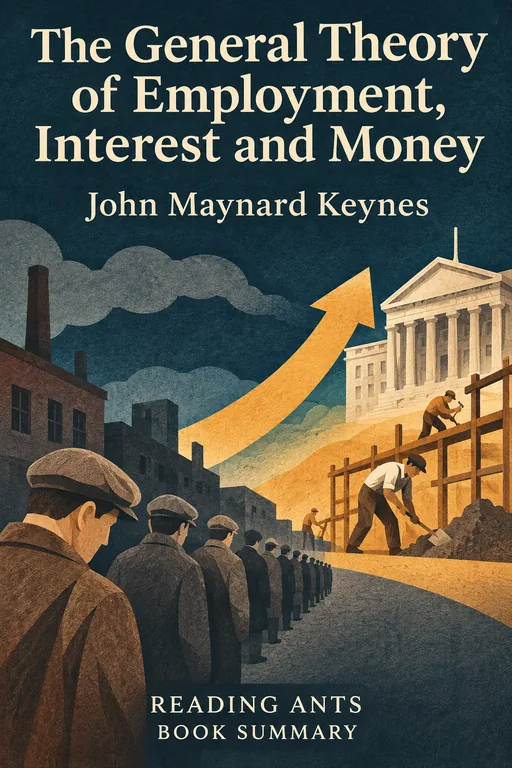
The General Theory of Employment, Interest and Money
Keynes argues that an economy can get stuck with high unemployment because total spending is too low, and that governments can and should act to raise demand when private spending falls short.
Overview
The General Theory of Employment, Interest and Money was published in 1936 by the British economist John Maynard Keynes. It was written in the shadow of the Great Depression, when millions of people in many countries were out of work and the older economic theories could not explain why the economy did not heal itself. Keynes challenged the idea that markets would always return quickly to full employment, arguing that the economy can settle at a level of output below full employment, and that saving and investment are brought into balance through changes in income. His book helped to create what is now called macroeconomics, the study of the economy as a whole, and shaped government policy for decades. It is a difficult, technical book, but its main ideas can be explained simply.
Full Summary
1. What was wrong with the old view
The idea: Before Keynes, the dominant theory held that markets tend to adjust on their own. If there was unemployment, wages would fall, businesses would hire again and the problem would go away. Keynes argued that this did not match the world he saw, where many people stayed jobless for years. He said that the old theory was a special case, true only in a limiting situation, and not general, and he argued that cutting wages does not reliably restore jobs. His book gives a general theory that includes cases of persistent unemployment.
In real life: If a shop has no customers, cutting everyone’s pay may not bring customers back, since the workers then have less to spend.
2. Demand drives production
The idea: Keynes says that the level of employment depends on the total demand in the economy, which is the spending of households, businesses and government. If demand is too low, firms will not produce more or hire more workers, no matter how willing the workers are. Unemployment can therefore be involuntary, meaning that people want to work at the going wage but cannot find jobs.
In real life: A factory will not make more bicycles if it cannot sell the ones it already has.
3. Consumption, saving and the multiplier
The idea: People spend a part of any extra income and save the rest. Keynes says that this habit means that when someone spends money, the income goes to someone else, who spends some of it again, and so on. This chain makes the total effect of an initial increase in spending larger than the first amount, an effect called the multiplier, which holds when there is spare capacity and not at full employment. It also works in reverse, so a fall in spending can lead to a larger drop in income.
In real life: When a town builds a school, the builders spend their pay at the grocery, and the grocer spends more at other shops.
4. Investment, uncertainty and “animal spirits”
The idea: Keynes says that business investment is the most unstable part of demand, since it depends on expectations about an uncertain future. Firms invest when they feel confident, and hold back when they are afraid. Investment depends on the expected return on new capital, which Keynes calls the marginal efficiency of capital, compared with the interest rate, as well as on confidence. He uses the phrase “animal spirits” to describe the spontaneous urge to act that drives much of economic life. He compares the stock market to a contest where people try to guess what others will think is beautiful, which shows how opinion can drive prices.
In real life: If everyone fears the future, they stop starting new things, and this fear can itself cause a slump.
5. Money, interest and liquidity preference
The idea: Keynes says that people hold money not only for purchases but also as a safe store when the future is uncertain, which he calls liquidity preference. The interest rate is the price that must be paid to persuade people to give up that safety, and it depends on the supply of money as well as on motives that include transactions, precaution and speculation. Because it depends on this preference, Keynes doubted that the central bank’s control of interest rates alone could secure full employment. He even allowed that, if almost everyone preferred cash to holding debt at a very low rate, the monetary authority could lose effective control over the rate, though he knew of no actual case in his own time.
In real life: In a scary time, a family might keep cash under the mattress even if the bank pays interest.
6. A role for the government
The idea: Since private spending can fall short, Keynes argues that the government can step in with extra spending, such as on public works, to lift demand and employment, even if it means borrowing in bad times. He also argues that a stronger urge to save across a whole society can lower incomes, and so make the problem worse, a point later called the paradox of thrift.
In real life: If every household cuts its spending at the same time, businesses lose sales, and people’s incomes fall, leaving them worse off.
Why It Matters
The General Theory is one of the most influential books in economics. It helped to establish macroeconomics as a field and changed the way that governments think about unemployment and recessions. After the Second World War, many countries used Keynes’s ideas to guide their policies, and the idea that governments should manage demand became a common part of economic debate. His ideas are still invoked whenever a country faces a recession, as they were after the financial crisis of 2008. The book also triggered fierce arguments with other economists, such as those of the Austrian school, that continue. Whether one supports or opposes Keynes, it is hard to understand modern economic policy without it.
Key Takeaways
- Demand matters. Total spending can limit how much an economy produces and how many people work.
- Unemployment can persist. Markets do not always return to full employment quickly.
- Spending has ripples. One person’s spending becomes another’s income, so effects multiply.
- Confidence drives investment. Fear and optimism can shape the economy.
- Government can help in a slump. Public spending can offset a fall in private demand.
What We Can Learn
The book helps us understand news about the economy. When you hear that people are saving more or spending less, think of the ripple effects on jobs and shops. It also teaches us that what is wise for one household, such as saving more, may not be good if everyone does it at once. At the same time, a careful reader will ask about the costs of government borrowing and about how to judge when to act. Reading Keynes encourages us to think about the economy as a system, and to ask what the data show, not only what seems logical.
Criticism and Counterpoints
Critics argue that Keynesian policies can lead to large government debts and inflation, and that politicians may be tempted to spend in good times as well as bad. Economists such as Friedrich Hayek and Milton Friedman challenged his ideas, and in the 1970s, when high inflation and unemployment appeared together, many felt that his theory had failed. Others say that later economists changed his ideas so much that the “Keynesianism” of textbooks is not what he wrote. The book itself is dense and sometimes unclear, and scholars still debate what Keynes meant.
Who Should Read It
This book is for students of economics, history and politics who want to read a foundational text. It is demanding, and many readers find it easier to start with a summary or a guide, and then read parts of the original. General readers who just want to understand modern debates can learn the main ideas from this summary and from more accessible books.
Want the whole book?
A summary is a taste, not the meal. Here is where to find the full book.
You reached the end 🎉
Nicely done. Mark this one as read, and we will suggest what to read next.
Read this next
The Road to Serfdom
Friedrich A. Hayek
Friedrich Hayek argues that when governments try to plan the whole economy from the center, they must gradually limit personal and political freedom, and that the road leads toward a dictatorship that nobody intended.
💰 Money & Economics
Capitalism and Freedom
Milton Friedman
Milton Friedman argues that economic freedom and political freedom support each other, and he applies this idea to a range of public issues, from money and schools to licensing and poverty, always asking what the government should and should not do.
💰 Money & Economics
The Wealth of Nations
Adam Smith
A nation's true wealth is not its stock of gold but the goods and services its people produce, and that wealth grows fastest when people specialize, trade freely and compete, with government providing justice, defense and public goods.
💰 Money & Economics
Rich Dad Poor Dad
Robert T. Kiyosaki
Schools teach people to work for money, but the rich learn to make money work for them by understanding the difference between assets and liabilities and by building businesses and investments.
💰 Money & Economics
The Intelligent Investor
Benjamin Graham
Successful investing is less about being clever than about being disciplined: buy sound businesses at a price that leaves a margin of safety, and don't let the mood of the market push you around.
💰 Money & Economics
A Random Walk Down Wall Street
Burton G. Malkiel
Burton Malkiel argues that stock prices are so hard to predict that most investors, professional or not, are better off holding a broad, low-cost index fund than trying to beat the market.
💰 Money & EconomicsWant something different?
Pick another topic and we will show you three books to start with.