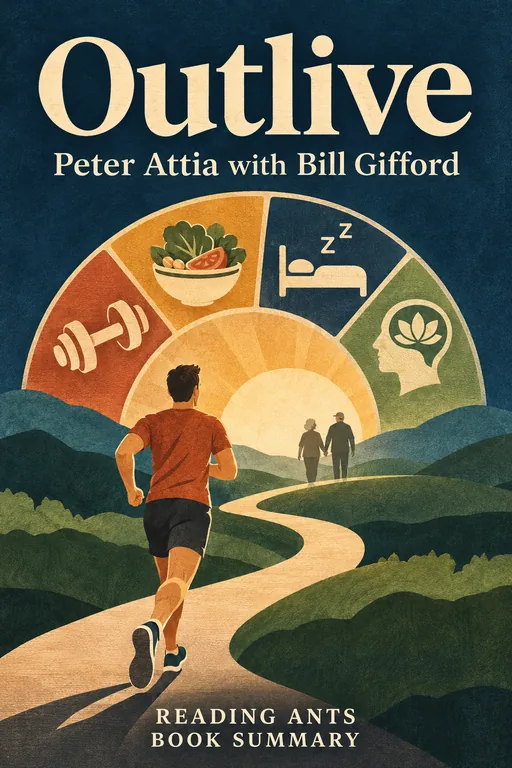
Outlive
To live longer and better, we should work early to prevent the chronic diseases that kill most people, by training the body with exercise, paying attention to nutrition and sleep, and caring for our mental health.
Overview
Outlive was written by Peter Attia, a physician who trained as a surgeon and later focused on the science of longevity, and was published in 2023, with writing help from the journalist Bill Gifford. Attia argues that modern medicine is good at treating emergencies but poor at preventing slow, long-developing diseases. He calls conventional medicine “Medicine 2.0” and calls for “Medicine 3.0,” an approach that starts prevention decades before illness appears. The book aims not only to extend lifespan, the years you live, but also healthspan, the years you live in good health.
Full Summary
1. The four horsemen
The idea: Attia says that most people in wealthy countries die from four groups of chronic diseases, which he calls the four horsemen: heart disease and other atherosclerotic diseases, cancer, neurodegenerative diseases such as Alzheimer’s, and type 2 diabetes with related metabolic problems. These diseases develop slowly, often over decades, which means there is time to act. His strategy is to delay or prevent them, rather than waiting until symptoms appear.
In real life: High blood pressure or rising blood sugar may produce no symptoms for years, but they are early signs that can be addressed.
2. Medicine 3.0
The idea: Medicine 2.0, in Attia’s view, focuses on treating illness once it has appeared and judges treatments by short-term trials. Medicine 3.0 is more preventive and more personal, takes risk factors seriously earlier, and considers the quality of life as much as the length. He urges readers to think of aging as a long process in which small advantages add up, and to set goals for the kind of old age they want, which he calls the centenarian decathlon: the list of physical tasks they want to be able to do in their last decade.
From the book: He asks readers to picture, for example, still being able to lift a suitcase, climb stairs or play with grandchildren at ninety.
In real life: Deciding what you want to do when you are old can guide what you do in your forties.
3. Exercise is the most powerful tool
The idea: Attia calls exercise the single most effective “drug” for longevity. He divides it into several parts: building aerobic fitness at both easy and hard intensities, building strength, and training stability and balance. He notes that research links higher aerobic capacity and muscle strength with lower risk of early death, and he encourages readers to train regularly, increase difficulty over time and avoid injury.
In real life: Taking a brisk walk most days, lifting weights twice a week and practicing balance is a realistic starting plan.
4. Nutrition without dogma
The idea: On food, Attia avoids pushing one diet. He argues that what matters is how much you eat, what you eat and your individual response, and he encourages readers to measure their own health markers. He suggests getting enough protein, limiting extra sugar and ultra-processed foods and avoiding both overeating and malnutrition. He stresses that no single diet is best for everyone, and that the best one is one a person can follow.
In real life: Someone who tracks their blood sugar, weight and energy can learn which foods suit them.
5. Sleep and emotional health
The idea: Attia stresses that sleep is essential for brain and body, and that chronic lack of sleep raises many health risks. He also gives attention to emotional health, explaining that stress, trauma and loneliness harm well-being, and that a long life without good relationships or peace of mind is not the goal. He shares his own struggles with perfectionism and burnout to show that physical success is not enough.
In real life: Keeping a regular bedtime and talking honestly with a friend or counselor can improve both mood and health.
6. Know your risks and measure them
The idea: The book encourages people to use medical tests and screening to discover risks early, such as measuring blood fats, blood sugar and other markers, and following family history. Attia recommends thinking in terms of probabilities and trade-offs, and discussing options with a doctor instead of relying on one number or on headlines. He also warns against believing in miracle supplements and quick fixes.
In real life: Learning your family history of heart disease can change when you start checking your cholesterol.
Why It Matters
Outlive became a bestseller and brought the idea of “healthspan” to many readers. Attia, who hosts a popular podcast, helped shape a public conversation about preventive medicine and longevity. The book encourages readers to take charge of their health through practical habits instead of treating aging as something that just happens to them.
It also reflects a broader shift in medicine toward prevention and personalized care, with more attention to fitness, metabolic health and mental well-being. Its emphasis on strength training and on measuring risk early has been widely discussed by doctors, trainers and podcasters, and it has led many readers to talk with their physicians about prevention instead of waiting for a problem.
Key Takeaways
- Prevent early. Chronic diseases build slowly, so act years ahead.
- Aim at healthspan. Quality of life matters as much as length.
- Exercise is key. Train endurance, strength and balance.
- Eat with awareness. Find a sustainable way of eating.
- Sleep and emotions count. Mental health supports physical health.
What We Can Learn
The book encourages us to treat our future selves with respect. The habits we build now, like moving daily, sleeping well and eating sensibly, are gifts to the person we will be in thirty years.
It also shows the value of picturing the life we want. If we know what we want to be able to do later, we can train for it now.
Finally, it reminds us that health is more than numbers. Relationships, purpose and peace of mind are part of living well, and ignoring them can undo the benefits of perfect diets and workouts.
Criticism and Counterpoints
Some doctors and scientists say that parts of the book rely on weaker evidence than it suggests, especially on topics like some tests and supplements, and that the approach can encourage worry and expensive testing for people who are healthy. Others note that the advice is aimed at people with time, money and access to doctors, which is not true for everyone.
Critics also point out that studies linking exercise or diet to longevity are often observational and cannot prove cause. Supporters respond that the core advice, move more, build strength, sleep well and eat sensibly, is solidly backed by research and carries little risk. Readers should talk with their own doctors before making big changes.
Who Should Read It
This book suits older teenagers and adults interested in health and prevention. It is long and sometimes technical, so readers can skip the detailed sections and focus on the practical chapters. It is not a substitute for personal medical advice.
Want the whole book?
A summary is a taste, not the meal. Here is where to find the full book.
You reached the end 🎉
Nicely done. Mark this one as read, and we will suggest what to read next.
Read this next
Why We Sleep
Matthew Walker
Neuroscientist Matthew Walker argues that sleep is essential for memory, mood, health and long life, and that modern habits are causing a widespread and dangerous lack of it.
🧩 Mind & PsychologyHow Not to Die
Michael Greger with Gene Stone
Dr. Michael Greger reviews research on the main causes of early death and argues that a diet based on whole plant foods can prevent and even help to reverse many chronic diseases.
🍎 Health
Being Mortal
Atul Gawande
Surgeon and writer Atul Gawande argues that modern medicine is good at fighting death but poor at helping people live well as they age and approach the end, and that doctors and families should focus on what matters most to the person.
👤 Real LivesThe Obesity Code
Jason Fung
Dr. Jason Fung argues that obesity is mainly a problem of hormones, especially insulin, and not just of eating too many calories, and he recommends cutting sugar and refined carbohydrates and using periods of fasting.
🍎 HealthThe Blue Zones
Dan Buettner
Dan Buettner visits places around the world where people live unusually long, healthy lives and finds common habits in diet, movement, purpose and community that the rest of us can borrow.
🍎 HealthIn Defense of Food
Michael Pollan
Michael Pollan argues that modern nutrition science and the food industry have confused us, and that we eat better by choosing real food, not too much of it, mostly plants, in the traditional ways of eating.
🍎 HealthWant something different?
Pick another topic and we will show you three books to start with.