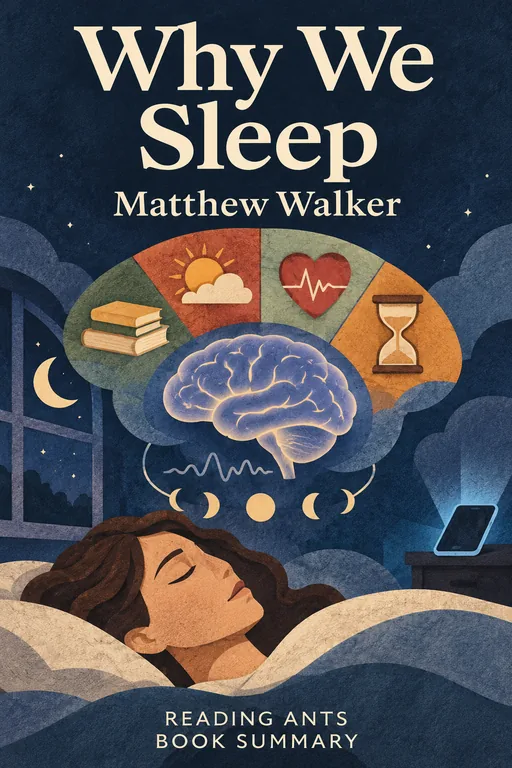
Neuroscientist Matthew Walker argues that sleep is essential for memory, mood, health and long life, and that modern habits are causing a widespread and dangerous lack of it.
Overview
Why We Sleep: Unlocking the Power of Sleep and Dreams was written by Matthew Walker, a professor of neuroscience and psychology at the University of California, Berkeley, who directs a sleep research lab. It was published in 2017 and became an international bestseller. Walker explains what happens in the brain and body during sleep, why we need it and what goes wrong when we do not get enough. He describes the cycle of sleep stages, including REM, or rapid eye movement sleep, when most vivid dreams occur, and non-REM sleep. He also offers practical tips for better sleep. His central message is that sleep is not a luxury but a basic need.
Full Summary
1. What sleep is and how it works
The idea: Walker begins by describing the two main systems that regulate sleep: the circadian rhythm, the body’s internal clock that follows a roughly twenty-four-hour cycle, and sleep pressure, a chemical called adenosine that builds up the longer we are awake and makes us sleepy. Caffeine works by blocking adenosine receptors, which hides the sleepiness without removing it. He also explains that sleep is made of cycles of non-REM and REM sleep, each doing different work for the brain and body, repeating about every ninety minutes.
In real life: A late afternoon coffee can still be affecting sleep at night, because caffeine lasts many hours in the body.
2. Sleep, learning and memory
The idea: Sleep helps the brain learn. Before learning, sleep prepares the brain to take in information; afterwards, it strengthens and stores new memories. Deep non-REM sleep seems to transfer memories from short-term storage to long-term, while REM sleep helps connect new information with existing knowledge and may boost creativity. Students who stay up all night to study may harm their learning, as they do not get the sleep that cements it. Walker also describes how sleep helps motor skills, such as sport or music.
In real life: A musician who practices a difficult passage in the evening and sleeps often plays it better the next morning.
3. Sleep, health and the body
The idea: Walker links insufficient sleep to many health risks, including heart disease, high blood pressure, obesity, diabetes, weakened immunity and certain cancers. Short sleep affects hormones that control appetite, increasing hunger and cravings, and it weakens the body’s defenses against infection. He also describes research that suggests sleep may help clear waste products from the brain, which could be connected to the risk of dementia. He emphasizes that sleep and health influence each other.
In real life: People who sleep poorly often find themselves craving sugary snacks and feeling more likely to catch colds.
4. Sleep, mood and mental health
The idea: Walker explains that a lack of sleep makes the emotional part of the brain, the amygdala, more reactive, while weakening the control from the prefrontal cortex. This leads to irritability, anxiety and poor emotional judgment. Sleep problems are common in disorders such as depression, anxiety and addiction. He suggests that dream sleep helps to process emotional experiences, taking the sting out of painful memories and helping us to cope.
In real life: Many people feel more upset about problems late at night or after a bad night’s sleep than they do after rest.
5. Dreams
The idea: The book discusses dreams, which occur most often in REM sleep. Walker reviews theories, from Freud’s ideas to modern research, and suggests that dreaming may help with emotional healing and with creative problem solving. He tells famous stories of scientists and artists who found inspiration in dreams. He also notes that REM sleep seems to help the brain combine memories in new ways.
In real life: Many people find that a problem looks different after sleeping on it.
6. What disrupts sleep and how to improve it
The idea: In the final part, Walker discusses causes of poor sleep, including sleep disorders such as insomnia and sleep apnea, shift work, early school start times, alcohol and screens. He also offers advice: keep a regular schedule, keep the bedroom cool, dark and quiet, avoid caffeine late in the day, limit alcohol, get daylight in the morning and avoid looking at bright screens before bed. He argues that society should treat sleep as a priority, including in schools, workplaces and health care.
In real life: Going to bed and waking up at the same times each day, even on weekends, helps the body clock work smoothly.
Why It Matters
Why We Sleep became a popular and influential book, bringing sleep science into conversation worldwide. It encouraged many people to take their sleep more seriously, and it influenced employers, schools and policymakers to think about issues such as later start times for teenagers and shift work. Walker’s lectures and podcast appearances reached millions of people.
The book helped shift cultural attitudes that glamorized getting by on little sleep, and made sleep a topic of health discussions along with diet and exercise. Many readers report that they changed small habits after reading it, such as setting a fixed bedtime and keeping phones out of the bedroom, which shows how a clear argument can lead to practical change even when some details are later corrected.
Key Takeaways
- Sleep is essential. It supports memory, mood and health.
- Both REM and non-REM matter. Each stage does different work.
- Caffeine and alcohol harm sleep. They affect its timing and quality.
- Regular routines help. Consistent sleep and wake times support the body clock.
- Sleep loss has real costs. It raises risk for many problems.
What We Can Learn
The book invites us to treat sleep as a foundation of health, not as time wasted. Setting a regular bedtime and creating a restful environment are small steps that can have large effects.
It also teaches us to notice how sleep affects our mood and thinking. If we feel irritable or unfocused, one of the first things to check may be how well we are sleeping.
Finally, it encourages us to look for support if needed. Persistent sleep problems may signal a treatable condition, and a doctor can help.
Criticism and Counterpoints
After the book’s publication, several scientists and writers, notably Alexey Guzey, pointed out errors and exaggerations. These included statistics stated more strongly than the studies supported, claims that were not accurately attributed to their sources and statements that went beyond what the evidence shows. Walker acknowledged some mistakes and the publisher made corrections in later printings.
Critics also noted that the book’s tone is alarmist, suggesting that even modest sleep loss is dangerous, which may cause anxiety about sleep itself and worsen insomnia. Much of the core science, that sleep matters for health and cognition, is well established. Readers should treat specific numbers with caution.
Who Should Read It
This book suits teenagers and adults who want to understand sleep. It is clearly written with many examples. Readers should take the figures with caution and consult a doctor for persistent sleep problems.
Want the whole book?
A summary is a taste, not the meal. Here is where to find the full book.
You reached the end 🎉
Nicely done. Mark this one as read, and we will suggest what to read next.
Read this next
Outlive
Peter Attia with Bill Gifford
To live longer and better, we should work early to prevent the chronic diseases that kill most people, by training the body with exercise, paying attention to nutrition and sleep, and caring for our mental health.
🍎 Health
The Body Keeps the Score
Bessel van der Kolk
Psychiatrist Bessel van der Kolk argues that trauma leaves lasting marks on the brain and body, and that healing needs more than talking: it involves restoring a sense of safety, body awareness and connection.
🧩 Mind & Psychology
Atomic Habits
James Clear
Big changes in life come not from huge leaps but from tiny habits repeated every day, and you can build good habits (and break bad ones) by designing your life so the right choices are obvious, attractive, easy and satisfying.
🌱 Self-Improvement
The Power of Habit
Charles Duhigg
Charles Duhigg shows that habits follow a loop of cue, routine and reward, and that by understanding the loop we can change our own habits, as well as those of companies and societies.
🌱 Self-Improvement
The Whole-Brain Child
Daniel J. Siegel and Tina Payne Bryson
Understanding how a child's brain develops helps parents respond to tantrums, fears and conflicts in ways that connect, calm and teach, so that different parts of the brain work together.
🎓 Parenting & Education
Thinking, Fast and Slow
Daniel Kahneman
Our minds run on two systems, a fast, intuitive one and a slow, careful one, and understanding how the fast system fools us can help us make better decisions about money, risk, work and happiness.
🧩 Mind & PsychologyWant something different?
Pick another topic and we will show you three books to start with.