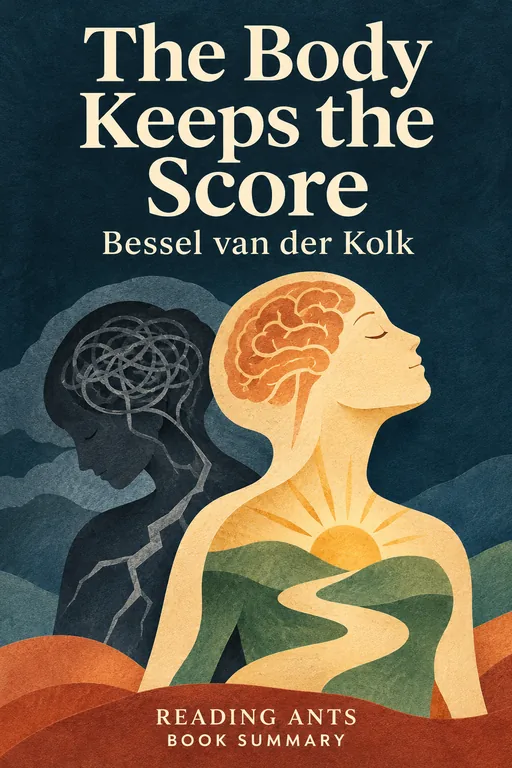
The Body Keeps the Score
Psychiatrist Bessel van der Kolk argues that trauma leaves lasting marks on the brain and body, and that healing needs more than talking: it involves restoring a sense of safety, body awareness and connection.
Overview
The Body Keeps the Score: Brain, Mind, and Body in the Healing of Trauma was written by Bessel van der Kolk, a Dutch-born psychiatrist, researcher and founder of a trauma center in Boston, and published in 2014. Van der Kolk has worked with trauma survivors for decades, starting with Vietnam veterans and later with survivors of child abuse, assault and accidents. He describes how traumatic experiences can change the way the brain processes information and how the body reacts, and he presents a range of treatments beyond traditional talk therapy. The book stayed on bestseller lists for years and became a widely used reference.
Full Summary
1. The nature of trauma
The idea: Van der Kolk starts by describing the effects of trauma on veterans and other survivors, who often relive the event, feel numb or on edge, and struggle with relationships. He explains that trauma is not just a memory but a change in how the person is wired to respond to the world. Survivors may react to reminders as if the danger were happening now, because the body reacts to a perceived threat before the thinking mind has a chance to intervene.
In real life: A person who survived a car crash may feel panic at the sound of screeching brakes, even years later.
2. The brain under threat
The idea: Drawing on brain imaging, he describes how parts of the brain involved in survival, such as the amygdala, the alarm system, become overactive in traumatized people, while the parts responsible for reasoning and calming, such as the prefrontal cortex, become less active. The area responsible for putting events into a coherent story and time frame can shut down during trauma, which may explain why traumatic memories are fragmented and feel like they are happening now. The body remains prepared for danger.
In real life: Someone under severe stress may find it hard to think clearly, as the brain focuses on survival.
3. Trauma in the body
The idea: The title idea is that the body holds the effects of trauma. People may experience chronic tension, pain, digestive or sleep problems, or may feel disconnected from their bodies. Van der Kolk argues that to heal, people must develop interoception, the ability to notice and tolerate inner physical sensations, and gain a sense of safety in their bodies. Ignoring the body can leave symptoms unresolved.
In real life: Learning to notice a racing heart and slow the breath can help someone feel more in control during stress.
4. Trauma in childhood and relationships
The idea: The author discusses how abuse, neglect and unstable early care affect development. Children raised in unsafe environments may learn to be hypervigilant or to shut down, and can be misdiagnosed with behavior problems. He argues for the recognition of developmental trauma, which would describe the pattern more accurately than existing diagnoses. He also stresses that secure relationships are central to healing, as trauma often damages trust and connection.
In real life: A child who has been mistreated may seem defiant when really they are afraid and trying to protect themselves.
5. Paths to recovery
The idea: In the later chapters, van der Kolk reviews various treatments. These include talk therapy, medication, and approaches such as EMDR (eye movement desensitization and reprocessing), which involves recalling memories while following guided eye movements, neurofeedback, yoga, theater, mindfulness and internal family systems therapy. He emphasizes that different people respond to different approaches and that the goal is to help people become calm, to feel safe in their bodies and to integrate the experience.
In real life: Some survivors find that activities like yoga, drumming or group theater help them reconnect with their body and with others.
6. Taking back control and finding community
The idea: He ends by arguing that healing involves regaining a sense of agency, the feeling that one can affect what happens, and rebuilding trust through relationships and community. He calls for schools, courts and health systems to recognize trauma and to offer support early. He insists that drug treatment alone is not enough, and that society should invest in approaches that help people feel safe and heard.
In real life: A school that trains teachers to understand trauma can respond to troubled students with support, not just punishment.
Why It Matters
The Body Keeps the Score has sold millions of copies, appeared on bestseller lists for years and been translated into dozens of languages. It helped bring the understanding of trauma into mainstream conversation, and has been widely read by survivors, therapists, teachers and parents. Its message that trauma is real and treatable has helped many people feel less alone.
It has also influenced the development of “trauma-informed” practices in schools, health care and justice settings, which aim to avoid retraumatizing people. Many readers say that simply finding words for what happened to them, or to someone they love, was the first useful step the book offered.
Key Takeaways
- Trauma affects the body and brain. It is more than a bad memory.
- Safety comes first. Healing starts with feeling safe.
- Body awareness helps. Noticing sensations can restore control.
- Relationships heal. Supportive connections are central.
- Many paths exist. Different treatments suit different people, and professional help matters.
What We Can Learn
The book helps us understand that reactions to trauma are not weakness or failure. If a person is jumpy, withdrawn or angry after a terrible experience, it may be their nervous system doing what it was shaped to do.
It also encourages kindness. Knowing that people may carry unseen burdens can help us respond with patience, at home, at school and at work.
Finally, it shows the value of reaching out for help. The author’s message is that recovery is possible and that it often involves other people, practices and time.
Criticism and Counterpoints
Some scientists and clinicians say that the book overstates what is known. Claims that trauma is stored “in the body” in a literal sense, or that the brain changes described are specific to trauma, have been questioned, as have some statements about memory and about the effectiveness of particular treatments such as yoga, which have limited evidence. Critics also note that the book relies on case stories and the author’s perspective.
Some argue that the focus on trauma could lead to overdiagnosis or to seeing normal distress as pathology. Defenders say the book raised awareness and that its main points about the effects of trauma and the importance of safety are widely supported. Readers who are struggling should consult a qualified professional.
Who Should Read It
This book suits older teenagers and adults. It describes abuse, violence and suffering in detail and can be distressing, especially for survivors. It is not a substitute for professional care. Readers can take it in pieces and stop if it becomes too heavy.
Want the whole book?
A summary is a taste, not the meal. Here is where to find the full book.
You reached the end 🎉
Nicely done. Mark this one as read, and we will suggest what to read next.
Read this next
Man's Search for Meaning
Viktor E. Frankl
A psychiatrist who survived the Nazi concentration camps explains that even in the worst suffering, people can choose their attitude, and that finding a reason to live is what gives us the strength to endure.
👤 Real Lives
The Whole-Brain Child
Daniel J. Siegel and Tina Payne Bryson
Understanding how a child's brain develops helps parents respond to tantrums, fears and conflicts in ways that connect, calm and teach, so that different parts of the brain work together.
🎓 Parenting & Education
When Breath Becomes Air
Paul Kalanithi
Paul Kalanithi, a young neurosurgeon, writes about facing terminal lung cancer at thirty-six and asks what makes a life meaningful when time is short.
👤 Real Lives
Educated
Tara Westover
A girl raised by survivalist parents in the mountains of Idaho, with no school, no birth certificate and no doctors, teaches herself enough to reach university and eventually earns a PhD from Cambridge, at the painful cost of her family.
👤 Real Lives
The Glass Castle
Jeannette Walls
Jeannette Walls recounts a childhood with brilliant but irresponsible parents who moved constantly, left their children hungry and unsafe, and still gave them a sense of wonder, and how she and her siblings made their own way out.
👤 Real Lives
Thinking, Fast and Slow
Daniel Kahneman
Our minds run on two systems, a fast, intuitive one and a slow, careful one, and understanding how the fast system fools us can help us make better decisions about money, risk, work and happiness.
🧩 Mind & PsychologyWant something different?
Pick another topic and we will show you three books to start with.