 Reading Ants
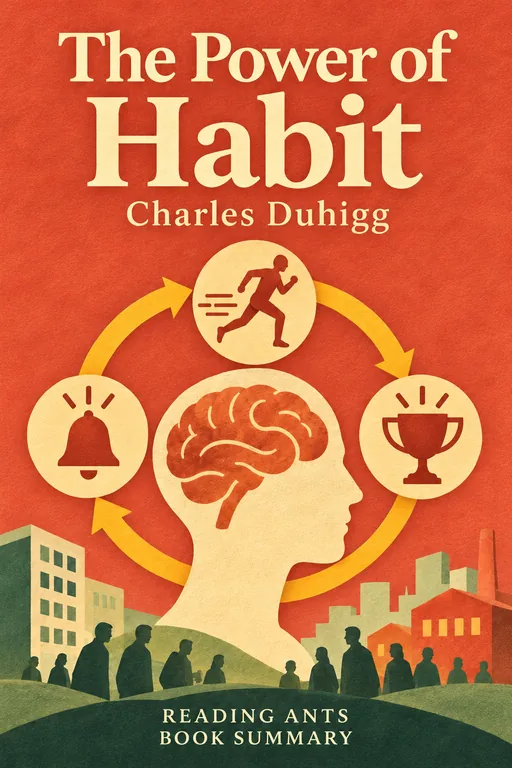
Charles Duhigg shows that habits follow a loop of cue, routine and reward, and that by understanding the loop we can change our own habits, as well as those of companies and societies.
Overview
The Power of Habit: Why We Do What We Do in Life and Business was written by Charles Duhigg, an investigative reporter for The New York Times, and published in 2012. Duhigg became interested in habits after learning about research suggesting that a large portion of our daily actions are automatic. The book draws on neuroscience, psychology and case studies from companies, sports teams and social movements. It is divided into three parts, which look at the habits of individuals, companies and societies. It became a major bestseller and has been influential in business and self-improvement.
Full Summary
1. The habit loop
The idea: Duhigg explains that habits form when the brain tries to save effort. Researchers at the Massachusetts Institute of Technology studied rats in mazes and found that, as a task becomes routine, the brain’s activity shifts toward a deeper region, the basal ganglia, and the thinking part becomes quieter. In Duhigg’s model, every habit follows a loop of three parts: a cue, which triggers the behavior; a routine, the behavior itself; and a reward, which tells the brain whether this loop is worth remembering. Over time, a strong craving for the reward grows, which drives the habit.
In real life: Feeling stressed (cue), eating a snack (routine) and feeling comfort (reward) can become an automatic loop.
2. Building new habits: the craving brain
The idea: The author tells about how Pepsodent toothpaste became a huge success in the early twentieth century, not just because it cleaned teeth but because it created a tingle that people came to crave and linked to a feeling of cleanliness. He shows that companies create habits by tying their products to cues and rewards. Likewise, people who start an exercise habit tend to succeed when they choose a clear cue, such as putting on running shoes after coming home, and a reward, such as a good feeling or a treat.
In real life: A habit sticks better if you notice and enjoy the reward, not just do the routine.
3. The golden rule of habit change
The idea: In Duhigg’s model, the key advice is that you cannot extinguish a bad habit, only change it. Keep the same cue and reward but change the routine. Duhigg points to the example of Alcoholics Anonymous, which helps people replace drinking with meetings and support while keeping the social reward. He adds that belief is also vital: habits change more reliably when people believe change is possible, often with the help of a group.
In real life: Someone who snacks out of boredom could replace the snack with a short walk, which also relieves boredom.
4. Keystone habits
The idea: Some habits are keystone habits, which set off chain reactions that change other behaviors. An example is exercise: people who begin exercising often start eating better and being more productive without planning to. Duhigg recounts how Paul O’Neill, the new head of Alcoa, a large aluminum company, focused on one keystone habit, worker safety, and this led to better communication, quality and profits. This shows that small, strategic changes can transform an entire organization.
In real life: Making your bed or having a family dinner can be the small habit around which a more organized life is built.
5. Willpower as a habit
The idea: Duhigg discusses willpower, which research suggests is like a muscle that can tire. Starbucks trained its employees to build willpower by teaching routines for dealing with difficult customers, so that, when stressed, they would follow a prepared plan instead of losing control. The lesson is that willpower can be strengthened through practice and by planning for moments of difficulty, such as deciding ahead of time what you will do if a particular situation arises.
In real life: Deciding in advance what to do when tempted, such as how to respond to an annoying comment, makes it easier to stay calm.
6. Habits in companies and societies
The idea: In the later parts, the author shows how habits drive organizations and movements. Retail stores like Target study customer habits and use data to predict purchases, even when a customer is expecting a baby. Duhigg also examines how social habits helped fuel the Montgomery bus boycott, where strong ties among friends and weaker ties across the community pushed many to join, and how leaders such as Rick Warren built a megachurch on habits and community. He concludes that we are responsible for our habits, even those formed unconsciously.
In real life: Social groups can change behavior as friends encourage one another, as in a study group or a team.
Why It Matters
The Power of Habit spent years on bestseller lists, and its ideas became widely known in business, education and personal development. The “habit loop” concept is used by coaches, therapists and app designers, and it helped prepare the way for later books on habits, such as James Clear’s Atomic Habits.
The book also brought scientific research into popular discussion in a readable way, with stories that made abstract ideas memorable. It has been used as a reference by people who want to build better routines at home and at work.
Its advice has been tested by many readers in simple, practical ways, such as changing a snack routine, starting a morning walk or tidying a desk each evening, and many report that the habit-loop idea gave them a clear starting point.
Key Takeaways
- Habits follow a loop. Cue, routine and reward drive automatic behavior.
- Change the routine, keep the reward. Replace instead of simply stopping.
- Keystone habits spread. Some small changes affect many areas.
- Willpower can be trained. Plans for hard moments help.
- Belief and community help. Support makes change last.
What We Can Learn
The book gives us a practical method for changing habits: identify the cue and the reward, and experiment with different routines. This works for habits such as biting nails, snacking, checking the phone or procrastinating.
It also reminds us to be patient. Habits form over time, and changing them involves trial and error, so we can treat slip-ups as information instead of failure.
Finally, it encourages us to think about our environment and relationships. Setting up our space and joining a group of people with similar goals can make good habits easier.
Criticism and Counterpoints
Some scientists point out that the book simplifies research and that its main stories are told in a very tidy way that may not match the full evidence. For example, the story of Target predicting a customer’s pregnancy is based on one anecdote, and the idea that willpower is like a muscle has been challenged by later studies that failed to replicate some results.
Others say that the advice is not always practical, since changing the routine while keeping the cue and reward is not easy, and that structural factors, such as poverty, can limit one’s ability to change habits. Even so, the habit loop remains a useful model.
Who Should Read It
This book suits teenagers and adults who want to understand and improve their habits. It is easy to read, and the stories are lively. It is a good companion to more practical guides on forming habits.
Want the whole book?
A summary is a taste, not the meal. Here is where to find the full book.
You reached the end 🎉
Nicely done. Mark this one as read, and we will suggest what to read next.
Read this next

Atomic Habits
James Clear
Big changes in life come not from huge leaps but from tiny habits repeated every day, and you can build good habits (and break bad ones) by designing your life so the right choices are obvious, attractive, easy and satisfying.
🌱 Self-Improvement
Mindset: The New Psychology of Success
Carol S. Dweck
Psychologist Carol Dweck shows that people who believe abilities can grow, a growth mindset, learn, cope with failure and achieve more than people who believe their talents are fixed.
🌱 Self-Improvement
Grit
Angela Duckworth
Psychologist Angela Duckworth argues that success depends not only on talent but on grit, a combination of passion and long-term perseverance, and shows how people can grow it in themselves and others.
🌱 Self-Improvement
Deep Work
Cal Newport
Cal Newport argues that the ability to focus without distraction on hard tasks, which he calls deep work, is becoming rare and valuable, and shows how to train it and protect it in a distracted world.
🌱 Self-Improvement
Flow
Mihaly Csikszentmihalyi
Psychologist Mihaly Csikszentmihalyi shows that people feel happiest not when relaxing but when fully absorbed in a challenging activity that matches their skills, a state he calls flow.
🧩 Mind & Psychology
The 7 Habits of Highly Effective People
Stephen R. Covey
Lasting success in life and work comes not from quick tricks or a charming personality but from good character, built through seven habits that move us from depending on others, to standing on our own, to working well with others.
🌱 Self-ImprovementWant something different?
Pick another topic and we will show you three books to start with.