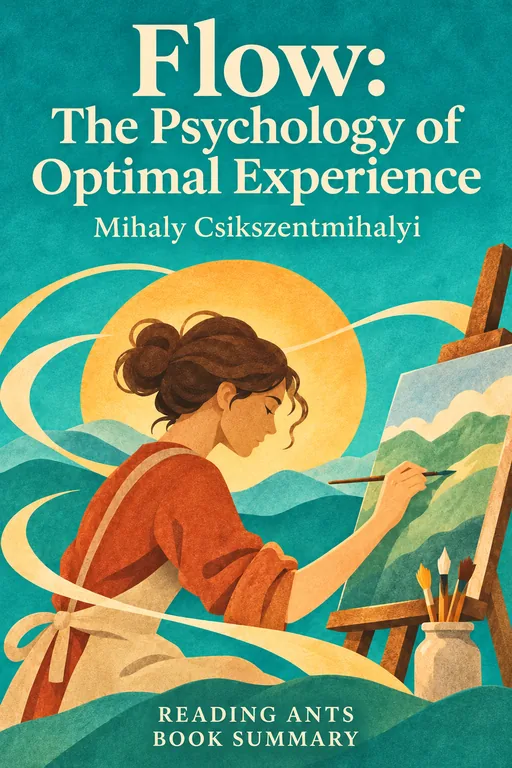
Psychologist Mihaly Csikszentmihalyi shows that people feel happiest not when relaxing but when fully absorbed in a challenging activity that matches their skills, a state he calls flow.
Overview
Flow: The Psychology of Optimal Experience was written by Mihaly Csikszentmihalyi, a Hungarian-American psychologist who taught at the University of Chicago and Claremont Graduate University, and published in 1990. His surname is pronounced something like “chick-sent-me-high.” Csikszentmihalyi, who had lived through the turmoil of World War II in Europe, became curious about what makes life worth living. He studied thousands of people, including artists, athletes, musicians, surgeons and ordinary workers, by asking them to describe moments when they felt most alive. They described a similar state of deep focus and enjoyment, which he named flow. The book explains the idea and how to apply it.
Full Summary
1. Happiness and control of consciousness
The idea: Csikszentmihalyi begins by asking why, despite wealth and comfort, many people are not happy. He argues that happiness does not depend simply on outside conditions but on how our minds interpret and organize experience. Our attention is limited, and what we pay attention to shapes our lives. If we learn to control our consciousness, directing attention to worthwhile goals, we can improve the quality of life.
In real life: Two people at the same job can have different experiences, depending on what they notice and how they frame their work.
2. What is flow?
The idea: Flow is an experience of total involvement in an activity. People in flow report a sense of effortless concentration, a loss of self-consciousness and a distorted sense of time, with hours passing like minutes. The activity is its own reward. It can occur in sports, music, work, conversation or hobbies. The state is so rewarding that people do it just for the experience itself, which he calls autotelic, meaning “having a purpose in itself.”
In real life: A guitarist who loses track of time while practicing a song is experiencing flow.
3. The conditions for flow
The idea: The author identifies several conditions that help produce flow. There must be clear goals at each step, immediate feedback about how one is doing and a balance between challenge and skill. If a task is too easy relative to our skills, we get bored; if too hard, we feel anxious. Flow happens in the channel between. As skills grow, the challenge must rise to keep it interesting. A sense of control and a focus so intense that worries fade are also typical.
In real life: A video game that increases difficulty as the player improves is designed, intentionally or not, to keep them in flow.
4. Flow in the body and mind
The idea: The book describes how flow can be found in many areas. Physical activity, such as running, dancing and martial arts, can produce flow when we pay close attention to movement. Mental activities, such as reading, writing, chess, mathematics and learning, can do the same. Even the senses, like music or food, can be cultivated by attention. Csikszentmihalyi suggests that we can enrich life by developing skills in a variety of areas.
In real life: Learning to cook a new dish with attention to each step can turn a chore into an absorbing experience.
5. Work and relationships
The idea: Surprisingly, Csikszentmihalyi found that people reported more flow at work than in leisure, because work often has clear goals and feedback, while free time can feel aimless, leading to passive entertainment, such as watching television, which seldom produces deep satisfaction. He recommends redesigning jobs so that they offer challenge and meaning, and encourages treating family life and friendship as areas in which flow can develop, through shared activities and real attention.
In real life: A teacher who sets new challenges for students, and a family that plays a game or cooks together, can both create flow.
6. Facing chaos and finding meaning
The idea: The final chapters discuss how to cope with difficulties and find purpose. He describes the autotelic personality, a person who can find enjoyment even in hard circumstances by setting goals, immersing in the task and adapting. He suggests that a meaningful life depends on creating a pattern in which our goals fit together, giving a sense of direction. He ends with the hope that if we learn to organize our lives for flow, we can contribute to a better society.
In real life: People who stay curious and focus on what they can control often cope better with setbacks.
Why It Matters
Flow has been highly influential in psychology and beyond. It helped inspire the field of positive psychology, which studies strengths and well-being instead of only illness. Its ideas are used by teachers, coaches, game designers, businesses and athletes, and the concept of “being in the zone” is now widely understood.
The book became a bestseller and has been translated into dozens of languages. It also gave people a language to describe their experience of deep absorption, and to look for ways to bring it into daily life. Teachers have used it to think about how to keep students engaged without making lessons too easy or too hard.
Key Takeaways
- Happiness comes from engagement. Deep involvement beats passive relaxation.
- Match challenge to skill. Too easy bores, too hard stresses.
- Set clear goals. Know what you are trying to do.
- Seek feedback. Knowing how you are doing keeps attention.
- Attention is a resource. What we focus on shapes our life.
What We Can Learn
The book encourages us to look for activities that absorb us fully, whether music, sport, craft or study, and to make room for them. They can bring more lasting satisfaction than constant entertainment.
It also teaches us to adjust difficulty. If a task is boring, we can add a challenge; if it is overwhelming, we can break it into smaller steps. This is helpful for study, work and hobbies.
Finally, it shows the value of controlling our attention. Turning off distractions and focusing on one thing at a time may be one of the simplest ways to improve our days.
Criticism and Counterpoints
Some psychologists have said that flow is hard to measure, since it relies on people’s reports about their own experiences, and that the concept may be too broad. Others point out that the original studies were based on particular groups and that flow may differ across cultures.
Critics have also warned that flow can be found in harmful activities, such as gambling or excessive gaming, and that being absorbed is not always the same as doing something worthwhile. A few readers find the book repetitive or academic. Still, the central idea has been widely supported and remains useful.
Who Should Read It
This book suits teenagers and adults interested in psychology and happiness. It is somewhat academic in places but full of examples. It is useful for students, workers and parents who want to think about engagement.
Want the whole book?
A summary is a taste, not the meal. Here is where to find the full book.
You reached the end 🎉
Nicely done. Mark this one as read, and we will suggest what to read next.
Read this next
Deep Work
Cal Newport
Cal Newport argues that the ability to focus without distraction on hard tasks, which he calls deep work, is becoming rare and valuable, and shows how to train it and protect it in a distracted world.
🌱 Self-Improvement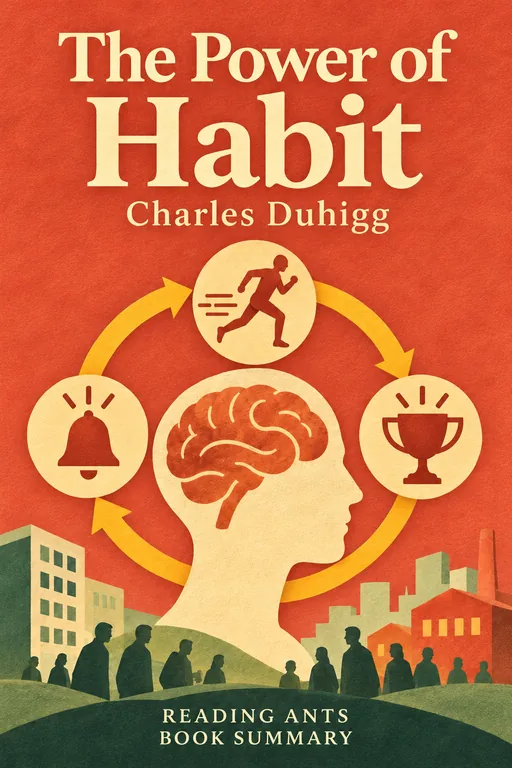
The Power of Habit
Charles Duhigg
Charles Duhigg shows that habits follow a loop of cue, routine and reward, and that by understanding the loop we can change our own habits, as well as those of companies and societies.
🌱 Self-Improvement
Grit
Angela Duckworth
Psychologist Angela Duckworth argues that success depends not only on talent but on grit, a combination of passion and long-term perseverance, and shows how people can grow it in themselves and others.
🌱 Self-Improvement
Man's Search for Meaning
Viktor E. Frankl
A psychiatrist who survived the Nazi concentration camps explains that even in the worst suffering, people can choose their attitude, and that finding a reason to live is what gives us the strength to endure.
👤 Real LivesThe Art of Happiness
Dalai Lama and Howard C. Cutler
In conversations with the American psychiatrist Howard Cutler, the Dalai Lama explains that happiness is the purpose of life, and that it can be trained through compassion, a calm mind and a change in the way we think about suffering and others.
🌱 Self-Improvement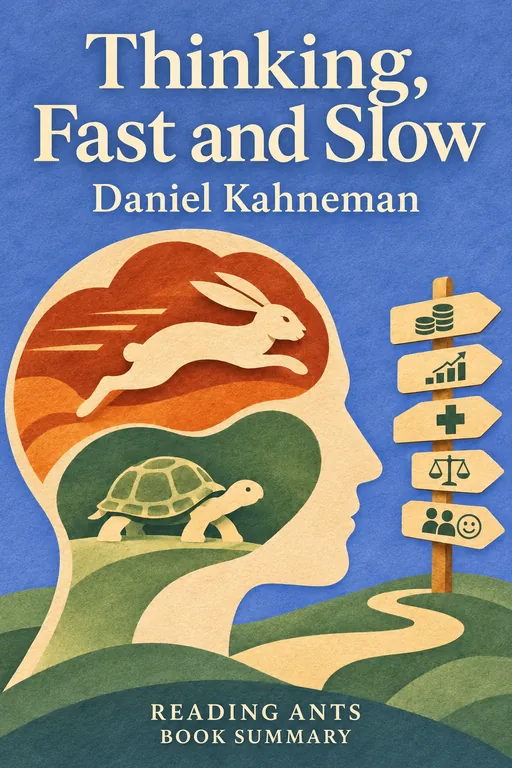
Thinking, Fast and Slow
Daniel Kahneman
Our minds run on two systems, a fast, intuitive one and a slow, careful one, and understanding how the fast system fools us can help us make better decisions about money, risk, work and happiness.
🧩 Mind & PsychologyWant something different?
Pick another topic and we will show you three books to start with.