
Big changes in life come not from huge leaps but from tiny habits repeated every day, and you can build good habits (and break bad ones) by designing your life so the right choices are obvious, attractive, easy and satisfying.
Overview
Atomic Habits is a practical guide to changing behavior. James Clear, a writer who became known for his newsletter about habits, argues that people usually fail to change not because they lack willpower, but because they rely on goals and motivation instead of systems. An “atomic” habit is a tiny routine that is small and easy, like an atom, but that also works as a building block of something much bigger. Drawing on psychology, neuroscience and stories from sports, business and everyday life, the book offers a simple framework, the Four Laws of Behavior Change, plus dozens of concrete techniques that anyone can try, whether the goal is exercising, studying, saving money or quitting a bad habit.
Full Summary
1. Tiny changes add up to huge results
The idea: Getting just 1 percent better each day compounds like interest. Over a year, small improvements add up to a dramatic difference, and small bad habits quietly add up to big problems. The catch is that progress is often invisible at first, so many people give up too early.
From the book: Clear compares this to an ice cube in a cold room. As the room warms degree by degree, nothing seems to happen, until suddenly the ice begins to melt. He calls this stretch of invisible progress the Plateau of Latent Potential. The work isn’t wasted; it is being stored.
In real life: Someone who practices piano for 15 minutes a day may hear no difference for weeks. Then one day, a piece that felt impossible suddenly flows. The breakthrough was built by all the boring days before it.
2. Systems beat goals
The idea: Goals are the results you want; systems are the daily routines that produce them. Winners and losers often have the same goals, so goals can’t be what separates them. A goal is reached once, but a system keeps working. Your results depend mostly on your systems.
From the book: British Cycling had a poor record for years. A new performance director focused on marginal gains: improving hundreds of tiny details, from more comfortable bike seats to better pillows for riders on the road. The small improvements added up, and the team went on to great success.
In real life: Two students both want an A in math. One sets the goal and hopes for the best. The other practices for 20 minutes after dinner every day. Only one of them has a system.
3. Change who you are, not just what you do
The idea: Change has three layers: outcomes (what you get), processes (what you do) and identity (what you believe about yourself). The most lasting change starts with identity. Every action is a vote for the type of person you want to become. You don’t need every vote, just a majority.
From the book: Clear describes two people who are offered a cigarette. One says no thanks, they are trying to quit. The other says no thanks, they are not a smoker. The second person has changed how they see themselves, and that makes the habit far easier to keep.
In real life: Instead of telling yourself you want to read more, start thinking of yourself as a reader. Reading two pages on the bus is a small vote for that identity, and each vote makes the next one easier.
4. Every habit follows the same loop
The idea: Habits run in a four-step loop. A cue triggers a craving, which leads to a response (the habit), which brings a reward. From this loop come the Four Laws of Behavior Change. To build a good habit, make it obvious, attractive, easy and satisfying. To break a bad habit, reverse them: make it invisible, unattractive, difficult and unsatisfying. The rest of the book takes one law at a time.
In real life: Your phone buzzes (cue). You want to know who messaged you (craving). You pick it up and check (response). You feel the small pleasure of knowing (reward). Repeat that a few hundred times, and checking your phone becomes automatic.
5. Make it obvious
The idea: Many habits run on autopilot, so the first step is to notice them and make the cues for good habits clear. Implementation intentions mean deciding exactly when and where you will act. Habit stacking links a new habit to one you already do. Most powerful of all is designing your environment, so good choices are easy to see and bad ones are out of sight.
From the book: Clear describes a hospital cafeteria that put bottled water in more places around the room. Without any lectures, people bought more water and less soda.
In real life: Decide that after you brush your teeth at night, you will lay out your clothes for the morning. Keep your guitar on a stand in the living room instead of in its case under the bed. Charge your phone in the kitchen instead of beside your pillow.
6. Make it attractive
The idea: Habits are driven by the expectation of a reward, so the more appealing a habit looks, the more likely you are to do it. Temptation bundling pairs something you need to do with something you want to do. We also copy the people around us, so joining a group where your desired habit is normal is one of the most effective changes you can make.
From the book: Clear tells the story of an engineering student who rigged his exercise bike so that his laptop would only play shows while he was pedaling. Watching TV, which he wanted, now required exercise, which he needed.
In real life: Only let yourself listen to your favorite podcast while you walk or tidy your room. If you want to run, join a running club; when everyone around you runs, running starts to feel normal.
7. Make it easy
The idea: Habits form through repetition, not time, so what matters is doing something often. People naturally follow the path of least resistance, so remove friction from good habits and add it to bad ones. The Two-Minute Rule says to shrink any new habit into a version that takes two minutes or less: first master showing up, then improve. For bad habits, use commitment devices, choices made in advance that lock in good behavior.
From the book: Clear’s examples include turning reading before bed into reading one page, and doing yoga into taking out the yoga mat.
In real life: Want to start homework right after school? Leave your books open on the desk in the morning. Want to watch less TV? Unplug it after each use, so turning it on takes extra effort.
8. Make it satisfying
The idea: We repeat what feels good right away, but many good habits only pay off later. So add a small, immediate reward. Habit tracking gives visible proof of progress. When you slip, follow one rule: never miss twice. Missing once is an accident; missing twice is the start of a new habit. To break bad habits, make them immediately painful, for example with an accountability partner.
From the book: Clear tells of a young stockbroker who kept two jars on his desk, one filled with paper clips. Each time he made a sales call, he moved one clip to the empty jar. Watching the clips pile up kept him going, and his results improved.
In real life: Put a calendar on the wall and draw an X on each day you practice. After a week, you won’t want to break the chain. If you forget one day, make the next day non-negotiable.
Why It Matters
Atomic Habits became one of the best-selling self-help books of its era and remains a constant presence on bestseller lists years after publication. Its appeal lies in turning research on habit formation into a simple, memorable framework that ordinary people can use the same day.
The book helped shift popular thinking about self-improvement away from motivation and willpower toward environment and systems. Ideas such as “1 percent better every day,” habit stacking, the Two-Minute Rule and identity-based habits are now widely used by coaches, teachers, companies and app designers. Its focus on identity, the idea that every action is a vote for who you want to become, gave many readers a new way to think about change: not as forcing yourself to do hard things, but as gradually becoming a different person.
Key Takeaways
- Small habits compound. Tiny daily improvements add up to remarkable results over time, even when progress is invisible at first.
- Fix the system, not the goal. Your results come from your daily processes far more than from your ambitions.
- Build habits around identity. Decide who you want to be, and let each small action prove it to yourself.
- Use the Four Laws. Make good habits obvious, attractive, easy and satisfying, and reverse each law for bad habits.
- Design your environment. Changing your surroundings is usually more effective than relying on willpower.
- Never miss twice. Mistakes happen; what matters is getting back on track quickly.
What We Can Learn
The most useful lesson is to start smaller than feels necessary. If you want to read more, start with one page a night; if you want to exercise, start by putting on your running shoes. Once the habit of showing up exists, growing it is much easier.
Try habit stacking today: pick one thing you already do every day, such as brushing your teeth, and attach a small new habit right after it. Look at your room or desk and ask what it is making easy. If your phone is the first thing you see, it will win your attention.
Students can use these ideas for studying: a set time and place, a short starting task, and a tracker on the wall. Families can use them too, by keeping healthy snacks visible and screens out of bedrooms. Above all, be patient during the plateau. The results you want may arrive later than you’d like, but the effort is never wasted.
Criticism and Counterpoints
Critics note that much of the book repackages ideas already popular in earlier works, such as Charles Duhigg’s The Power of Habit and B. J. Fogg’s research on tiny habits, and Clear openly builds on this research. Some readers find the stories selected to fit the message, with successes highlighted and failures left out, which can make change look more predictable than it is.
The book also focuses on individual behavior. It says little about outside factors such as poverty, long working hours, mental health conditions or disability, which can make even simple habits much harder to keep. Some psychologists caution that research on habit formation is more mixed and complex than a four-step framework suggests. Still, most reviewers agree that the advice is sensible, low-risk and easy to test for yourself.
Who Should Read It
This book is ideal for anyone who wants to start a good habit or stop a bad one, including students, parents, athletes and professionals. It is easy to read and full of practical tips. Readers who have already read several habit books may find much of it familiar.
Want the whole book?
A summary is a taste, not the meal. Here is where to find the full book.
You reached the end 🎉
Nicely done. Mark this one as read, and we will suggest what to read next.
Read this next
The Power of Habit
Charles Duhigg
Charles Duhigg shows that habits follow a loop of cue, routine and reward, and that by understanding the loop we can change our own habits, as well as those of companies and societies.
🌱 Self-ImprovementTiny Habits
BJ Fogg
Stanford behavior scientist BJ Fogg teaches that lasting change comes not from willpower but from starting with very small behaviors, attaching them to existing routines and celebrating each success to make them stick.
🌱 Self-Improvement
The 7 Habits of Highly Effective People
Stephen R. Covey
Lasting success in life and work comes not from quick tricks or a charming personality but from good character, built through seven habits that move us from depending on others, to standing on our own, to working well with others.
🌱 Self-Improvement
Mindset: The New Psychology of Success
Carol S. Dweck
Psychologist Carol Dweck shows that people who believe abilities can grow, a growth mindset, learn, cope with failure and achieve more than people who believe their talents are fixed.
🌱 Self-Improvement
Deep Work
Cal Newport
Cal Newport argues that the ability to focus without distraction on hard tasks, which he calls deep work, is becoming rare and valuable, and shows how to train it and protect it in a distracted world.
🌱 Self-Improvement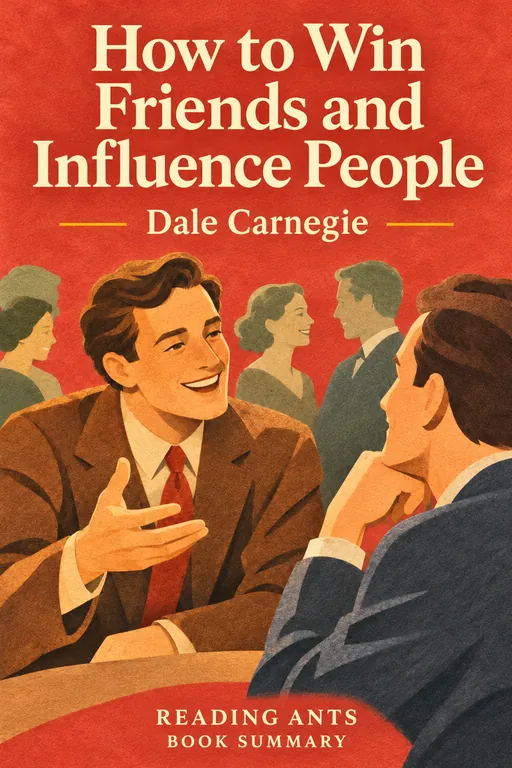
How to Win Friends and Influence People
Dale Carnegie
People are driven by emotion and the desire to feel important, so the way to get along with them, and win them to your point of view, is to stop criticizing, show genuine interest and appreciation, and see things from their side.
🌱 Self-ImprovementWant something different?
Pick another topic and we will show you three books to start with.