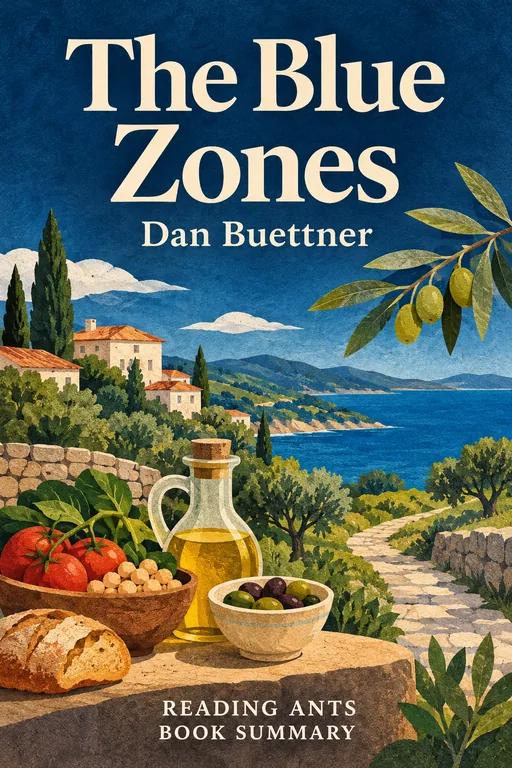
The Blue Zones
Dan Buettner visits places around the world where people live unusually long, healthy lives and finds common habits in diet, movement, purpose and community that the rest of us can borrow.
Overview
The Blue Zones was published in 2008 by Dan Buettner, a writer and explorer who worked with the National Geographic Society and with scientists who study aging. The title refers to areas on the map, first marked in blue ink, where an unusually large number of people reach old age in good health. The book describes his visits to several of these places, including Okinawa in Japan, the island of Sardinia in Italy, a community in Loma Linda, California, and the Nicoya Peninsula in Costa Rica, while the wider list of blue zones also includes Ikaria in Greece. In each place, he looks for the lifestyle patterns that may explain the long lives, and ends with practical lessons.
Full Summary
1. What a blue zone is
The idea: Buettner explains that researchers have identified a handful of regions where people tend to live past their nineties and even a hundred, and with a low rate of the diseases that trouble many other places. Scientists estimate that genes play only a modest part in how long we live, and that lifestyle and environment matter a great deal, though such estimates do not translate neatly into any one person’s lifespan. This suggests that people can influence their own aging.
In real life: Two neighbors may have a similar family history, but the one who walks daily and eats well may feel much better at seventy.
2. Move naturally
The idea: In the blue zones, people do not usually go to a gym. Instead, their surroundings make them move, through gardening, walking, housework and other daily tasks. They are active all day, without special effort. Buettner says that an environment that nudges you to move, such as walking to the shop, is more powerful than a plan that needs willpower.
In real life: If you walk to school instead of being driven, you get exercise without having to think about it.
3. Eat mostly plants, and stop before you are full
The idea: Diets in these places are different but share patterns: they are mainly based on beans, vegetables, whole grains and other plants, with little meat, eaten in small amounts. In Okinawa, there is a saying that reminds people to stop eating when they feel about eighty percent full. Smaller portions and early evening meals appear to help people to avoid overeating.
In real life: Putting the leftovers in the fridge rather than taking a second helping is a simple way to practice stopping early.
4. Purpose and rest
The idea: Many of the long-lived people have a clear sense of purpose, which Okinawans call by a word that roughly means a reason for living. It might be caring for grandchildren, tending a garden or helping the community. They also have routines to relieve stress, such as prayer, naps, remembering ancestors or time with friends, since constant stress is thought to harm health.
In real life: A person who has a reason to get up in the morning, such as a pet to feed or a hobby they love, often feels more energetic.
5. Belonging and family
The idea: Close family and community ties are strong in blue zones. Grandparents are usually part of the household and are respected, and people belong to groups, whether a church, a club or a circle of friends. In the community in California, members of a religious group, the Seventh-day Adventists, put great emphasis on rest, faith and a healthy, largely vegetarian way of eating. Buettner says that people tend to adopt the habits of those around them, so choosing a healthy “tribe” matters.
In real life: If your friends enjoy sports and cooking, you are more likely to do the same.
6. Putting it into practice
The idea: The lessons are gathered into a set of nine shared habits, which Buettner calls the “Power 9”: move naturally, have a purpose, down shift, eat until about eighty percent full, favor a plant-based diet, drink a little wine with friends and meals (the book’s claim, not advice for young readers), belong to a faith or community, put loved ones first and choose the right tribe. The regions include Okinawa, Sardinia, Loma Linda’s Seventh-day Adventists and Nicoya, and Ikaria in Greece is counted among the blue zones too. Buettner suggests that the changes need not be dramatic. Small steps, such as planning walks with a friend or sharing meals, can add up, and changing your surroundings can be easier than relying on willpower.
In real life: Choosing one habit to try for a month, like a daily walk after dinner, is easier than overhauling your life.
Why It Matters
The Blue Zones helped to popularize the idea that longevity is not just a matter of luck or genes, but of the daily environment and choices. It has been influential in public health and in community programs, and the author later worked with towns to apply the ideas. The book’s message is hopeful, and it connects health to social life and meaning, not only to diet and exercise. Its simple lists have been widely shared, and the term “blue zone” is now familiar to many people. It also gives readers a respectful look at older people and traditional cultures, whose daily habits show how to live well with limited resources.
Key Takeaways
- Lifestyle matters. Daily habits have a large effect on health and aging.
- Move without thinking. An active environment beats occasional workouts.
- Eat plants and stop early. Smaller portions of mostly plant foods are common among the long-lived.
- Have a purpose. Reasons to live bring energy and resilience.
- Belong. Strong family and community ties support health.
What We Can Learn
You can start by choosing one or two habits. Take walks, play outside or do chores that keep you moving. Add more beans, vegetables and fruit to meals, and eat slowly so that you notice when you are full. Spend time with people who support your health, and be part of a group. Think about what gives you a sense of purpose, and keep time for rest. Remember that these are general lessons, not medical advice, and that it is wise to talk to a doctor about your own health.
Criticism and Counterpoints
Some researchers question the claims about very old people in certain regions, since records of birth can be incomplete or unreliable, and they say that some of the data may be flawed. Others note that the evidence for particular habits is mostly observational, so it cannot prove cause and effect, and that the longevity advantage in some places, such as Okinawa and Nicoya, has faded among people born in later decades. A 2024 review also argued that the blue zone idea became a profitable business of books, diets and shows without strong scientific evidence behind it. These debates mean that the findings should be read with caution, while the habits themselves are generally sensible.
Who Should Read It
This book is for readers who are curious about healthy aging, culture and travel, and for families who want practical ideas for a healthier life. It is easy to read and positive in tone. Those who want rigorous scientific proof may want to read the scientific studies, and anyone with a health condition should seek medical advice before changing their diet or activity.
Want the whole book?
A summary is a taste, not the meal. Here is where to find the full book.
You reached the end 🎉
Nicely done. Mark this one as read, and we will suggest what to read next.
Read this next
In Defense of Food
Michael Pollan
Michael Pollan argues that modern nutrition science and the food industry have confused us, and that we eat better by choosing real food, not too much of it, mostly plants, in the traditional ways of eating.
🍎 Health
How Not to Die
Michael Greger with Gene Stone
Dr. Michael Greger reviews research on the main causes of early death and argues that a diet based on whole plant foods can prevent and even help to reverse many chronic diseases.
🍎 Health
Why We Sleep
Matthew Walker
Neuroscientist Matthew Walker argues that sleep is essential for memory, mood, health and long life, and that modern habits are causing a widespread and dangerous lack of it.
🧩 Mind & Psychology
Born to Run
Christopher McDougall
Christopher McDougall searches for the secret of why running hurts so many people and finds a hidden tribe of Mexican runners, a mysterious ultramarathon legend and a case that humans were made to run for the joy of it.
🍎 Health
Being Mortal
Atul Gawande
Surgeon and writer Atul Gawande argues that modern medicine is good at fighting death but poor at helping people live well as they age and approach the end, and that doctors and families should focus on what matters most to the person.
👤 Real Lives
Outlive
Peter Attia with Bill Gifford
To live longer and better, we should work early to prevent the chronic diseases that kill most people, by training the body with exercise, paying attention to nutrition and sleep, and caring for our mental health.
🍎 HealthWant something different?
Pick another topic and we will show you three books to start with.