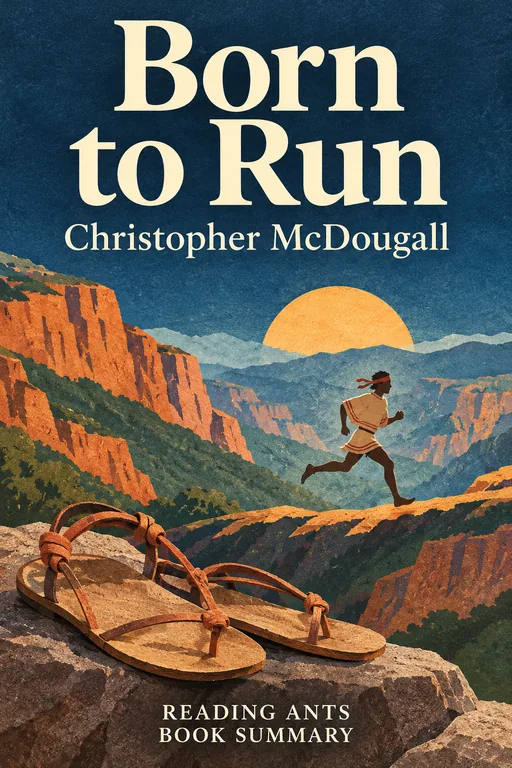
Born to Run
Christopher McDougall searches for the secret of why running hurts so many people and finds a hidden tribe of Mexican runners, a mysterious ultramarathon legend and a case that humans were made to run for the joy of it.
Overview
Born to Run: A Hidden Tribe, Superathletes, and the Greatest Race the World Has Never Seen was published in 2009 by Christopher McDougall, a journalist who suffered repeated running injuries. He wanted to know why his feet hurt, and the question led him to the Tarahumara, a Native people in the Copper Canyons of northern Mexico, who are known for running very long distances in simple sandals. The book mixes adventure, science and portraits of colorful ultrarunners. It also argues that modern running shoes might cause some of the problems that they are meant to prevent.
Full Summary
1. A question about pain
The idea: McDougall begins with a simple question: why does his foot hurt when he runs? Frustrated by repeated injuries, he does not accept that running is simply bad for the body. Humans have run for a very long time, he reasons, so the pain must have a cause that can be understood. His search leads him to scientists and runners who suggest that modern, heavily cushioned shoes may make us run in an unnatural way, and may be part of the problem rather than the cure.
In real life: When something hurts every time you do it, it is worth asking whether the way you do it, and not the activity itself, is the problem.
2. The hidden people of the canyons
The idea: McDougall learns of the Tarahumara, who call themselves the Rarámuri, a Native people who live in remote canyons in northern Mexico and who run great distances for pleasure, ceremony and survival, often in simple sandals. In McDougall’s portrayal, they seem to be free of many of the injuries that trouble other runners. He travels to Mexico to find a mysterious American who lives among them, known as Caballo Blanco, who is also known as Micah True. The region is remote and drug smugglers operate there, so the journey is difficult and a little dangerous.
In real life: Sometimes the best way to understand a skill is to go and watch the people who do it every day without thinking.
3. The idea of a great race
The idea: Caballo Blanco dreams of bringing the Tarahumara together with the best ultrarunners from abroad, in a single long race through the canyons. A group of American runners, including the famous Scott Jurek and Jenn Shelton, makes the trip, and McDougall goes along. McDougall also decides to train, with a coach named Eric Orton, so that he can take part himself, and he learns to run in a lighter, more relaxed way.
From the book: The book introduces a cast of unusual runners, from a champion known for his plant-based diet to enthusiasts who prefer to run barefoot.
In real life: A big, slightly crazy goal, such as a race you are not sure you can finish, can push you to learn far more than a safe one.
4. Why humans were made to run
The idea: Between the adventures, McDougall makes a case that humans evolved to run long distances. He describes theories that early humans may have hunted by outlasting animals in the heat, since we sweat and can keep going when many animals must stop. He suggests that our bodies, with springy tendons and strong buttock muscles, are designed for it. He argues that running well has more to do with form and joy than with expensive equipment.
In real life: A child who runs around the playground for the sheer fun of it is showing the same instinct that the book celebrates.
5. The race in the canyons
The idea: On race day, the runners set out into the heat and rough ground of the canyon. McDougall describes the competition as a mix of friendship and rivalry, with the Tarahumara running in sandals, laughing and chatting, while the visitors try to keep pace. The course, about 50 miles long, is hard, and the story is full of tiredness, surprise and drama. A Tarahumara runner, Arnulfo Quimare, wins, narrowly beating the American star Scott Jurek, and the runners from both sides show respect for each other.
In real life: A race can be a celebration as much as a contest, especially when the people around you are cheering.
6. Run for joy
The idea: The book ends with McDougall’s reflections. He says that running is natural and should be fun, and that the Tarahumara show that it can be play and community, not a chore. He concludes that when we run with good form and a sense of joy, we connect with something very old in ourselves. He encourages readers to try, and to listen to their bodies.
In real life: If you stop thinking of exercise as a punishment and start thinking of it as play, you are more likely to keep it up.
Why It Matters
Born to Run was a bestseller and sparked a surge of interest in barefoot and minimalist running, and in ultramarathons. Sales of minimalist shoes grew, and many runners experimented with changing their running style. The book also helped to bring wider attention to the Tarahumara and to the beauty of the Copper Canyons. It showed that a book about running could also be a thrilling adventure and a lively argument about how bodies work. Even those who disagree with parts of its claims often credit it with making people think about running form and enjoyment. It remains one of the most popular books about the sport.
Key Takeaways
- We are built for endurance. Humans may be well suited to running long distances.
- Footwear matters. Heavy cushioning may change how we run, and not always for the better.
- Joy is the point. Running as play is more sustainable than running as punishment.
- Community helps. The Tarahumara run together, with friendship and laughter.
- Question assumptions. Pain and injury may have causes that are not obvious.
What We Can Learn
If you enjoy running or want to begin, the book encourages you to start gently and to focus on how it feels. Short, light steps and a relaxed body may be easier on your joints than long strides. Make exercise social and fun, as the Tarahumara do. Do not copy the extreme parts of the story, such as long races, without preparation. If you have an injury or a medical condition, speak with a doctor or a coach before changing your shoes or style. Above all, remember that moving the body is one of the oldest human pleasures.
Criticism and Counterpoints
Scientists and sports doctors say that the case against cushioned shoes is not settled, since studies have not shown clearly that barefoot or minimalist running prevents injuries, and some runners who switched quickly were hurt. Others say that the book romanticizes the Tarahumara, whose lives involve hardship, and that parts of the story are told in a dramatic way that blends fact and legend. Some critics feel that the account of the theories of human evolution is simplified. Readers should treat the book as an engaging, one-sided argument.
Who Should Read It
This book is for runners, walkers, adventure fans and anyone who likes stories about unusual people and places. It is fast-moving and funny. Readers who want a neutral, scientific review of running shoes and injuries should consult other sources, and those who dislike stories involving danger may find some sections tense.
Want the whole book?
A summary is a taste, not the meal. Here is where to find the full book.
You reached the end 🎉
Nicely done. Mark this one as read, and we will suggest what to read next.
Read this next
The Blue Zones
Dan Buettner
Dan Buettner visits places around the world where people live unusually long, healthy lives and finds common habits in diet, movement, purpose and community that the rest of us can borrow.
🍎 Health
Breath: The New Science of a Lost Art
James Nestor
Journalist James Nestor investigates how we breathe, and argues that most of us breathe poorly in ways that harm our health, and that simple changes, such as breathing through the nose and more slowly, can help.
🍎 Health
Endurance: Shackleton's Incredible Voyage
Alfred Lansing
Alfred Lansing tells how Ernest Shackleton's ship was crushed by Antarctic ice in 1915, and how he led his twenty-seven companions through nearly two years of cold, hunger and danger, until all twenty-eight men were brought home alive.
🏛️ History
Unbroken
Laura Hillenbrand
This is the true story of Louis Zamperini, an Olympic runner who survived a plane crash, weeks adrift on the Pacific and years in brutal Japanese prison camps during World War II, then fought to rebuild his life.
🏛️ History
Being Mortal
Atul Gawande
Surgeon and writer Atul Gawande argues that modern medicine is good at fighting death but poor at helping people live well as they age and approach the end, and that doctors and families should focus on what matters most to the person.
👤 Real Lives
Outlive
Peter Attia with Bill Gifford
To live longer and better, we should work early to prevent the chronic diseases that kill most people, by training the body with exercise, paying attention to nutrition and sleep, and caring for our mental health.
🍎 HealthWant something different?
Pick another topic and we will show you three books to start with.