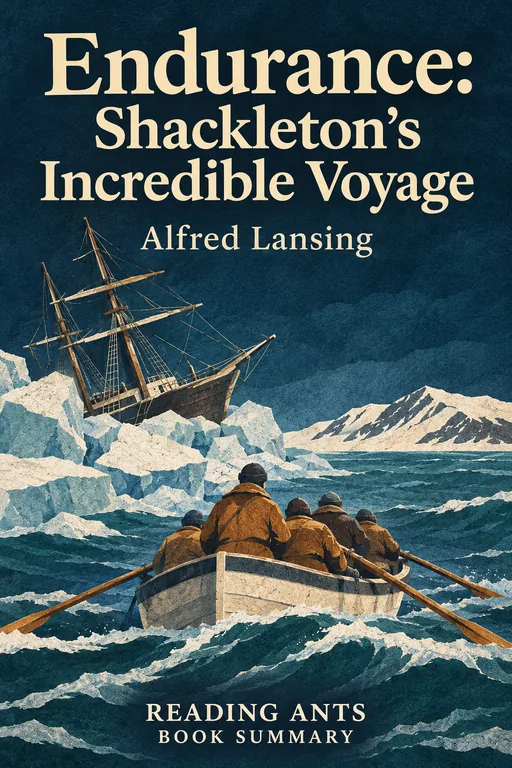
Endurance: Shackleton's Incredible Voyage
Alfred Lansing tells how Ernest Shackleton's ship was crushed by Antarctic ice in 1915, and how he led his twenty-seven companions through nearly two years of cold, hunger and danger, until all twenty-eight men were brought home alive.
Overview
Endurance: Shackleton’s Incredible Voyage was published in 1959 by Alfred Lansing, an American journalist. It tells the story of the Imperial Trans-Antarctic Expedition, led by the British explorer Sir Ernest Shackleton, which set out in 1914 to cross the continent of Antarctica on foot. The ship, Endurance, became trapped in the ice of the Weddell Sea before the party could land. Lansing based the book on the diaries of members of the crew and on interviews with survivors. It is a story of leadership and survival rather than of exploration success.
Full Summary
1. Trapped in the ice
The idea: The Endurance sailed from England as the First World War began, and went on to South Georgia, the last stop before the expedition headed south into the Antarctic ice. In January 1915, before they could reach the coast where they had hoped to land, the ship was caught in pack ice, and could not move. Shackleton hoped that the ice would loosen in spring and let the ship break free, but it carried the ship drifting slowly northward for months. The men settled into a routine on the frozen ship, with exercise, entertainments and care for the dogs.
In real life: When your plans are suddenly stopped by something out of your control, the first task is to keep people calm and busy.
2. The end of the ship
The idea: As the winter went on, the pressure of the ice grew, and the hull of the Endurance began to crack and fill with water. In late October 1915, Shackleton ordered the crew off the ship, and in November it sank into the sea. The men were left on the ice with three lifeboats, sleds, tents and provisions. They had nearly no chance of rescue, since no one knew where they were. Shackleton first planned to march with the boats across the ice toward land, and he turned their minds to survival. Two attempts to haul the boats made so little progress through the broken ice that he gave them up.
In real life: Accepting that a plan is over, and starting on the next one quickly, can save lives.
3. Months on a drifting floe
The idea: The men camped on the floating ice, and waited, hoping that it would drift toward land. They set up camps on the floes, hunted seals and penguins, and shot most of the sled dogs when food ran short, which was a painful decision. Lansing describes the hardships of the cold and boredom, the quarrels, the humor and the efforts of Shackleton to keep up morale, by being fair with food, listening to everyone and keeping order.
In real life: In a hard time, small acts of fairness and a regular routine can hold a group together.
4. Escape by boat
The idea: In April 1916, the ice broke up, and the men took to the three lifeboats in freezing seas, surrounded by floating ice, and wild weather. They made a terrifying journey of about a week, soaked, frozen and short of water, before reaching a rocky, bleak shore at Elephant Island. It was the first time in sixteen months that the men were standing on solid land. But the island was far from any shipping routes, and rescue seemed impossible.
In real life: Reaching safety is a relief, but it may only be the next step toward the real goal.
5. The voyage of the James Caird
The idea: Shackleton decided to try to get help by sailing one of the small boats, the James Caird, across about eight hundred miles of the stormy Southern Ocean to South Georgia, an island with whaling stations. He took five men, including the captain, Frank Worsley, a skilled navigator, Tom Crean, and the ship’s carpenter, Harry McNish, who had strengthened the boat. After more than two weeks of freezing, wet and exhausting sailing, the tiny boat reached the island, though on the uninhabited southern side, far from the whaling stations. Shackleton, Worsley and Crean then crossed the mountains and glaciers of the island, with very little equipment, to reach a whaling station.
In real life: Sometimes the only way to help a group is to take a huge risk yourself.
6. Rescue and the return
The idea: Shackleton organized several attempts to reach Elephant Island, which failed because of ice and storms, before a Chilean ship, the Yelcho, commanded by Luis Pardo, finally reached the island in August 1916. The men who had been left behind, under the command of Frank Wild, were waiting, having lived under the upturned boats for months. Shackleton’s first question was whether everyone was alive, and they were. All twenty-eight men of the Endurance party survived. The separate Ross Sea party of the same expedition lost men. The men returned to a world still at war.
In real life: Keeping your promises to people who depend on you can be the hardest and most important part of leadership.
Why It Matters
Endurance has become a classic of adventure writing and one of the best-known stories of survival. It is also read as a study in leadership, because Shackleton’s skill in keeping hope alive and the group united made the difference between life and death. The book has been used in business and in schools to talk about teamwork and resilience. The wreck of the ship was found in 2022 on the bottom of the Weddell Sea, which brought renewed attention to the story. Lansing’s book remains a gripping account, and the photographs taken by the expedition’s photographer, Frank Hurley, are famous in their own right.
Key Takeaways
- Leadership under pressure. Shackleton kept morale high by caring for each person.
- Adapt to new goals. When the mission changed, he changed it too.
- Routine and humor help. Normal habits kept the men sane.
- Teamwork saves lives. Each person’s effort was needed.
- Never give up on people. Shackleton returned for those he left behind.
What We Can Learn
Think of the story when you meet a big setback. Ask what you can control, and what the next small step is. Keep routines, humor and kindness in a difficult time, and give others a role. Be fair, and share both the burdens and the rewards. And remember that a good leader often shows his or her strength in listening, not just in giving orders. The story also reminds us how much people can do when they refuse to give up on one another.
Criticism and Counterpoints
The expedition never achieved its goal of crossing the continent, so it is a story of survival after failure. Because the book is based on the diaries and memories of the men themselves, it tends to give a heroic portrait of the leader and the crew. It also contains slips: Lansing describes the carpenter, Harry McNish, as an old man much older than the rest, but he was in fact around forty at the start of the expedition. Despite this, the story has stood the test of time, and the crew’s survival remains remarkable.
Who Should Read It
This book is for readers who enjoy adventure and true stories of courage, from teenagers to adults. It is easy to follow and hard to put down. Those who are very sensitive to descriptions of cold and hunger, or the killing of animals, may find some pages hard, but the story has a happy ending.
Want the whole book?
A summary is a taste, not the meal. Here is where to find the full book.
You reached the end 🎉
Nicely done. Mark this one as read, and we will suggest what to read next.
Read this next
Longitude
Dava Sobel
Dava Sobel tells how a self-taught English clockmaker, John Harrison, spent decades building clocks that solved the problem of finding longitude at sea, and fought for recognition from the scientific establishment.
🏛️ HistoryBorn to Run
Christopher McDougall
Christopher McDougall searches for the secret of why running hurts so many people and finds a hidden tribe of Mexican runners, a mysterious ultramarathon legend and a case that humans were made to run for the joy of it.
🍎 Health
The Boys in the Boat
Daniel James Brown
Daniel James Brown tells how a group of working-class young men from the University of Washington learned to row as one and won the gold medal for the United States at the 1936 Berlin Olympics, with the story of Joe Rantz at its heart.
🏛️ History
Unbroken
Laura Hillenbrand
This is the true story of Louis Zamperini, an Olympic runner who survived a plane crash, weeks adrift on the Pacific and years in brutal Japanese prison camps during World War II, then fought to rebuild his life.
🏛️ History
Into Thin Air
Jon Krakauer
Jon Krakauer, a journalist who climbed Mount Everest in 1996, recounts the storm that killed eight people on the mountain over a single day and night, and reflects on what went wrong and on his own survivor's guilt.
🏛️ History
Sapiens: A Brief History of Humankind
Yuval Noah Harari
Humans came to rule the planet not because we are the strongest animals but because we can believe in shared stories (gods, nations, money, companies) that let millions of strangers cooperate.
🏛️ HistoryWant something different?
Pick another topic and we will show you three books to start with.