 Reading Ants
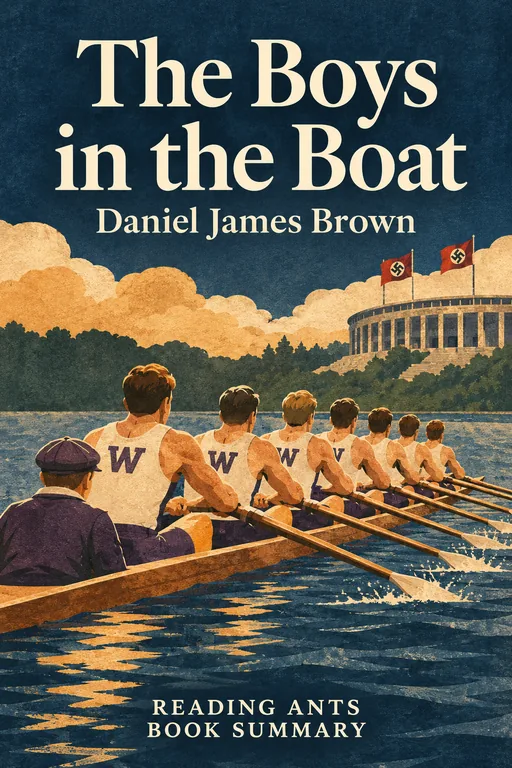
The Boys in the Boat
Daniel James Brown tells how a group of working-class young men from the University of Washington learned to row as one and won the gold medal for the United States at the 1936 Berlin Olympics, with the story of Joe Rantz at its heart.
Overview
The Boys in the Boat: Nine Americans and Their Epic Quest for Gold at the 1936 Berlin Olympics was published in 2013 by Daniel James Brown. The book weaves together three stories: the rise of the University of Washington’s rowing crew during the Great Depression, the personal journey of one of its members, Joe Rantz, and the backdrop of Nazi Germany, which was preparing to show off its power in Berlin. The nine in the boat were eight rowers and the coxswain, Bobby Moch. Many of the rowers came from poor families, and rowing offered them a chance of an education and a place on a team. Brown learned the details of Rantz’s story from Rantz himself, and drew on other sources about the crew and the Games.
Full Summary
1. A boy left on his own
The idea: Joe Rantz grew up in difficult conditions in the Pacific Northwest, where his mother died when he was a small child, and when he was about fifteen his father and stepmother left him to fend for himself. He learned to support himself with hard physical work, such as cutting timber, and to rely on no one. When he reached the university in the middle of the Depression, he was short of money and wary of trusting anyone. Brown uses his story to show how the crew helped him to learn trust.
In real life: A person who has had to look after themselves from a young age may find it hard to accept help, and need time to do so.
2. A place in the boat
The idea: Rowing at the university drew many young men, but only a few could make the top boat. The coach, Al Ulbrickson, was demanding, and he tried out many combinations of rowers before settling on his eight. Brown describes the grueling training and the pain of pulling an oar for miles. Joe worked hard to earn his seat, and the crew that formed was made up of young men from working-class families, many from timber towns, farms and fishing communities, who often paid their way through school with hard physical work.
In real life: Winning a place on a team usually takes more effort than people see from the outside.
3. The boatbuilder’s wisdom
The idea: A key figure in the book is George Pocock, an English-born boatbuilder who made the racing shells in which the crews rowed from a workshop at the university’s boathouse, and who also acted as a mentor to rowers and coaches. He taught the young men that rowing was more than strength: it required harmony, in which each rower gave up his own ego and matched the others. Brown writes about the idea of “swing,” a state when all eight move so perfectly together that the boat seems to fly.
In real life: A band or a team plays best when each person listens to the others.
4. Beating the odds
The idea: In 1936, the Washington crew came from behind to win the national collegiate title at Poughkeepsie, beating California and the powerful eastern schools, and then won the Olympic trials at Princeton, again coming from behind. Even then, the trip was not secure: the American Olympic Committee told the university that the crew had to pay its own way. Brown follows the efforts of the Seattle community, where a newspaper and many ordinary people gave donations, large and small, to send the crew abroad.
In real life: A whole town can feel part of a team’s success when it helps to make it possible.
5. Berlin and the shadow of the Nazis
The idea: In Germany, the Nazi regime used the Olympics to promote its image and ideology, with spectacular venues and propaganda, and hid its persecution of Jews and other minorities from many visitors. Brown shows the contrast between that display and the American crew of working-class young men. He describes the tension on the day of the final: the Americans were placed in one of the worst lanes, exposed to wind and rough water, while the Germans and Italians had the most sheltered ones. Don Hume, the stroke who sets the pace for the whole boat, was seriously ill, and the team’s chances were in doubt. The coach considered replacing him, but the crew, including the coxswain Bobby Moch, wanted Hume in the boat, and he stayed.
In real life: Sometimes the real test comes when conditions are far from ideal.
6. The final race
The idea: In the final, the starter’s signal was hard to make out for the American crew, who got away late and fell behind, running last early in the race. Gradually they found their rhythm and moved up. In the last stretch, they surged past Germany and Italy to win the gold medal, beating Italy by only about six-tenths of a second. Brown tells the race stroke by stroke, with the cheers of the crowd and the thrill of the victory. Afterward, the men returned home and went on with their lives, but their friendship lasted.
In real life: A comeback depends on staying calm while others expect you to fail.
Why It Matters
The Boys in the Boat became a long-running bestseller, won several awards, and was adapted into a film in 2023; the crew’s story also inspired a 2016 PBS documentary, The Boys of ‘36. It connects a sports story to the social history of the Depression and the shadow of Nazi Germany, which gives it depth. The book is valued for its portrait of teamwork, perseverance and humility, and for celebrating a group of ordinary young men who achieved something remarkable. It also drew new readers to the history of the 1936 Games. Its message, that success comes from trust and shared effort, has made it a popular choice for classrooms and for teams looking for an example of cooperation.
Key Takeaways
- Teamwork requires trust. The best crews act as one.
- Humility matters. Each member must be willing to put the group first.
- Hardship builds resilience. The rowers’ tough backgrounds shaped their determination.
- Community support counts. Ordinary people helped the crew to get to Berlin.
- Skill and spirit combine. Technique and heart win races together.
What We Can Learn
If you are part of a team, whether in sports, music or a school project, think about how you can fit with others and not stand out for yourself. Practice patience, since mastery takes months and years of unglamorous work. Accept help when it is offered, and offer it when you can. And remember that even a person who feels alone can find a place in a group that values them. The story also shows how important it is to keep going when things do not go as planned.
Criticism and Counterpoints
The book follows a familiar underdog pattern, and as narrative nonfiction it tells the story in scenes, so readers should remember that some of the conversations and thoughts are reconstructed. The parts about Nazi Germany are background to a sports story and are not a full treatment of the Olympic Games. Because much of the personal material came from Joe Rantz himself, the focus on him may leave the other rowers less developed. Overall, the book is considered an inspiring, carefully researched story, with the usual caution of narrative nonfiction.
Who Should Read It
This book is for readers who like true stories about sports, friendship and perseverance, and who are interested in the 1930s. It is easy to follow and moving. Those who want a technical history of rowing or of the Olympic Games may need another book, but most readers find it hard to put down.
Want the whole book?
A summary is a taste, not the meal. Here is where to find the full book.
You reached the end 🎉
Nicely done. Mark this one as read, and we will suggest what to read next.
Read this next
Unbroken
Laura Hillenbrand
This is the true story of Louis Zamperini, an Olympic runner who survived a plane crash, weeks adrift on the Pacific and years in brutal Japanese prison camps during World War II, then fought to rebuild his life.
🏛️ History
Band of Brothers
Stephen E. Ambrose
Historian Stephen Ambrose follows a single company of American paratroopers, from training in the United States through the fighting in Europe to the end of the Second World War, and shows how the men's bond carried them through.
🏛️ History
Endurance: Shackleton's Incredible Voyage
Alfred Lansing
Alfred Lansing tells how Ernest Shackleton's ship was crushed by Antarctic ice in 1915, and how he led his twenty-seven companions through nearly two years of cold, hunger and danger, until all twenty-eight men were brought home alive.
🏛️ History
Born to Run
Christopher McDougall
Christopher McDougall searches for the secret of why running hurts so many people and finds a hidden tribe of Mexican runners, a mysterious ultramarathon legend and a case that humans were made to run for the joy of it.
🍎 Health
Sapiens: A Brief History of Humankind
Yuval Noah Harari
Humans came to rule the planet not because we are the strongest animals but because we can believe in shared stories (gods, nations, money, companies) that let millions of strangers cooperate.
🏛️ History
Guns, Germs, and Steel
Jared Diamond
Some societies came to conquer others not because their people were smarter or better, but because geography gave them a head start in farming, animals, germs and technology.
🏛️ HistoryWant something different?
Pick another topic and we will show you three books to start with.