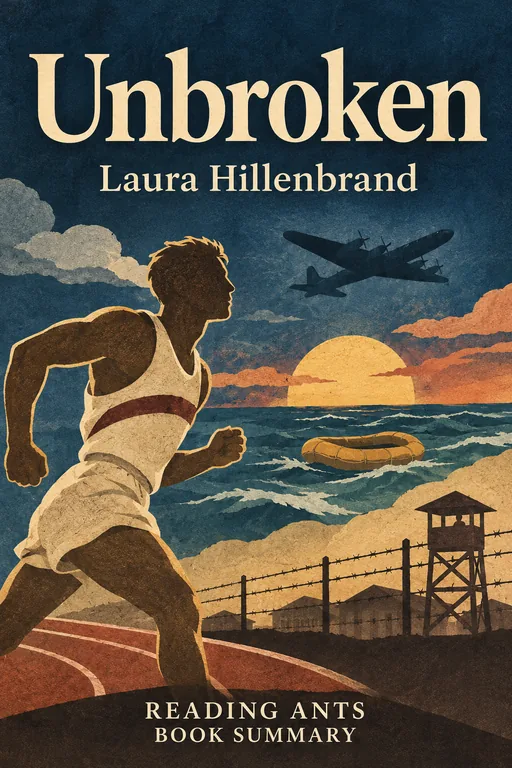
Unbroken
This is the true story of Louis Zamperini, an Olympic runner who survived a plane crash, weeks adrift on the Pacific and years in brutal Japanese prison camps during World War II, then fought to rebuild his life.
Overview
Unbroken: A World War II Story of Survival, Resilience, and Redemption was written by Laura Hillenbrand, who also wrote Seabiscuit, and published in 2010. The book follows Louis Zamperini, born in 1917 in Olean, New York, to an Italian-American family that soon moved to California. As a boy he was a troublemaker, but with the help of his older brother Pete he became a champion runner and competed at the 1936 Berlin Olympics. When war came, he joined the Army Air Forces and became a bombardier. The book tells of what happened next and how he found a way to live after the war. It was based on extensive interviews with Zamperini and many others, and it was a long-running bestseller.
Full Summary
1. A wild boy who learns to run
The idea: Louis grows up in Torrance, California, in a family that came from Italy. He is a mischievous child who steals, fights and gets into trouble. His brother Pete sees that he can run fast and gets him into school athletics, where Louis starts winning races, becomes a record-setting miler and earns a place in the 1936 Olympics in Berlin. He does not win a medal, but he runs a remarkable last lap that is noticed, and he dreams of competing again at a later Games. The war ends that dream.
In real life: A young person’s energy, even when it causes trouble, can be turned into something positive when someone believes in them and gives them a path.
2. From the air force to a crash
The idea: Louis joins the Army Air Forces even before the United States enters World War II, and becomes a bombardier on a B-24 bomber in the Pacific. The book shows how perilous such flights were, with many airmen lost to accidents and mechanical failures, not only to enemy fire. In 1943, while on a search mission, his aircraft, a plane called Green Hornet, suffers engine failure and crashes into the ocean. Only three men survive: Louis, the pilot Russell Allen Phillips, known as Phil, and the tail gunner Francis McNamara, called Mac.
In real life: The story reminds us that in war, accidents and equipment failures could be as deadly as combat.
3. Adrift on the Pacific
The idea: The three survivors drift on small rafts with almost no food or water. They collect rainwater, catch fish and birds and fight off sharks. Hunger, thirst, sun and despair wear them down, and Mac dies on the raft after several weeks. Louis and Phil keep going, supporting each other with stories and memories. After forty-seven days adrift, they reach the Marshall Islands, only to be captured by the Japanese. The book shows how close to death they came and how much their friendship mattered.
In real life: Surviving a long ordeal often depends on small routines, shared hope and the company of another person.
4. Prison camps
The idea: Louis and Phil are first held at Kwajalein and then separated, held in different prison camps in Japan. They are beaten, starved and forced to work in harsh conditions. Louis is singled out by a camp guard nicknamed “the Bird,” Mutsuhiro Watanabe, who beats and humiliates him again and again. The authorities also use prisoners for propaganda. Louis refuses to give in, and his stubborn spirit helps him survive, although the cruelty leaves lasting scars. The book gives a larger picture of the suffering of Allied prisoners of war in Japan, and of the many who did not survive.
In real life: Even under extreme pressure, small acts of defiance can help a person hold on to their dignity.
5. Liberation and a shattered peace
The idea: When the war ends in 1945, the prisoners are freed and Louis returns home as a hero. But he is haunted by nightmares and memories of Watanabe. He marries Cynthia Applewhite, but he begins drinking heavily, and his anger and trauma threaten the marriage. He dreams of revenge against Watanabe, who has disappeared. The book shows how hard it can be for survivors to return to normal life, and that surviving is only part of the struggle. The war continues inside him long after it has ended.
In real life: Veterans and survivors of trauma often need years of support, and the people who love them may suffer too.
6. A turning point
The idea: Cynthia, close to leaving him, attends a religious revival led by the evangelist Billy Graham, and then persuades Louis to go. There, he has an experience that changes his life: he stops drinking, finds peace and gives up his hatred. In the years after, he becomes a speaker, helps young people and returns to Japan, where he forgives many of his former captors. The book closes with his long life, including carrying the Olympic torch in Japan in 1998, and notes that Watanabe never accepted his offer to meet.
In real life: Letting go of a grudge can bring freedom to the person who forgives, even if the other person never changes.
Why It Matters
Unbroken was a long-running bestseller and was adapted into a film in 2014 directed by Angelina Jolie. It brought a lesser-known side of World War II, the Pacific war and the treatment of prisoners, to a wide audience. It also became a popular book in schools and book clubs, offering a gripping story about endurance and forgiveness.
The book is also valued as an example of narrative nonfiction based on careful research, drawing on interviews, letters and records to bring a real life to the page. Hillenbrand wrote it while living with a chronic illness, and her own persistence is often mentioned by readers.
Key Takeaways
- Resilience can be learned. Louis’s stubborn spirit helped him survive.
- Survival is not the end. Trauma can follow people for years afterward.
- Support matters. Family, friends and companions help in the worst times.
- Forgiveness can free you. Letting go of hatred brought him peace.
- War has costs beyond battle. Prisoners and survivors suffer long afterward.
What We Can Learn
The story shows that a person can endure terrible hardships through determination and the help of others. Louis did not survive alone: his raft companions, his brother’s encouragement and his wife’s persistence were all part of his story.
It also teaches that healing takes time and often needs help. His struggle after the war shows that trauma is real and that seeking support is not a weakness.
Finally, the book offers a lesson in forgiveness. Louis found that holding on to hatred kept him a prisoner, and letting it go let him live more fully, a lesson that many readers, whatever their beliefs, find moving.
Criticism and Counterpoints
Some critics say that the book is sometimes too dramatic and written in a heroic style, which can make events seem larger than life, and that it leans on the memories of one man and his friends. A few historians feel that it simplifies the wider Pacific war.
Others noted that the book’s account of Louis’s religious conversion and forgiveness is brief and told in a gentle way, and that the later film left out some of this, which disappointed some viewers. The descriptions of torture and starvation are hard to read. Even so, most reviewers praise the book for its research and its moving, carefully told story.
Who Should Read It
This book suits teenagers and adults who enjoy true stories of courage. It contains scenes of violence and cruelty, so it is not for young children. It can be read as a gripping adventure and as a reflection on endurance and forgiveness.
Want the whole book?
A summary is a taste, not the meal. Here is where to find the full book.
You reached the end 🎉
Nicely done. Mark this one as read, and we will suggest what to read next.
Read this next
Band of Brothers
Stephen E. Ambrose
Historian Stephen Ambrose follows a single company of American paratroopers, from training in the United States through the fighting in Europe to the end of the Second World War, and shows how the men's bond carried them through.
🏛️ History
Into Thin Air
Jon Krakauer
Jon Krakauer, a journalist who climbed Mount Everest in 1996, recounts the storm that killed eight people on the mountain over a single day and night, and reflects on what went wrong and on his own survivor's guilt.
🏛️ History
Hiroshima
John Hersey
Through the stories of six people who survived the atomic bomb on Hiroshima, John Hersey shows in calm, plain language what the first use of a nuclear weapon meant for human beings.
🏛️ History
The Boys in the Boat
Daniel James Brown
Daniel James Brown tells how a group of working-class young men from the University of Washington learned to row as one and won the gold medal for the United States at the 1936 Berlin Olympics, with the story of Joe Rantz at its heart.
🏛️ History
Sapiens: A Brief History of Humankind
Yuval Noah Harari
Humans came to rule the planet not because we are the strongest animals but because we can believe in shared stories (gods, nations, money, companies) that let millions of strangers cooperate.
🏛️ History
Guns, Germs, and Steel
Jared Diamond
Some societies came to conquer others not because their people were smarter or better, but because geography gave them a head start in farming, animals, germs and technology.
🏛️ HistoryWant something different?
Pick another topic and we will show you three books to start with.