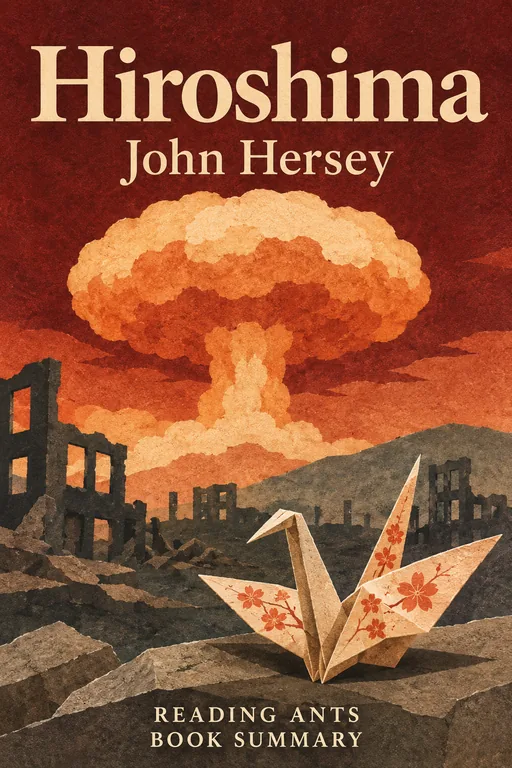
Hiroshima
Through the stories of six people who survived the atomic bomb on Hiroshima, John Hersey shows in calm, plain language what the first use of a nuclear weapon meant for human beings.
Overview
Hiroshima was written by John Hersey, an American journalist and novelist, and first appeared in 1946 as an entire issue of The New Yorker magazine, before being published as a book. Hersey traveled to Japan in 1946 and interviewed survivors of the bombing of Hiroshima on August 6, 1945. He chose six of them and told their stories in detail: what they did that morning, how they experienced the blast and what happened in the following days. The six are Miss Toshiko Sasaki, a young clerk; Dr. Masakazu Fujii, a physician; Mrs. Hatsuyo Nakamura, a widowed seamstress; Father Wilhelm Kleinsorge, a German priest; Dr. Terufumi Sasaki, a young surgeon; and the Reverend Kiyoshi Tanimoto, a pastor. The book is short and its tone is restrained, and it is widely considered one of the finest pieces of journalism of the twentieth century.
Full Summary
1. A Noiseless Flash
The idea: The book opens on the morning of August 6, 1945, just before the bomb exploded, and introduces each of the six at an ordinary moment: Mrs. Nakamura looking out of her window, Dr. Fujii settling down to read, Miss Sasaki at her desk, Father Kleinsorge resting, Dr. Sasaki arriving at work and Mr. Tanimoto starting his day. Then comes the flash, and in an instant a normal morning is destroyed. Each person experiences it in a different place and is thrown into confusion, not understanding what has happened. Hersey’s choice to begin with small, familiar details makes the sudden change more striking.
In real life: Most of us can picture an ordinary morning, with breakfast and a commute, which is why seeing it end so suddenly feels so close to home.
2. The Fire
The idea: In the second part, the survivors try to find their families and escape the burning city. Buildings have collapsed, fires are spreading and the streets are full of injured and dying people. Father Kleinsorge and others try to help the wounded, while Mr. Tanimoto ferries injured people across the river in a borrowed boat. Dr. Sasaki, almost unhurt, works without rest at the Red Cross hospital, which is overrun with patients. Hersey writes with remarkable calm, letting the facts speak for themselves.
In real life: In any disaster, ordinary people, not only professionals, often become rescuers, which Hersey shows in the actions of a pastor and a priest.
3. Details Are Being Investigated
The idea: The third part follows the days after the bombing. People begin to fall ill with strange symptoms, such as nausea, hair loss and bleeding, that doctors do not understand and that we now know to be radiation sickness. Rumors spread about what kind of weapon was used, and the survivors struggle to find food, shelter and medical care. Hersey shows how confusion and fear mix with kindness and shared suffering, while the characters try to learn what happened to relatives and friends.
In real life: When people lack clear information in a crisis, rumors fill the gap, which is why accurate reporting matters.
4. Panic Grass and Feverfew
The idea: The fourth section describes the aftermath over the following months. Plants begin to grow again in the ruined city, a sign of life returning. The survivors continue to recover or suffer from their injuries. Some are treated by doctors, some receive help from missionaries and others face poverty and uncertainty. The book follows how each person copes with illness and loss, and shows how unsure they were about their long-term health and about what their lives would become.
In real life: Recovery from a great loss often looks slow and uneven, with signs of hope appearing next to continued hardship.
5. The Aftermath
The idea: In the final part, which Hersey added in 1985, nearly forty years later, he returns to the same six people to see what became of them. Some lived long lives and some died, and some became known for speaking about their experience. He also describes how they felt about what had happened and how they regarded the bomb and the war, showing that the effects lasted for the rest of their lives, including health problems and social difficulties for survivors, who in Japan are known as hibakusha.
In real life: Following people over decades, as Hersey did, shows that the true cost of an event can only be understood long after the headlines fade.
Why It Matters
Hiroshima was one of the first accounts to show the human cost of the atomic bomb to a wide audience. When The New Yorker published it in 1946, the issue sold out quickly, and the story was widely read and broadcast on radio. It influenced debate about nuclear weapons and is often cited as an example of how careful reporting can change public understanding.
The book remains a regular choice in schools and universities, both for its history and for its style: Hersey tells the story plainly, without making speeches, which makes it more powerful. It is still studied by journalism students as a model of how to report on a huge event by focusing on a few people.
Key Takeaways
- War affects ordinary people. The survivors were doctors, clerks, a priest and a mother, not soldiers.
- Plain facts can be powerful. Hersey avoids drama and lets events speak for themselves.
- Effects last long. Illness, loss and uncertainty continued for decades.
- Individual stories matter. Numbers alone cannot show the human cost.
- Journalism can shape opinion. Careful reporting helped the world understand.
What We Can Learn
The book teaches us to see the people behind large events. Statistics about casualties are hard to feel, but the story of one woman looking for her children shows what they mean.
It also shows the force of restraint in writing. By describing events calmly, Hersey allows readers to respond with their own feelings, which can be deeper than if the author had told them what to think.
Finally, it invites reflection on the choices nations make about weapons. Whatever one believes about the decision to use the bomb, knowing what it did to people helps us think carefully about the future.
Criticism and Counterpoints
Some critics have argued that the book focuses on six survivors and therefore does not tell the whole story, including the many who died and those who suffered discrimination later, and that it avoids political questions about why the bomb was used or about Japan’s role in the war. Hersey chose to keep to the personal experience of the people he interviewed.
Others point out that the six were not typical, since several were doctors or religious figures, and that, at the time, American censorship in occupied Japan limited what could be published there. Historians also continue to debate the decision to use the bomb, which the book deliberately does not settle. Despite this, it is respected as a landmark of reporting.
Who Should Read It
This book suits teenagers and adults. It is short and clear, but it describes serious injuries and suffering, so it may be upsetting. It is a good choice for readers interested in history, journalism and the human side of war.
Want the whole book?
A summary is a taste, not the meal. Here is where to find the full book.
You reached the end 🎉
Nicely done. Mark this one as read, and we will suggest what to read next.
Read this next
Night
Elie Wiesel
Elie Wiesel tells, in short and searing pages, how as a teenager he was taken from his hometown of Sighet to Auschwitz and Buchenwald, lost his family and watched his faith and childhood break apart.
👤 Real Lives
Unbroken
Laura Hillenbrand
This is the true story of Louis Zamperini, an Olympic runner who survived a plane crash, weeks adrift on the Pacific and years in brutal Japanese prison camps during World War II, then fought to rebuild his life.
🏛️ History
The Diary of a Young Girl
Anne Frank
A Jewish teenage girl hiding from the Nazis in a secret apartment in Amsterdam records two years of fear, family quarrels, first love and big dreams in a diary that became one of the most famous books in the world.
👤 Real Lives
The Making of the Atomic Bomb
Richard Rhodes
Richard Rhodes tells the full story of nuclear weapons, from the physics discoveries of the late nineteenth century to the secret wartime project that built the first bombs and the explosions over Hiroshima and Nagasaki in 1945.
🏛️ History
Sapiens: A Brief History of Humankind
Yuval Noah Harari
Humans came to rule the planet not because we are the strongest animals but because we can believe in shared stories (gods, nations, money, companies) that let millions of strangers cooperate.
🏛️ History
Guns, Germs, and Steel
Jared Diamond
Some societies came to conquer others not because their people were smarter or better, but because geography gave them a head start in farming, animals, germs and technology.
🏛️ HistoryWant something different?
Pick another topic and we will show you three books to start with.