 Reading Ants
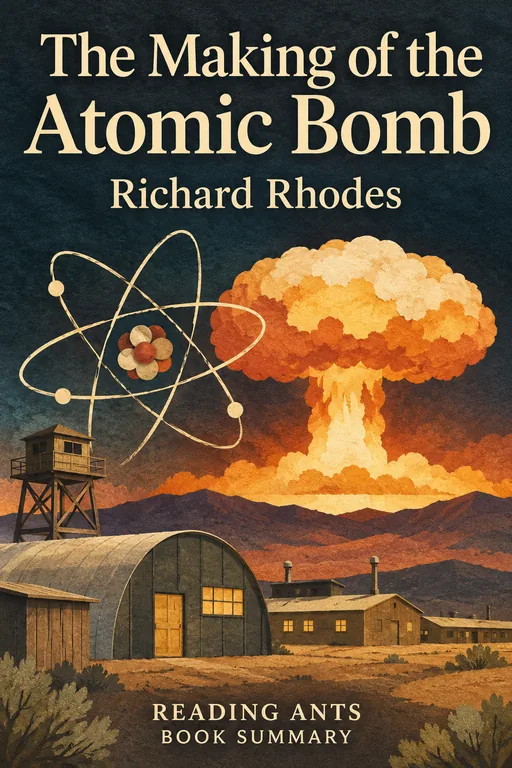
The Making of the Atomic Bomb
Richard Rhodes tells the full story of nuclear weapons, from the physics discoveries of the late nineteenth century to the secret wartime project that built the first bombs and the explosions over Hiroshima and Nagasaki in 1945.
Overview
The Making of the Atomic Bomb was published in 1986 by Richard Rhodes, an American writer. It covers about fifty years of history, mixing science, politics, espionage and human drama. It starts with the scientists who first explored the atom, and then follows the physicists, engineers, soldiers and politicians who turned an idea into a weapon during the Second World War. Rhodes explains the science in clear terms, and gives many portraits of the people involved. The book won a Pulitzer Prize, the National Book Award and the National Book Critics Circle Award.
Full Summary
1. The discoveries that opened the atom
The idea: Rhodes traces the revolution in physics in the decades around 1900, as researchers probed the structure of the atom. After J. J. Thomson found the electron, Ernest Rutherford developed the nuclear model of the atom, with a tiny, dense center, and Niels Bohr applied the new quantum ideas to its structure. In 1932, James Chadwick discovered the neutron. For many years, this was pure science, pursued out of curiosity, in laboratories in Europe.
In real life: Many world-changing technologies begin as questions that someone found interesting, and not as plans to build something.
2. The idea of a chain reaction
The idea: In 1933, the physicist Leo Szilard, waiting to cross a street in London, had the idea that if a nuclear reaction could release more neutrons than it used, it could sustain itself in a chain reaction, releasing vast energy. In 1938, the German chemists Otto Hahn and Fritz Strassmann discovered that uranium could split, a process called fission, and Lise Meitner and Otto Frisch explained it and saw its potential. Rhodes shows how scientists raced to work out whether a bomb was possible.
In real life: A single insight can open a door that cannot be closed again.
3. Fear of a Nazi bomb
The idea: Many of the physicists who understood the danger were refugees from Hitler’s Europe, who feared that Germany might build a bomb first. Szilard and Eugene Wigner visited Albert Einstein, who agreed to sign a letter to President Roosevelt in 1939, warning of the possibility. Rhodes describes how officials were slow to grasp its significance and the American effort began slowly, and how Britain contributed key ideas, such as a memorandum by Frisch and Rudolf Peierls on the bomb’s feasibility. Later, it was learned that the German program was far behind, but the scientists did not know that at the time.
In real life: Fear of what an opponent might do can drive decisions, even if the danger turns out to be smaller than imagined.
4. The Manhattan Project
The idea: In 1942, the United States launched a huge secret program, called the Manhattan Project, led by General Leslie Groves, with the physicist J. Robert Oppenheimer in charge of the weapons laboratory in the desert at Los Alamos, New Mexico. Thousands of workers, scientists and soldiers labored at sites around the country to produce the nuclear material and design the bomb. The first self-sustaining chain reaction was achieved in Chicago in 1942 under Enrico Fermi.
In real life: A huge goal can be reached when thousands of people with different skills work toward it, even in secrecy.
5. Trinity and the decision to use the bomb
The idea: On July 16, 1945, the first nuclear device was exploded in the New Mexico desert in a test called Trinity, and the result was beyond many expectations. Some scientists urged that the bomb be demonstrated or its use limited, while others said that it would end the war and save lives. Rhodes describes the debates among scientists and officials, and the new president, Harry Truman, who decided to use it against Japan.
In real life: Powerful tools raise moral questions that cannot be answered by technical skill alone.
6. Hiroshima, Nagasaki and the future
The idea: On August 6, 1945, a bomb destroyed much of the city of Hiroshima, and three days later another hit Nagasaki. Tens of thousands of people were killed at once, and many more died from burns and radiation in the following months. Japan surrendered soon after. Rhodes also follows the scientists’ mixed feelings, the beginning of the nuclear arms race and the efforts, including those of Niels Bohr, to urge openness and international control.
In real life: A discovery that is made in a moment can shape the lives of every person for generations.
Why It Matters
The Making of the Atomic Bomb is widely regarded as the definitive popular history of the development of nuclear weapons. It brings together science, politics and moral questions in a gripping narrative, and it makes complex physics understandable to a general reader. It has been read by students, scientists and policymakers, and informs debates about nuclear arms, scientific responsibility and the role of secrecy. Rhodes followed it with other books on the later history of nuclear weapons. Its enduring value is that it shows how a group of brilliant, often idealistic people created a weapon that changed the world, and asks how we can live with the consequences.
Key Takeaways
- Curiosity can change the world. Basic research led to a weapon of immense power.
- Fear drives action. The worry that Germany would build a bomb spurred the project.
- Science and politics are linked. Decisions about technology are decisions about society.
- Moral questions remain. Scientists and leaders debated how and whether to use the bomb.
- The story did not end in 1945. The arms race and the question of control began.
What We Can Learn
The book invites you to think about the responsibility that goes with knowledge. Ask what could be done with a new technology, and who should decide. It also shows the value of international cooperation and open discussion, as Bohr argued. It teaches us to understand history through the eyes of the people at the time, who did not know how events would turn out. And it reminds us that behind great events, there are individuals with doubts, hopes and fears, who make choices.
Criticism and Counterpoints
Some historians say that the book focuses mainly on the physicists and on the American effort, and that it is a narrative of people and events more than an analysis, with limited attention to institutions. The debate about whether the bombings were necessary also remains controversial. Others note that new documents, especially about Soviet espionage, have appeared since 1986 and have changed parts of the story. The book is also very long and detailed. Readers who want a different view of the bombings should read Japanese and critical accounts as well.
Who Should Read It
This book is for readers who are interested in history, science and ethics, and who are prepared for a long read. It is lively and well written, but it deals with death and destruction. Those who want a short introduction might begin with a summary, and then explore Rhodes’s work for the full story.
Want the whole book?
A summary is a taste, not the meal. Here is where to find the full book.
You reached the end 🎉
Nicely done. Mark this one as read, and we will suggest what to read next.
Read this next
The Guns of August
Barbara W. Tuchman
Barbara Tuchman gives a gripping account of the first month of the First World War in 1914, showing how plans, pride and misjudgment led the great powers into a conflict that none was able to stop.
🏛️ History
The Rise and Fall of the Third Reich
William L. Shirer
Journalist William Shirer tells the story of how Adolf Hitler came to power in Germany, built a dictatorship, started the Second World War and carried out genocide, until the regime's defeat in 1945.
🏛️ History
A Short History of Nearly Everything
Bill Bryson
Bill Bryson sets out to understand how we know what we know about the universe, the Earth and life, and tells the story through the odd, brilliant and sometimes unlucky people who figured it out.
🏛️ History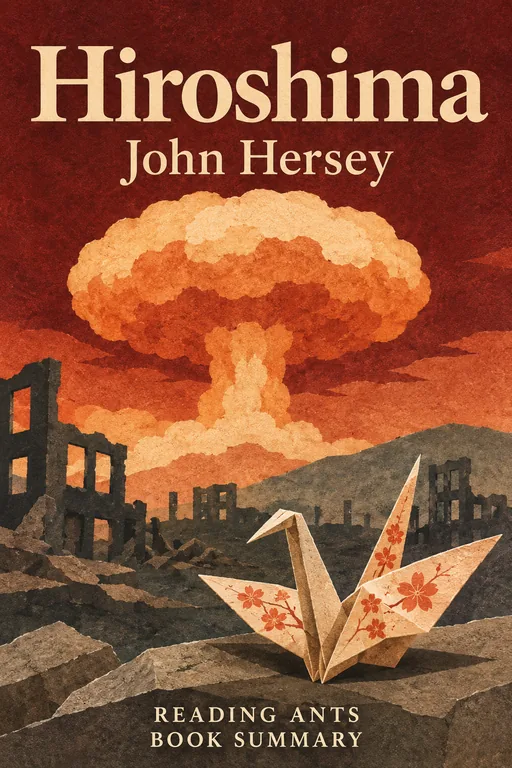
Hiroshima
John Hersey
Through the stories of six people who survived the atomic bomb on Hiroshima, John Hersey shows in calm, plain language what the first use of a nuclear weapon meant for human beings.
🏛️ History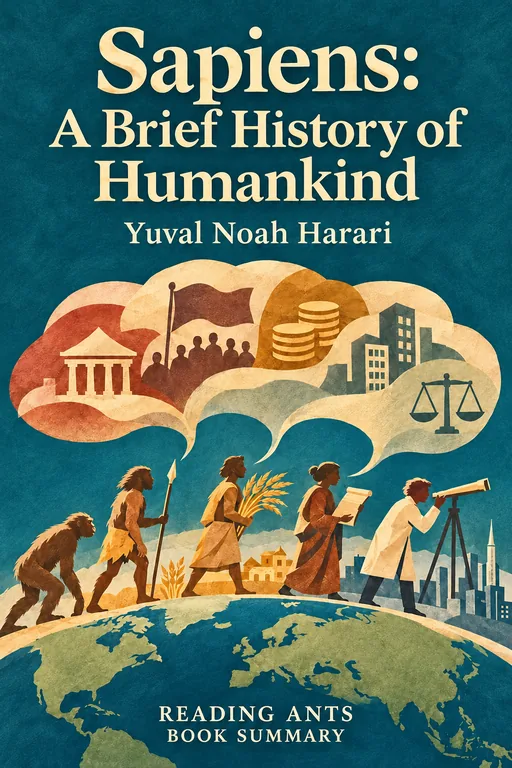
Sapiens: A Brief History of Humankind
Yuval Noah Harari
Humans came to rule the planet not because we are the strongest animals but because we can believe in shared stories (gods, nations, money, companies) that let millions of strangers cooperate.
🏛️ History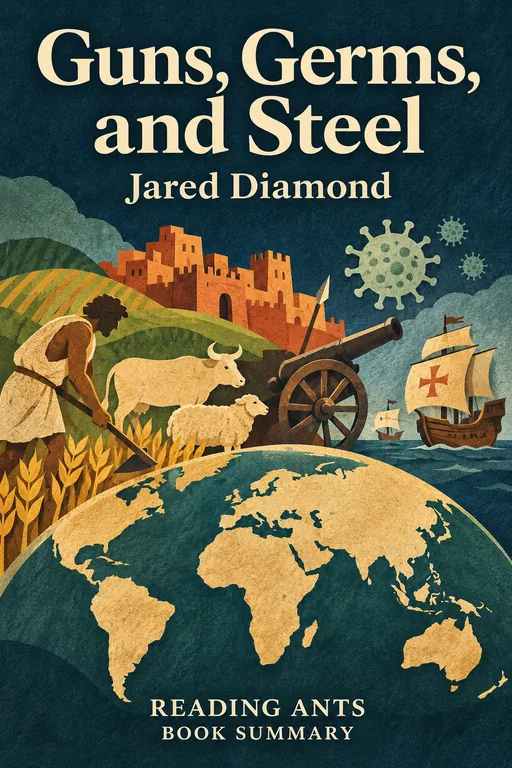
Guns, Germs, and Steel
Jared Diamond
Some societies came to conquer others not because their people were smarter or better, but because geography gave them a head start in farming, animals, germs and technology.
🏛️ HistoryWant something different?
Pick another topic and we will show you three books to start with.