 Reading Ants
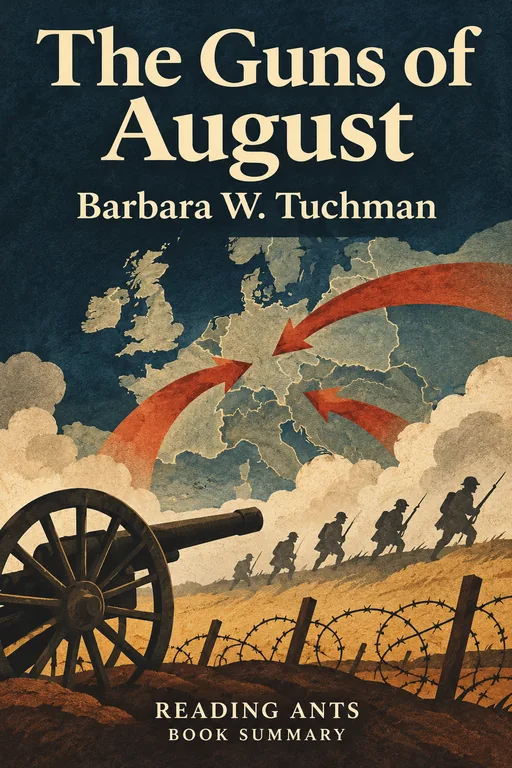
The Guns of August
Barbara Tuchman gives a gripping account of the first month of the First World War in 1914, showing how plans, pride and misjudgment led the great powers into a conflict that none was able to stop.
Overview
The Guns of August was published in 1962 by the American historian Barbara W. Tuchman. It covers a short span of time, from the funeral of King Edward VII of Britain in 1910, which brought together the rulers of Europe, to the Battle of the Marne in September 1914. Tuchman explains the war plans of Germany, France, Britain and Russia, and how they unfolded on the ground. She writes in an elegant, lively style and with a sharp eye for character. The book won the Pulitzer Prize for General Nonfiction and became a classic of popular history.
Full Summary
1. A funeral and a fragile peace
The idea: Tuchman opens with the funeral of the British king in 1910, a grand gathering of the European monarchs. She uses the scene to introduce the rulers who would later lead their countries into the war, and the atmosphere of a continent that seemed safe and civilized. Beneath the surface were alliances, rivalries and plans which would soon be tested.
In real life: A calm surface, such as a polite family dinner, can hide tensions that are waiting to explode.
2. The plans that made war
The idea: Each major power had a plan for war, prepared by its generals in great detail, and the plans were rigid. Germany’s, known as the Schlieffen Plan, aimed to avoid a war on two fronts by defeating France quickly by marching through Belgium. France’s Plan XVII stressed attack over careful planning. Britain had developed military talks with France, though few of its leaders knew about the commitments, and Russia, with its huge army, planned to invade East Prussia. Tuchman shows how these plans left little room for diplomacy: when the German leader Moltke was asked to change course, he insisted that the mobilization plans could not be altered.
In real life: If everyone has a rigid timetable, a small delay or change can set off a chain reaction.
3. The road to war
The idea: After the assassination of the heir to the Austrian throne in Sarajevo in the summer of 1914, the crisis escalated in a few weeks, and Tuchman concentrates on the first days of August. In Berlin, the Kaiser briefly tried to turn the army east after a telegram suggested that Britain might stay neutral. France ordered mobilization, and the British cabinet was divided. Germany gave Belgium an ultimatum demanding passage, and King Albert refused. Germany then declared war on France and invaded Belgium, which brought Britain in. Tuchman shows how leaders who did not want a general war found that they could not stop one.
In real life: A quarrel between two people can drag in friends on both sides, until no one can back down.
4. Belgium and the German advance
The idea: The German armies swept into Belgium, and the Belgian army put up resistance at Liège that slowed the advance, although the Germans entered Brussels on August 20. German atrocities against civilians, above all the burning of the city of Louvain, shocked the world and helped to turn opinion against Germany. Britain sent its expeditionary force to the Continent, and the French and British were pushed back. Tuchman describes the confusion and the courage.
In real life: A smaller group’s brave stand can slow a bigger force and change what happens next.
5. Failure and chaos on the Allied side
The idea: The French High Command was poorly prepared for the German attack, and the French General Lanrezac pulled his army back from a hopeless position at Charleroi, which saved the French line from collapse. The British force suffered heavy losses at Le Cateau. In the east, Russia invaded East Prussia, but the Germans, now under Hindenburg and Ludendorff, used intercepted Russian messages to defeat General Samsonov’s army at the Battle of Tannenberg. Tuchman shows how pride, bad communication and a rigid doctrine led to costly mistakes on several sides.
In real life: A strong plan that does not allow for change can be brittle.
6. The Marne
The idea: By early September, the French armies had fallen back about 150 miles and the Germans were advancing toward Paris. But the German General von Kluck turned southeast instead of marching on Paris, Allied intelligence spotted the change, and the French commander in Paris, Gallieni, ordered an attack. Joffre planned a counteroffensive, and the British force joined it after being persuaded. The Germans halted and fell back at the Battle of the Marne, and the chance of a quick victory was lost. In an afterword, Tuchman argues that the Marne mattered less for who won than for making sure that the war would go on, as years of trench warfare.
In real life: A calm leader who refuses to panic can turn a situation around.
Why It Matters
The Guns of August shaped the way many people understand the beginning of the First World War. It was a huge bestseller and won the Pulitzer Prize for General Nonfiction in 1963. Its lessons about miscalculation, rigid plans and the danger of escalation were taken seriously by leaders in later years: President John F. Kennedy is reported to have given it to his cabinet and military advisers and to have drawn on it during the Cuban Missile Crisis, when he did not want the world to bungle into war. The book also shows how history can be a gripping story when told with style and narrative skill. Its influence on the popular understanding of how wars begin, by accident and pride as well as by design, continues today.
Key Takeaways
- War plans can trap leaders. Rigid timetables limited choices.
- Pride and fear escalate crises. No one wanted to be seen as weak.
- Alliances spread conflict. A local quarrel became a continental war.
- Early assumptions fail. All sides expected a short war.
- Leadership matters. Individual decisions changed the course of events.
What We Can Learn
Tuchman’s book invites us to think carefully about how disputes escalate. In a quarrel, ask what each side fears and whether a way out remains. Be careful with plans that cannot be changed, and with the belief that you can control the outcome. Notice how stories about honor and weakness can push people into actions that they regret. And remember that people at the time did not know how things would end, and that this is true of us as well.
Criticism and Counterpoints
Academic reviewers praised the writing but raised objections. Some said that the book connects events in too deterministic a chain, and the historian Margaret MacMillan has written that its central argument, that alliances and timetables led inevitably to catastrophe, is no longer accepted by most historians. Critics said that Tuchman leaned on memoirs and on sources that fit her thesis, gave too little attention to causes such as nationalism, imperialism and economics, and left out fronts such as Galicia. Some found her portrayal of the Germans one-sided. Still, the book is valued for its style and insight.
Who Should Read It
This book is for anyone who enjoys history written as a story, and for readers who want to understand how the First World War began. It is vivid and well paced, but it names many people and places. Those looking for a full account of the whole war, or for the latest research on its causes, will want to read further.
Want the whole book?
A summary is a taste, not the meal. Here is where to find the full book.
You reached the end 🎉
Nicely done. Mark this one as read, and we will suggest what to read next.
Read this next
The Rise and Fall of the Third Reich
William L. Shirer
Journalist William Shirer tells the story of how Adolf Hitler came to power in Germany, built a dictatorship, started the Second World War and carried out genocide, until the regime's defeat in 1945.
🏛️ History
The Making of the Atomic Bomb
Richard Rhodes
Richard Rhodes tells the full story of nuclear weapons, from the physics discoveries of the late nineteenth century to the secret wartime project that built the first bombs and the explosions over Hiroshima and Nagasaki in 1945.
🏛️ History
All Quiet on the Western Front
Erich Maria Remarque
A young German soldier discovers that modern war destroys not only bodies but also the beliefs, relationships and futures of those forced to fight it.
🌍 World Literature
The Art of War
Sun Tzu
The greatest victory is the one won without fighting, achieved through careful planning, knowing both yourself and your opponent, and using deception, flexibility and timing.
🕊️ Philosophy & Religion
Sapiens: A Brief History of Humankind
Yuval Noah Harari
Humans came to rule the planet not because we are the strongest animals but because we can believe in shared stories (gods, nations, money, companies) that let millions of strangers cooperate.
🏛️ History
Guns, Germs, and Steel
Jared Diamond
Some societies came to conquer others not because their people were smarter or better, but because geography gave them a head start in farming, animals, germs and technology.
🏛️ HistoryWant something different?
Pick another topic and we will show you three books to start with.