 Reading Ants
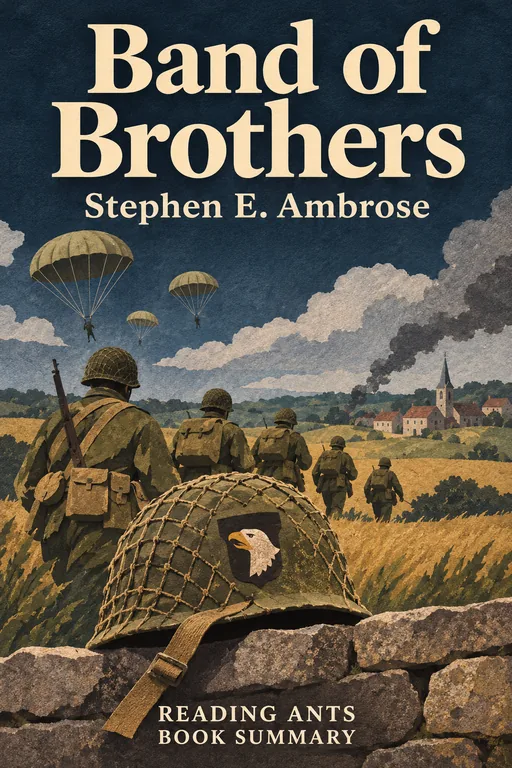
Band of Brothers
Historian Stephen Ambrose follows a single company of American paratroopers, from training in the United States through the fighting in Europe to the end of the Second World War, and shows how the men's bond carried them through.
Overview
Band of Brothers: E Company, 506th Regiment, 101st Airborne from Normandy to Hitler’s Eagle’s Nest was published in 1992 by Stephen E. Ambrose, an American historian. He based it on interviews with surviving members of Easy Company, and he shared drafts with them so that they could correct and comment on his account. The unit was part of the 101st Airborne Division, and its soldiers parachuted into France on D-Day, fought in the Netherlands and in the Battle of the Bulge, and reached Hitler’s mountain retreat in Bavaria. The book was the basis for a major television series in 2001. It is a story of courage, fear, leadership and friendship.
Full Summary
1. Training at Toccoa
The idea: Easy Company was formed in 1942 at Camp Toccoa in Georgia, where volunteers for the new parachute infantry went through tough conditioning. They ran up and down Currahee Mountain again and again, and later went to Fort Benning to learn to jump from planes. Their first commander, Herbert Sobel, drove the men hard, and many came to dislike and distrust him. Later, while the company trained in England, some of the sergeants refused to serve under him, and he was moved to another post. The hard training and the shared struggle helped to build the unity of the unit.
In real life: A team that goes through hard practice together, even under a coach they dislike, can become close.
2. D-Day and the first fight
The idea: On the night of June 5 to 6, 1944, Easy Company flew to Normandy, and the men jumped into the dark over France, widely scattered. Many landed far from their targets and had to find each other. The plane carrying the company commander, Lieutenant Thomas Meehan, and most of the headquarters group was shot down. Lieutenant Richard Winters took command of the company and led an attack on a German artillery battery at Brécourt Manor, which was firing on Utah Beach, one of the landing beaches. The assault succeeded and became the best-known action of the regiment, and Winters received a high award for it.
In real life: When a plan falls apart, someone has to step forward and make a decision, even without all the facts.
3. Carentan and Holland
The idea: After Normandy, Easy Company fought in the battle for the town of Carentan in June, and then returned to England to rest and train. In September 1944, they jumped into the Netherlands as part of a large operation to seize bridges, called Market Garden. The company advanced toward Eindhoven, defended the area around Veghel and Uden, and later fought on the low ground between Arnhem and Nijmegen known as “the island.” The wider operation failed to reach its final goal at Arnhem. Ambrose describes the confusion of battle, and the losses of friends.
In real life: Not every well-planned mission works, and the people involved still have to deal with the consequences.
4. Bastogne in the cold
The idea: In December 1944, a German offensive known as the Battle of the Bulge surprised the Allies. Easy Company was sent to the area of Bastogne in Belgium, where the Americans were surrounded. The men fought in freezing woods, with limited supplies. It was one of the hardest tests the company faced, with many casualties, and a time when the bond among the men was most important. They held their ground until the encirclement was broken. In January 1945, in the attack on the village of Foy, the company commander, Lieutenant Norman Dike, froze under fire and was relieved, and Lieutenant Ronald Speirs took over.
In real life: In very hard times, knowing that others are depending on you can keep you going.
5. Into Germany
The idea: In the spring of 1945, the company moved into Germany with the advancing Allied armies. In late April, soldiers of the 101st Airborne came upon the Kaufering concentration camp complex, where prisoners had been held in terrible conditions. The men were horrified by what they saw. This summary keeps the details brief, as the subject calls for. The discovery stands apart from the fighting in the rest of the book, because it showed the soldiers something of the cruelty of the regime they were fighting.
In real life: Sometimes a single experience changes how a person sees the purpose of their work.
6. The end of the war and aftermath
The idea: In May 1945, Easy Company reached Berchtesgaden, the mountain town near Hitler’s retreat, the Berghof, and the war in Europe ended soon after. (Other units have disputed the claim that Easy Company got there first.) The company then moved to occupation duty in Austria. Ambrose closes the story with an afterword about the men’s lives after the war, and shows that the memory of the war and the closeness of their friendships stayed with them.
In real life: Friendships formed in difficult times can last for decades.
Why It Matters
Band of Brothers is among the best-known books about the Second World War, and, together with the television series, it brought the experience of ordinary American soldiers to millions of people. It is valued for its focus on individuals, and on the bonds of comradeship, rather than on strategy alone. It also contains reflections on the cost of war and on leadership and teamwork. The book grew out of interviews that Ambrose recorded with the veterans for his D-Day oral-history work in New Orleans, linked to the National D-Day Museum, so it preserves the testimony of men from a generation that was aging.
Key Takeaways
- Unity is built together. Shared hardship creates strong bonds.
- Leadership is shown in action. Good leaders earn trust by example.
- War is chaos. Plans change, and individual initiative matters.
- Ordinary people do extraordinary things. The men began as civilian volunteers and became highly trained soldiers.
- Memory matters. Preserving the stories of veterans keeps history alive.
What We Can Learn
The book encourages us to value teamwork and loyalty, and to be ready to step up when others need us. It shows that leaders earn respect by sharing the risks and caring for those they lead. It also reminds us of the human cost of war, and of the importance of listening to people who were there. If you know a veteran, or an older relative who lived through hard times, you can ask them about their story, with respect. And think about how you can support others who are going through difficulty.
Criticism and Counterpoints
The book relies mainly on the memories of the men decades after the events, which can be incomplete or shaped by later accounts, and it is more a tribute than a critical study. Its claim that Easy Company was first to reach Berchtesgaden has been disputed by other units, and historians credit the 3rd Infantry Division with reaching the town first. Ambrose also faced accusations of plagiarism in his other works around the time of his death, which led some readers to look more closely at his books. Others say that the focus on one company gives a narrow view of the war, and that it leaves out the experiences of civilians and of other nations. The book is best read as a human story of a unit.
Who Should Read It
This book is for readers who like military history and stories of friendship and courage. It is clearly written and well paced. Because it contains scenes of combat and the aftermath of atrocities, and some strong language, it is best suited to mature teenagers and adults.
Want the whole book?
A summary is a taste, not the meal. Here is where to find the full book.
You reached the end 🎉
Nicely done. Mark this one as read, and we will suggest what to read next.
Read this next

The Boys in the Boat
Daniel James Brown
Daniel James Brown tells how a group of working-class young men from the University of Washington learned to row as one and won the gold medal for the United States at the 1936 Berlin Olympics, with the story of Joe Rantz at its heart.
🏛️ History
Unbroken
Laura Hillenbrand
This is the true story of Louis Zamperini, an Olympic runner who survived a plane crash, weeks adrift on the Pacific and years in brutal Japanese prison camps during World War II, then fought to rebuild his life.
🏛️ History
The Rise and Fall of the Third Reich
William L. Shirer
Journalist William Shirer tells the story of how Adolf Hitler came to power in Germany, built a dictatorship, started the Second World War and carried out genocide, until the regime's defeat in 1945.
🏛️ History
If This Is a Man
Primo Levi
Primo Levi, an Italian Jewish chemist, describes with clarity and restraint his eleven months as a prisoner in the Auschwitz camp, and asks what it means to remain human when everything is taken from you.
👤 Real Lives
All Quiet on the Western Front
Erich Maria Remarque
A young German soldier discovers that modern war destroys not only bodies but also the beliefs, relationships and futures of those forced to fight it.
🌍 World Literature
Sapiens: A Brief History of Humankind
Yuval Noah Harari
Humans came to rule the planet not because we are the strongest animals but because we can believe in shared stories (gods, nations, money, companies) that let millions of strangers cooperate.
🏛️ HistoryWant something different?
Pick another topic and we will show you three books to start with.