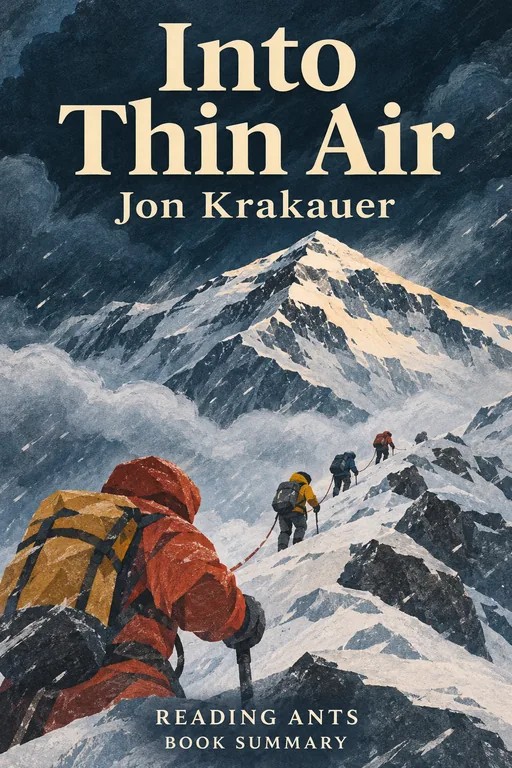
Into Thin Air
Jon Krakauer, a journalist who climbed Mount Everest in 1996, recounts the storm that killed eight people on the mountain over a single day and night, and reflects on what went wrong and on his own survivor's guilt.
Overview
Into Thin Air: A Personal Account of the Mount Everest Disaster was written by Jon Krakauer and published in 1997. He had been sent to Everest by Outside magazine to write about the growing business of guided climbs, and he joined an expedition led by the New Zealander Rob Hall. In May 1996, a storm hit the mountain during a summit attempt, and several climbers, including Hall, died. Krakauer, who reached the summit and survived, wrote the book to try to understand what had happened. He shows how a combination of crowds, ambition, delays, bad weather and human error, rather than one mistake, led to the disaster.
Full Summary
1. The business of Everest
The idea: Krakauer explains how Everest had changed from a place only expert climbers attempted into a destination for paying clients, who could hire guides and Sherpas to help them reach the top. Rob Hall’s company, Adventure Consultants, and another team run by the American Scott Fischer, called Mountain Madness, were leading groups in 1996. Krakauer notes that experienced climbers worried that clients with less skill were being led up a dangerous mountain, and that commercial pressure, including the wish for publicity and good results, could cloud judgment.
In real life: When money and fame are involved, it can be harder for people to turn back, even if conditions are risky.
2. The approach and acclimatization
The idea: The expeditions travel to Nepal and spend weeks walking to base camp and climbing up and down the lower slopes so their bodies can adjust to the thin air. Krakauer describes the cold, the altitude sickness and the rough physical conditions, as well as the clients and guides: a mix of doctors, businesspeople, a postal worker and a journalist. He also describes the crowds of other expeditions, which caused delays on the narrow route, and the dangerous Khumbu Icefall.
In real life: At very high altitude, the body gets less oxygen, so even simple tasks become exhausting and thinking becomes unclear.
3. Summit day
The idea: On May 10, 1996, the teams set out for the summit during the night. Bottlenecks at fixed ropes on the way up slow many climbers. Hall had set a strict turnaround time, after which climbers were meant to head down no matter how close they were to the top, but this rule was not followed by everyone. Krakauer reaches the summit in the afternoon, but others arrive much later, when it is already late in the day. The delay will have deadly consequences.
In real life: Rules like a turnaround time exist because tired minds make bad decisions, and sticking to them can be life-saving.
4. The storm
The idea: As the climbers descend, a violent storm arrives with high winds, whiteout conditions and freezing temperatures. Climbers lose their way, run out of oxygen and are separated from their groups. Some, such as the guide Andy Harris and client Doug Hansen, die on the mountain. Rob Hall, trapped high up with the exhausted Hansen, stays on the radio with base camp, and speaks by satellite phone to his pregnant wife in New Zealand, before he dies. Scott Fischer also dies after becoming ill and unable to descend.
In real life: A storm that seems far away can arrive within an hour, which is why weather planning is critical in the mountains.
5. Rescues and survival
The idea: Some people survive because others take big risks. The Russian guide Anatoli Boukreev rescues several climbers from Fischer’s team in the storm, and the climber Beck Weathers, who was left for dead, wakes and walks into camp with severe frostbite. Krakauer, who survived, describes his own exhaustion and the guilt he felt afterward, including over a case in the dark and storm in which he mistook one climber for another. Eight climbers from several expeditions died in the storm and the events around it, and several others suffered serious injuries.
In real life: Survivors often struggle with guilt and “what if” questions, which are a normal part of grief.
6. Aftermath and blame
The idea: In the last part, Krakauer reflects on why the disaster happened. He points to a series of factors: crowding, delays, ignoring the turnaround time, summit fever, too little oxygen and the weather. He expresses criticism of some decisions, including Boukreev’s choice to climb without bottled oxygen and to descend ahead of clients, which led to a public dispute, and Boukreev later published his own account defending his actions. Krakauer admits that his own account may include errors, and that memory is unreliable at high altitude.
In real life: Investigations of accidents often find many small errors that add up, instead of a single cause.
Why It Matters
Into Thin Air was a major bestseller and brought the 1996 disaster to millions of readers. It sparked public debate about commercial guiding on Everest and about the ethics of climbing, and it is frequently cited in discussions of risk, leadership and decision making. The book was also the basis for studies in business and psychology about group decisions under pressure.
It contributed to a boom in mountaineering narratives and has been followed by documentaries and films, including the 2015 movie Everest. Because it describes how crowds, weather, hierarchy and pride combined to produce a catastrophe, it is also used in classes about leadership and safety, far from the mountains.
Key Takeaways
- Many small errors add up. Disasters rarely have a single cause.
- Plans and rules matter. The turnaround time was ignored when it counted.
- Ambition can cloud judgment. Summit fever pushed people to risk too much.
- Nature is indifferent. Weather and altitude can overwhelm skill.
- Survivors carry burdens. Guilt and doubt can last for years.
What We Can Learn
The book teaches how risk grows when people are tired, committed to a goal and unwilling to turn back. Deciding in advance when to stop, and sticking to that decision, is a lesson that applies to climbing and to everyday projects.
It also shows the danger of trusting a crowd or an expert without thinking for oneself. Many climbers assumed that guides would take care of everything, and some did not question decisions that seemed wrong.
Finally, it offers a lesson in honesty. Krakauer describes his own mistakes and doubts, and does not pretend to have all the answers, which is a good model for how to think about difficult events.
Criticism and Counterpoints
The book has been criticized by some who were there. Anatoli Boukreev and his co-author argued that Krakauer misrepresented his actions and the role of guides, and others who knew the dead said that some details were incorrect or unfair. Krakauer acknowledged that memory of events at high altitude is uncertain and updated the book with a postscript.
Other critics say that the book dwells on blame and that it is a one-person view, while some people feel that it exploits real tragedies. Defenders say it is a careful and honest effort to understand a complicated event. Readers may wish to compare it with other accounts, such as Boukreev’s The Climb.
Who Should Read It
This book suits teenagers and adults who like adventure and true stories. It contains scenes of death and suffering at high altitude that can be hard to read. It is also useful for anyone interested in how people make decisions under stress.
Want the whole book?
A summary is a taste, not the meal. Here is where to find the full book.
You reached the end 🎉
Nicely done. Mark this one as read, and we will suggest what to read next.
Read this next

Into the Wild
Jon Krakauer
Jon Krakauer investigates the story of Christopher McCandless, a young man who gave away his money, abandoned his family and walked alone into the Alaskan wilderness, where he died in 1992.
👤 Real Lives
Touching the Void
Joe Simpson
Joe Simpson tells how, after breaking his leg high on a Peruvian mountain in 1985, he was lowered down a cliff by his partner Simon Yates, who was forced to cut the rope, and how Simpson crawled alone to safety.
👤 Real Lives
Unbroken
Laura Hillenbrand
This is the true story of Louis Zamperini, an Olympic runner who survived a plane crash, weeks adrift on the Pacific and years in brutal Japanese prison camps during World War II, then fought to rebuild his life.
🏛️ History
Endurance: Shackleton's Incredible Voyage
Alfred Lansing
Alfred Lansing tells how Ernest Shackleton's ship was crushed by Antarctic ice in 1915, and how he led his twenty-seven companions through nearly two years of cold, hunger and danger, until all twenty-eight men were brought home alive.
🏛️ History
Sapiens: A Brief History of Humankind
Yuval Noah Harari
Humans came to rule the planet not because we are the strongest animals but because we can believe in shared stories (gods, nations, money, companies) that let millions of strangers cooperate.
🏛️ History
Guns, Germs, and Steel
Jared Diamond
Some societies came to conquer others not because their people were smarter or better, but because geography gave them a head start in farming, animals, germs and technology.
🏛️ HistoryWant something different?
Pick another topic and we will show you three books to start with.