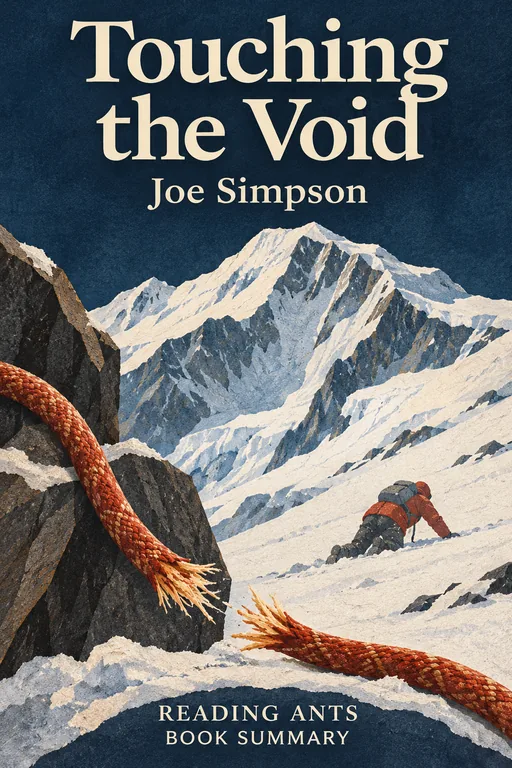
Touching the Void
Joe Simpson tells how, after breaking his leg high on a Peruvian mountain in 1985, he was lowered down a cliff by his partner Simon Yates, who was forced to cut the rope, and how Simpson crawled alone to safety.
Overview
Touching the Void is a mountaineering memoir by Joe Simpson, published in 1988. In 1985, Simpson and his friend Simon Yates, two young British climbers, set out to climb the west face of Siula Grande, a mountain of over six thousand meters in the Peruvian Andes, which had never been climbed that way. They reached the summit by the previously unclimbed west face, but the descent proved far harder than expected, and disaster struck. The book tells the story from Simpson’s point of view, with some sections from Yates’s account. It was a bestseller, and was adapted as a film that combined interviews with dramatized scenes.
Full Summary
The Climb
Simpson and Yates travel to Peru with a friend, Richard Hawking, who is not a climber and stays at the base camp to look after their supplies. They decide to attempt the west face in alpine style, meaning with little equipment and no extra help. The climb is long, cold and steep. They reach the summit by the west face, but the descent is much harder than they expected, and the weather is turning. Soon after leaving the top, Yates breaks through a cornice and falls down the face they have just climbed, and only the rope holds him. They spend a night in a snow hole on the ridge, having eaten the last of their food.
The Fall
The next morning, on the ridge, Simpson falls from an ice cliff and lands badly. His right leg is broken, with the lower bone driven into his knee. This is a very serious injury, and a death sentence for most climbers at that altitude. Yates is faced with a choice, but he decides not to leave his friend. Instead, he comes up with a plan: he will lower Simpson down the mountain in stages using two ropes tied together, a laborious process in the snow and wind, with Yates digging a seat in the slope each time to brace himself.
Lowered in the Storm
The pair continue to descend in this way, Yates lowering Simpson a rope’s length at a time, in a storm. Simpson is in terrible pain and exhaustion. At one point, Yates cannot see him in the darkness or hear him in the wind. Eventually, Simpson slides over the edge of a cliff and is left hanging in the air, with Yates unable to pull him back up or to lower him further, and the weight is pulling Yates down the slope.
The Cut Rope
For something like an hour and a half, Yates holds on, but his seat in the snow is slowly giving way, and he realizes that he will be pulled off the mountain too. He makes the terrible decision to cut the rope, which sends Simpson falling into the dark. Yates spends a stormy night in a snow cave. In the morning, he descends to the glacier, finds a large crevasse beneath the cliff where Simpson had been hanging, and calls out. Hearing no reply, he concludes that his friend is dead and continues down alone. In his own account, he feels guilt but also an acceptance that he did what he had to.
Crawling Out
Simpson, however, has survived the fall, landing on a ledge in a deep crevasse. He is alive, but with a broken leg and no food or water, in a place from which there is no easy way out. He lowers himself further into the crevasse and finds a way out onto the glacier. Then he begins a long crawl, hopping and dragging himself across the glacier and the moraines below it, with a growing sense that he must reach camp. He experiences hallucinations, thirst and despair, but he continues.
The Return to Camp
After about three days, Simpson drags himself to the base camp, only hours before Yates and their camp-minder, Richard Hawking, are about to leave. They are astonished to see him, since Yates had believed him dead. Simpson is taken for medical treatment, and over time has several operations on his leg. Some in the climbing world criticize Yates’s act, and Simpson has said that part of his reason for writing the book was to set out the facts in Yates’s defense.
Why It Matters
Touching the Void is regarded as one of the greatest mountaineering books ever written, and was a major success. It is a powerful story of survival and will, and also a study of a moral dilemma: when is it right to sacrifice one life to save another? The book prompted discussions in the climbing community about responsibility to partners. It also won the Boardman Tasker Prize for Mountain Literature, and the 2003 film version brought it to a wider audience. For many readers, the story is a reminder of the endurance of the human mind and body, and of the importance of loyalty and honesty between friends.
Key Takeaways
- The will to live is powerful. Simpson crawled for days with a broken leg.
- Moral decisions are hard. Yates faced an impossible choice and acted to save a life.
- Partnership matters. The bond between climbers is a matter of life and death.
- Calm planning helps. Yates’s rope system kept them going for a time.
- Honesty heals. Both men told the story openly, even though it was painful.
What We Can Learn
The story invites us to think about how we would act in a crisis, and about the pressure of impossible decisions. It also suggests that, in extreme situations, setting small goals, such as reaching a rock ahead of you, can help you to keep going. It encourages honesty with friends, and forgiveness. If you enjoy outdoor activities, learn from experts, practice safety and never take risks without preparation. Finally, it shows how survivors can find meaning in their experience and use it to help others.
Criticism and Counterpoints
Some mountaineers criticized Yates for cutting the rope, though he and Simpson both defended the decision. Others pointed out that the account is told from the point of view of the survivors, and that it focuses on their feelings, with limited information on how the decisions were made. Yates later said that the film version was one-sided. A few have questioned whether the author’s hallucinations and details are fully reliable, as memory under stress is imperfect.
Who Should Read It
This book is for readers who like adventure and true survival stories, even if they have never climbed. It is gripping and well written, but contains scenes of serious injury and some strong language. Those who are squeamish about physical suffering may find some passages hard to read.
Want the whole book?
A summary is a taste, not the meal. Here is where to find the full book.
You reached the end 🎉
Nicely done. Mark this one as read, and we will suggest what to read next.
Read this next
Endurance: Shackleton's Incredible Voyage
Alfred Lansing
Alfred Lansing tells how Ernest Shackleton's ship was crushed by Antarctic ice in 1915, and how he led his twenty-seven companions through nearly two years of cold, hunger and danger, until all twenty-eight men were brought home alive.
🏛️ History
Kon-Tiki
Thor Heyerdahl
Thor Heyerdahl tells how he and five companions sailed a raft of balsa logs across the Pacific Ocean in 1947, to test his theory that ancient South Americans could have settled the islands of Polynesia.
👤 Real LivesBorn to Run
Christopher McDougall
Christopher McDougall searches for the secret of why running hurts so many people and finds a hidden tribe of Mexican runners, a mysterious ultramarathon legend and a case that humans were made to run for the joy of it.
🍎 Health
Into Thin Air
Jon Krakauer
Jon Krakauer, a journalist who climbed Mount Everest in 1996, recounts the storm that killed eight people on the mountain over a single day and night, and reflects on what went wrong and on his own survivor's guilt.
🏛️ History
Seven Years in Tibet
Heinrich Harrer
Austrian mountaineer Heinrich Harrer tells how, after escaping a prison camp in British India during World War II, he crossed the Himalayas into Tibet and spent nearly seven years there, about five of them in Lhasa, where he befriended the young Dalai Lama.
👤 Real Lives
Man's Search for Meaning
Viktor E. Frankl
A psychiatrist who survived the Nazi concentration camps explains that even in the worst suffering, people can choose their attitude, and that finding a reason to live is what gives us the strength to endure.
👤 Real LivesWant something different?
Pick another topic and we will show you three books to start with.