 Reading Ants
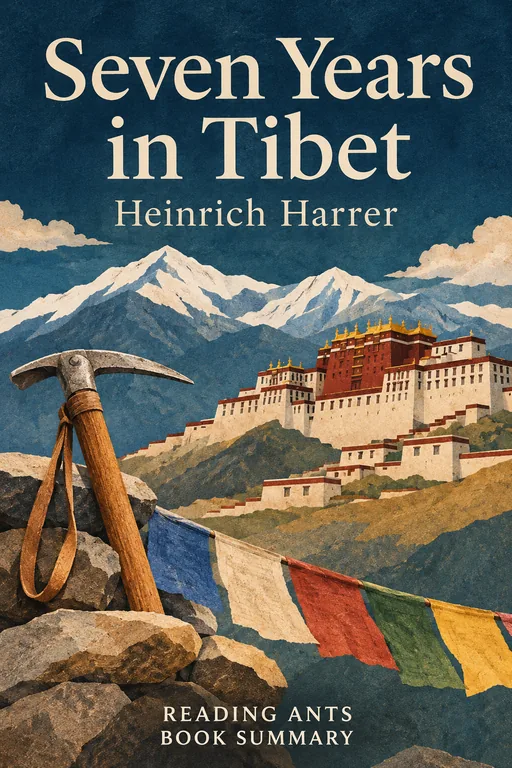
Seven Years in Tibet
Original title: Sieben Jahre in Tibet. Mein Leben am Hofe des Dalai Lama
Austrian mountaineer Heinrich Harrer tells how, after escaping a prison camp in British India during World War II, he crossed the Himalayas into Tibet and spent nearly seven years there, about five of them in Lhasa, where he befriended the young Dalai Lama.
Overview
Seven Years in Tibet was published in German in 1952 and was a bestseller around the world; the English translation by Richard Graves appeared in 1953. Harrer was a skilled mountaineer who went to the Himalayas in 1939, just before the outbreak of the Second World War. As an Austrian, he was by then a citizen of Germany, which had annexed Austria in 1938, so he was treated as an enemy alien and interned by the British in India, and he spent years in a camp. The book follows his escape, his hard journey and his years in Tibet, which at that time was closed to most foreigners. He describes a Buddhist society with its customs and festivals, and ends with the Chinese invasion that ended an era. A film in 1997 was loosely based on it.
Full Summary
Prisoners of War
Harrer had been on a German reconnaissance expedition to Nanga Parbat in the Himalayas in 1939, led by Peter Aufschnaiter, to scout a new route up the mountain. When the work was over and war was near, Harrer and two companions tried to reach Persia, but British authorities arrested them just before war broke out. They were interned, first in a camp near Bombay and then at a large camp at Dehradun, in northern India. Harrer began looking for ways out almost at once. A first attempt, jumping from a truck during a transfer, failed when his companion was caught. At Dehradun he saw that the closest free place was Tibet, over the mountains to the north. In 1943 he got out with an Italian general as his partner, but after about five weeks the two were caught by an official in the hills and brought back, and Harrer spent time in solitary confinement. He made a second break-out in April 1944, together with six other prisoners, including Peter Aufschnaiter. Some of them disguised themselves as British officers and others as Indian workers, and the group soon split up on the way. Harrer went on alone for a few days, then met Aufschnaiter and his companions again on the trail, and they reached the Tibetan border in May 1944.
Across the Plateau
Harrer and Aufschnaiter crossed a Himalayan pass of great height, with little food or equipment, and found a cool welcome from local officials, who told them again and again to turn back. They were once sent back over the border into India, but returned and eventually won permission from officials in the west to stay for some months. Later they were ordered to leave toward Nepal, but spent most of a year in the valley village of Kyirong instead. In November 1945, with their permitted stay at an end, they slipped away and made for Lhasa by the hard northern route across the high Chang Tang plateau in winter, with a yak to carry their loads. They traveled through empty, freezing country, were often taken for Indian pilgrims, and had to bluff their way past officials with their old travel permit. They narrowly avoided a band of Khampa robbers, lived on whatever they could buy or beg, and suffered from the cold, hunger and altitude. After about twenty months in Tibet, they reached Lhasa on 15 January 1946, a remarkable arrival for two foreigners without papers. They talked their way into the city and were given shelter by a noble family.
The Forbidden City
In Lhasa, a city of monasteries and the great Potala Palace, Harrer and Aufschnaiter were welcomed by some nobles, and made friends. The government decided to let them stay, at least for the time being, and within days they were invited to meet the Dalai Lama’s parents. He describes the rhythm of life in the city, the festivals, the sports and the color and music. He also noted the differences between rich and poor and the power of the monasteries. He and Aufschnaiter found work. Aufschnaiter’s first job was an irrigation canal, commissioned by a monastic official, and Harrer’s was a fountain in the garden of the noble Tsarong. Later the two of them drew the first proper map of Lhasa, and Harrer built flood banks to protect the gardens of the Dalai Lama’s summer palace and planted willows on the land they reclaimed. He also translated news from foreign papers for the government, gave lessons in English and mathematics to young nobles, and took photographs and film. He also helped start a skating club on a frozen stream.
The Young Dalai Lama
Harrer’s most famous relationship was with the young Dalai Lama, the spiritual and political leader of Tibet, who was about fourteen when they met and still a teenager during their friendship, and curious about the world. He was keen to learn about geography, science and Western ways, and wanted Harrer to teach him. Harrer taught him English, geography and arithmetic, answered his many questions about the outside world, and built a small cinema theater for him, with a projector, in the Summer Palace garden. He found the boy to be intelligent and warm, and the two became close friends.
Customs and Daily Life
The book gives details of Tibetan life, from the food and clothing to marriage customs, such as families where one wife has several husbands, and the way the dead were laid to rest. Harrer was struck by the people’s cheerfulness and faith, and by the way that Buddhism shaped the culture. He also describes some of the harsh customs, such as punishments, and the social order, with nobles and monks above the common people. He admires the society, but also sees its weaknesses. His account is that of an outsider who had come to love the place.
The End of Tibetan Independence
On 7 October 1950, Chinese forces attacked the eastern frontier of Tibet in several places, and the small Tibetan army was quickly routed. The Tibetan government appealed for help abroad, without result. The Dalai Lama, then still in his mid-teens, was asked to take on full power early. Harrer realized that the old way of life would not last. In mid-November 1950 he left Lhasa, saying goodbye with sadness. He later saw the Dalai Lama’s party pass through Gyantse as the young ruler fled toward the Indian border, and waited in the Chumbi Valley until March 1951 before crossing into India. The book ends with a note of grief for the country that he had grown to love, and which was about to change.
Why It Matters
Seven Years in Tibet introduced many readers in the West to Tibet and its culture, at a time when the country was little known. It helped draw attention to Tibet, its Buddhism and the Dalai Lama, and it was a major source of knowledge about Tibet before the Chinese takeover. The book is also a classic of adventure, with its escape, its trek and its meeting of cultures. It has been translated into many languages. In later years, the author’s past, including his membership in the Nazi party before the war, was reported in the press, which added a complicated aspect to the story. Even so, the book remains well loved.
Key Takeaways
- Perseverance in escape. Harrer persisted through repeated failures and hardship.
- Hospitality across cultures. Tibetans, from nomads to nobles, often helped two fugitive strangers.
- Learning goes both ways. Harrer taught, and he also learned.
- A way of life can vanish. The Chinese invasion ended Tibet’s independence.
- Friendship crosses boundaries. His bond with the Dalai Lama shows this.
What We Can Learn
The book invites us to be curious about other ways of life, and to approach them with respect. It also shows how patience and determination can overcome great obstacles. Think about how it feels to be a stranger in a new place, and how you can welcome newcomers. Learn about the history of Tibet and the situation of Tibetans today, with attention to different viewpoints. And remember that every account is shaped by its author’s background, so it is useful to know who the author was and read widely.
Criticism and Counterpoints
Some critics say that Harrer’s picture of Tibet is romantic, and that it plays down inequalities and harsh aspects of the old society. In 1997, it was revealed that Harrer had been a member of the Nazi party and the SS before the war, which had not been widely known, and which led to debate about how to regard his work. He later said that he regretted his involvement. Historians also note that the book is a personal memoir and not a thorough history of Tibet or of the events of 1950.
Who Should Read It
This book is for readers who enjoy adventure, travel and stories of friendship between cultures. It is well paced and easy to read. Those who want a complete or critical history of Tibet should read other books as well, and readers should be aware of the author’s complicated background.
Want the whole book?
A summary is a taste, not the meal. Here is where to find the full book.
You reached the end 🎉
Nicely done. Mark this one as read, and we will suggest what to read next.
Read this next

Kon-Tiki
Thor Heyerdahl
Thor Heyerdahl tells how he and five companions sailed a raft of balsa logs across the Pacific Ocean in 1947, to test his theory that ancient South Americans could have settled the islands of Polynesia.
👤 Real Lives
Touching the Void
Joe Simpson
Joe Simpson tells how, after breaking his leg high on a Peruvian mountain in 1985, he was lowered down a cliff by his partner Simon Yates, who was forced to cut the rope, and how Simpson crawled alone to safety.
👤 Real Lives
The Motorcycle Diaries
Ernesto Che Guevara
The young Ernesto Guevara, who later became known as Che, records the journey through South America that he made in 1952 with his friend Alberto Granado, a trip of adventure and humor that opened his eyes to poverty and injustice.
👤 Real Lives
Endurance: Shackleton's Incredible Voyage
Alfred Lansing
Alfred Lansing tells how Ernest Shackleton's ship was crushed by Antarctic ice in 1915, and how he led his twenty-seven companions through nearly two years of cold, hunger and danger, until all twenty-eight men were brought home alive.
🏛️ History
Into Thin Air
Jon Krakauer
Jon Krakauer, a journalist who climbed Mount Everest in 1996, recounts the storm that killed eight people on the mountain over a single day and night, and reflects on what went wrong and on his own survivor's guilt.
🏛️ History
Man's Search for Meaning
Viktor E. Frankl
A psychiatrist who survived the Nazi concentration camps explains that even in the worst suffering, people can choose their attitude, and that finding a reason to live is what gives us the strength to endure.
👤 Real LivesWant something different?
Pick another topic and we will show you three books to start with.