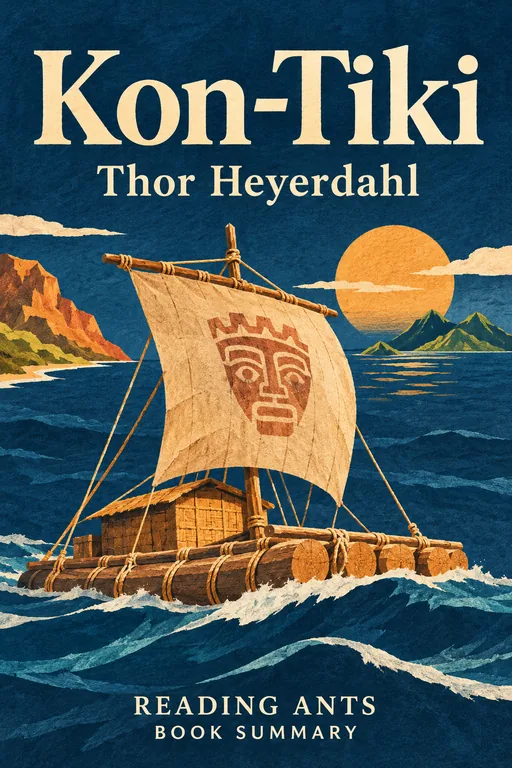
Kon-Tiki
Original title: Kon-Tiki ekspedisjonen
Thor Heyerdahl tells how he and five companions sailed a raft of balsa logs across the Pacific Ocean in 1947, to test his theory that ancient South Americans could have settled the islands of Polynesia.
Overview
Kon-Tiki is an account of an expedition led by Thor Heyerdahl, a Norwegian explorer and scientist, and published in Norwegian in 1948. Most scientists then believed that the peoples of Polynesia had come from Asia, in the west. Heyerdahl noticed signs of possible links with South America in the east, such as similar legends and customs. To show that a voyage from Peru was possible with simple, ancient technology, he built a raft like those of the Inca era, and sailed it for about a hundred days. The book is a lively adventure story and became a worldwide bestseller.
Full Summary
A Theory and Skeptics
Heyerdahl describes how he first became interested in the Pacific while studying animal life on the island of Fatu Hiva in the Marquesas, where an old islander named Tei Tetua told him of Tiki, a figure who brought the islanders’ ancestors from a big country beyond the sea. He suspected that early people from Peru could have sailed west on the winds and currents. Experts laughed at the idea. In New York, an elderly anthropologist dismissed it, saying that the peoples of South America had no boats able to cross the ocean, and friends were doubtful too. Heyerdahl decided to prove it in the only way he could, by making the voyage himself.
Building the Raft
Heyerdahl and his friend Herman Watzinger, an engineer, gathered a crew and won help from diplomats, the military and Peruvian officials. In Ecuador the team found balsa logs, a very light wood, deep in the forest, since the best trees were hard to reach after rains and wartime cutting. The raft was then built in the naval dockyard at Callao, Peru. They lashed nine logs together with hemp ropes, without nails or wire, in a way based on early raft designs, though the voyage also used some modern supplies, and they built a small bamboo cabin and a mast with a square sail. They named the raft Kon-Tiki, after the name of an ancient sun god in Inca tradition. The crew consisted of five Norwegians and a Swede, Bengt Danielsson, with a parrot as a mascot, and a radio for contact with the world.
Into the Open Sea
In April 1947, the raft left Callao, Peru, and was towed some fifty miles out to sea by a navy tug, and then cast off to sail west on the current. Almost at once, the crew faced problems of steering, since the raft had no keel and wandered in the waves. They learned how to guide it with the steering oar and with boards pushed down between the logs. Day after day, they lived on the raft, fishing, eating their stores and their catch, and enjoying the sunsets. The sea teemed with creatures, including flying fish that landed on deck, and the crew sometimes watched dolphins and glowing plankton. For safety, they stayed close to the raft when they took out their small rubber dinghy, and they used their radio to reach amateur operators far away.
Sharks, Storms and Danger
The voyage was not without danger. Huge sharks followed the raft, and the men sometimes pulled them in. They also saw a giant whale shark swim beneath the raft. In bad weather, waves washed over the deck, and the ropes were put under great strain, but they held. One crewman, Herman Watzinger, fell overboard, and he was saved only because the others acted quickly and bravely. Heyerdahl describes these moments in a straightforward way, and conveys the closeness that the men felt.
Drifting Westward
As weeks passed, the raft drifted far from the coast, carried by the current and wind, until they saw small signs of land, such as birds. They sighted Puka-Puka and then Angatau, in the Tuamotu group, but wind and surf prevented them from landing. They realized that they were approaching a dangerous chain of reefs, and that they could not steer away from them. In the end, they were driven toward an island by the current, with waves breaking on the coral.
Landing on the Reef
The raft was thrown onto a reef at Raroia, in the Tuamotu group, and the men had to cling to it, while the surf broke the mast and damaged the deck. The balsa logs held together, and all six men survived. They also managed to get their wet radio working again and tell the world that they were safe. They were able to reach a small uninhabited island inside the lagoon, where they moved their gear and set up camp. After some days, people from a neighboring island came to see them. The villagers welcomed the crew warmly, adopted them in a ceremony, and a government schooner later took them to Tahiti. The voyage had lasted about a hundred and one days and covered thousands of miles, showing that a raft could cross the Pacific, though not that it had.
Why It Matters
Kon-Tiki became one of the best-selling travel books of all time, and was made into a documentary film that won an Academy Award in 1951, and a feature film in 2012. It excited the world with its spirit of adventure, and encouraged an interest in archaeology and anthropology. Heyerdahl’s expedition showed that long ocean voyages by raft were possible, and prompted discussions of how ancient peoples crossed the sea. Later research, including DNA studies, suggests that Polynesia was mainly settled from Asia, but also that there may have been some contact with South America. The book remains a classic of adventure writing.
Key Takeaways
- Test your ideas. Heyerdahl tried to prove his theory in practice.
- Ancient people were skilled. The raft showed what early technology could do.
- Teamwork is crucial. The crew relied on each other’s skills and humor.
- Courage meets preparation. The voyage was bold but carefully planned.
- Science changes. Later evidence modified the picture.
What We Can Learn
The book encourages curiosity and a willingness to try something that others consider impossible, but it also reminds us that proof requires more than a good story. If you have an idea, think about how you can test it. Respect the knowledge and skills of people in the past. And remember that adventure depends on planning, teamwork and a sense of humor. At the same time, be careful with risky activities, and learn from experts before you attempt a dangerous journey.
Criticism and Counterpoints
Most scientists today do not accept Heyerdahl’s main theory, since linguistic, archaeological and genetic evidence shows that the great majority of Polynesians came from Asia by way of Southeast Asia. A raft voyage shows only that a crossing was possible, not that it happened. Some critics point out that he overlooked the sailing skills of the Polynesians themselves, who could have traveled in both directions. Others say that the book tends to be romantic. Supporters note that evidence for some limited contact has appeared, and that the book is a marvelous adventure.
Who Should Read It
This book is for readers of all ages who like adventure stories and true tales of exploration. It is lively and not hard to read. Those who want the current scientific view of how the Pacific was settled should consult recent studies.
Want the whole book?
A summary is a taste, not the meal. Here is where to find the full book.
You reached the end 🎉
Nicely done. Mark this one as read, and we will suggest what to read next.
Read this next
Endurance: Shackleton's Incredible Voyage
Alfred Lansing
Alfred Lansing tells how Ernest Shackleton's ship was crushed by Antarctic ice in 1915, and how he led his twenty-seven companions through nearly two years of cold, hunger and danger, until all twenty-eight men were brought home alive.
🏛️ History
Seven Years in Tibet
Heinrich Harrer
Austrian mountaineer Heinrich Harrer tells how, after escaping a prison camp in British India during World War II, he crossed the Himalayas into Tibet and spent nearly seven years there, about five of them in Lhasa, where he befriended the young Dalai Lama.
👤 Real Lives
Touching the Void
Joe Simpson
Joe Simpson tells how, after breaking his leg high on a Peruvian mountain in 1985, he was lowered down a cliff by his partner Simon Yates, who was forced to cut the rope, and how Simpson crawled alone to safety.
👤 Real Lives
The Old Man and the Sea
Ernest Hemingway
An old Cuban fisherman who has gone eighty-four days without a catch hooks a giant marlin far out at sea and fights it for three days, only to lose it to sharks, yet he returns home undefeated in spirit.
📜 Classics
1491: New Revelations of the Americas Before Columbus
Charles C. Mann
Charles Mann gathers recent research to argue that the Americas before Columbus held more people, older cities and more skillful land managers than most of us were taught, and that the picture of a pristine, empty wilderness is wrong.
🏛️ History
Man's Search for Meaning
Viktor E. Frankl
A psychiatrist who survived the Nazi concentration camps explains that even in the worst suffering, people can choose their attitude, and that finding a reason to live is what gives us the strength to endure.
👤 Real LivesWant something different?
Pick another topic and we will show you three books to start with.