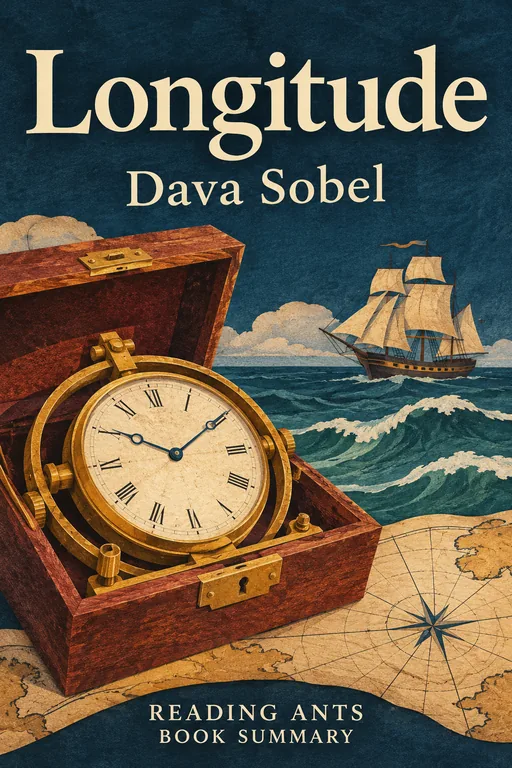
Longitude
Dava Sobel tells how a self-taught English clockmaker, John Harrison, spent decades building clocks that solved the problem of finding longitude at sea, and fought for recognition from the scientific establishment.
Overview
Longitude: The True Story of a Lone Genius Who Solved the Greatest Scientific Problem of His Time was published in 1995 by Dava Sobel, a science writer. It is a short and lively book about the problem of knowing where a ship is east or west on the ocean. Latitude, the position north or south, can be found from the sun and stars, but longitude was much harder, and thousands of sailors died because ships got lost. In the eighteenth century, the British government offered a huge prize for a solution. The book tells how Harrison, a carpenter’s son, took on the challenge with a series of beautiful and ingenious clocks.
Full Summary
1. The problem at sea
The idea: Sobel begins by explaining why longitude mattered. Without a way to know their position east or west, sailors could miss their destination or hit rocks. In 1707, a British fleet returning from war ran aground off the Isles of Scilly, in bad weather, and four ships were lost, with the lives of nearly two thousand men. The disaster shocked the nation. The government passed a law in 1714 creating a board and offering a large prize, up to twenty thousand pounds, to anyone who could find a practical way of determining longitude.
In real life: A traveler without a map may know how far north they are, but not how far east, and still be lost.
2. The idea of using time
The idea: The key insight was that longitude is related to time. The earth turns once every twenty-four hours, so a difference of one hour between local time and the time at a fixed place, such as the home port, means a distance of fifteen degrees. If a ship carried an accurate clock set to home time, and the navigator could find local noon from the sun, the difference would give the longitude. But no clock of the time could keep accurate time on a rolling ship through changes in temperature and humidity.
In real life: If your watch says it is noon at home, but the sun is overhead an hour later, you know you have moved a long way.
3. Two roads: the stars or a clock
The idea: Scientists such as the astronomers at the royal observatory favored an approach that used the moon and stars, which required complex calculations and careful observations. Others thought that a clock was the answer, but many experts thought it impossible. Sobel describes the debate, which pitted the learned men of the Board of Longitude against craftsmen. Isaac Newton himself was skeptical that a clock could do the job.
In real life: Experts often prefer solutions that fit their own training, and may not see the value of an outsider’s approach.
4. Harrison and his clocks
The idea: John Harrison, from a village in northern England, was a self-taught clockmaker who proposed to build a clock that could work at sea. He presented his first design in 1730 and spent about five years building a large sea clock, with two linked balances in place of a pendulum so that a ship’s motion would not disturb it. It was tested on a voyage to Lisbon and back in 1736 and performed well, and the Board gave him money to continue. He then built a second and a third sea clock, spending many years on the third, and each taught him something about friction, temperature and the motion of a ship. His fourth, which looked like a large pocket watch, was a masterpiece of precision.
In real life: Years of patient trial and error, with each version learning from the last, can lead to a breakthrough.
5. The long fight for the prize
The idea: Harrison’s watch was tested on voyages to the West Indies in the 1760s, and kept time remarkably well. But the Board of Longitude, whose members included astronomers who preferred their own method, kept asking for more tests and more details, and withheld the full reward. Sobel shows the frustration of an aging craftsman who felt he had earned the prize. With the help of King George III, who had a later watch of Harrison’s design tested himself, Harrison finally received a large payment from Parliament in 1773, though not the full prize on the Board’s terms.
In real life: Being right does not always mean being recognized quickly, and persistence is often needed.
6. The legacy of the sea clock
The idea: After Harrison, other watchmakers made copies and simplified versions, and the chronometer, as it was called, became a standard tool on ships. Famous voyages of exploration, such as the second and third voyages of Captain James Cook, used a copy of Harrison’s fourth watch, made by Larcum Kendall, and found it reliable. Sobel closes by showing how the invention made sea travel safer and more precise, and how accurate timekeeping changed the world.
In real life: A tool that seems to be a small improvement can transform how a whole activity works.
Why It Matters
Longitude was an unexpected bestseller, and it helped to popularize the history of science and technology for a general readership. It tells the story of a lone craftsman whose skill and determination solved a problem that learned men had not, and it shows how new ideas can meet resistance. The book led to a wave of interest in the history of clocks and navigation, and to exhibits and a television adaptation. It also highlights the importance of accurate time to exploration, trade and safety. Because it is short, clear and full of human drama, it also suits younger readers.
Key Takeaways
- Longitude is about time. A clock set to a known place can reveal how far east or west you are.
- Persistence pays. Harrison worked for decades to improve his clocks.
- Outsiders can innovate. A self-taught maker beat the experts.
- Establishments resist change. The prize committee was slow to accept a solution that did not fit its own method.
- Accuracy saves lives. Better navigation made the seas safer.
What We Can Learn
Harrison’s story encourages us to stick with a difficult problem and to learn from each failure. It also reminds us to judge ideas on their merits, not on the status of the person who proposes them. If you create something and meet resistance, keep careful records, ask for fair tests and look for allies. And it shows that science and craftsmanship often work together, and that small improvements in precision can have large effects on the world. If you enjoy this story, try building a simple sundial and comparing it with a clock, to see for yourself how time and position are connected.
Criticism and Counterpoints
Some historians say that Sobel’s portrait of Harrison as a lone genius, and of the Board of Longitude and the astronomers as villains, is too simple. They point out that astronomers such as Nevil Maskelyne also made important contributions, that the lunar method also worked and was widely used for a time, and that the cost of a watch like Harrison’s meant that a cheaper solution was also needed. Others note that the book simplifies the technical details of the clocks. The book is best read as a lively introduction, and not a complete history.
Who Should Read It
This book is for readers of all ages, from curious teenagers to adults, who enjoy stories of invention and perseverance. It is short and easy to read. Those who want a technical history of navigation or horology may need a more specialized source, but anyone who likes a good story about a stubborn inventor will enjoy it.
Want the whole book?
A summary is a taste, not the meal. Here is where to find the full book.
You reached the end 🎉
Nicely done. Mark this one as read, and we will suggest what to read next.
Read this next
Endurance: Shackleton's Incredible Voyage
Alfred Lansing
Alfred Lansing tells how Ernest Shackleton's ship was crushed by Antarctic ice in 1915, and how he led his twenty-seven companions through nearly two years of cold, hunger and danger, until all twenty-eight men were brought home alive.
🏛️ History
The Boys in the Boat
Daniel James Brown
Daniel James Brown tells how a group of working-class young men from the University of Washington learned to row as one and won the gold medal for the United States at the 1936 Berlin Olympics, with the story of Joe Rantz at its heart.
🏛️ History
A Short History of Nearly Everything
Bill Bryson
Bill Bryson sets out to understand how we know what we know about the universe, the Earth and life, and tells the story through the odd, brilliant and sometimes unlucky people who figured it out.
🏛️ History
The Making of the Atomic Bomb
Richard Rhodes
Richard Rhodes tells the full story of nuclear weapons, from the physics discoveries of the late nineteenth century to the secret wartime project that built the first bombs and the explosions over Hiroshima and Nagasaki in 1945.
🏛️ History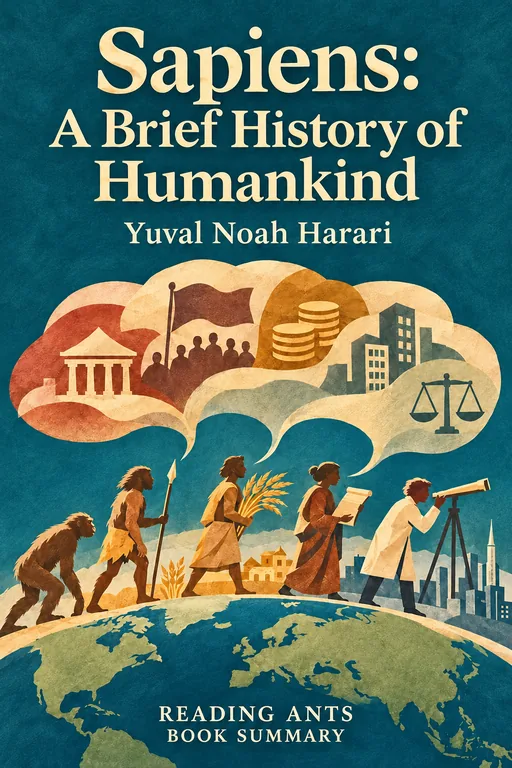
Sapiens: A Brief History of Humankind
Yuval Noah Harari
Humans came to rule the planet not because we are the strongest animals but because we can believe in shared stories (gods, nations, money, companies) that let millions of strangers cooperate.
🏛️ History
Guns, Germs, and Steel
Jared Diamond
Some societies came to conquer others not because their people were smarter or better, but because geography gave them a head start in farming, animals, germs and technology.
🏛️ HistoryWant something different?
Pick another topic and we will show you three books to start with.