 Reading Ants
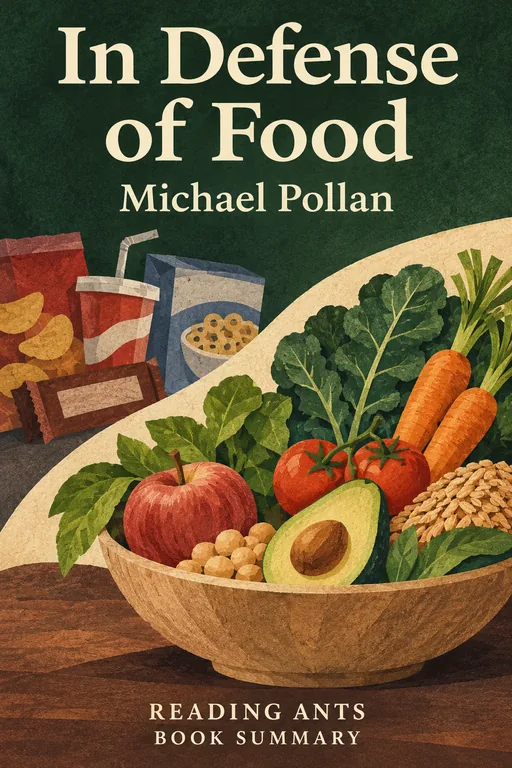
Michael Pollan argues that modern nutrition science and the food industry have confused us, and that we eat better by choosing real food, not too much of it, mostly plants, in the traditional ways of eating.
Overview
In Defense of Food: An Eater’s Manifesto was published in 2008 by Michael Pollan, a journalist and professor. It follows his earlier book, The Omnivore’s Dilemma, which looked at where our food comes from. This book asks what we should eat. Pollan says that the question has become strangely difficult in a culture full of health claims and processed products. He gives a short answer, and then explains it in three parts: the rise of “nutritionism,” the problems of the Western diet and a set of practical guidelines.
Full Summary
1. The age of nutritionism
The idea: Pollan says that in recent decades, we have started to think about food as a collection of nutrients, such as vitamins, fats and antioxidants, instead of as whole foods. He popularizes the term “nutritionism,” which the Australian scholar Gyorgy Scrinis coined, for this way of thinking, and he does not say that nutrients are unimportant. It leads to ideas that a food is good or bad according to the nutrient it contains, which allows companies to add or remove things and to sell products with health claims. Scientists, he says, have also been drawn to studying single nutrients, because they are easier to measure.
In real life: A cereal box that boasts about added vitamins may be less healthy than a plain apple, which comes with fiber and many natural compounds.
2. Why nutrient science is shaky
The idea: Pollan argues that studying nutrients in isolation does not tell us much, because food is complex, and its effects depend on the whole. Advice has changed often, such as shifting views on fats, butter and margarine. He says that this uncertainty should make us cautious about confident advice. He also notes that many studies are observational, and that people who eat healthy foods tend to differ in other ways.
From the book: He gives examples of past nutrition advice that was later changed, to show how confident claims can be overturned.
In real life: If a rule that was repeated for years is dropped, it makes sense to be skeptical about the next one.
3. The Western diet and its problems
The idea: In the second part of the book, Pollan describes how the typical diet in rich countries has changed, with more refined grains, sugar, processed oils and packaged products, and fewer whole plants. He notes that people who live on traditional diets, which are very diverse, tend to avoid the so-called diseases of Western society, such as type 2 diabetes and heart disease. When they move to the Western diet, their health often gets worse.
In real life: A family that switches from home-cooked meals to fast food every day may see changes in energy and weight over time.
4. Real food versus foodlike products
The idea: Pollan encourages readers to eat real food, not the industrial products that he calls “edible foodlike substances.” He suggests a simple rule of thumb: avoid products that your great-grandmother would not recognize as food, and be wary of long lists of ingredients with unfamiliar names. These are rules of thumb, not a chemical test: an unfamiliar name does not prove that an ingredient is harmful, and tradition does not guarantee safety. He also notes that foods that make health claims are often processed products.
In real life: A plain yogurt with fruit is easy to understand, while a brightly colored yogurt drink with ten additives is harder to judge.
5. Mostly plants, and not too much
The idea: His brief advice is to eat food, to avoid overeating and to eat mostly plants, particularly leaves. He says that traditional diets vary widely, but they share the use of real, whole foods and moderate portions. He suggests eating a wide variety of plants, and treating meat, if you eat it, more as a flavoring than as the center of the meal. He supports smaller servings, eating more slowly and stopping before you are full.
In real life: Putting a smaller plate on the table makes it easier to eat less without feeling deprived.
6. Eat the way people used to
The idea: The last part is a list of practical guidelines. They include shopping in the outer parts of the supermarket where fresh foods are found, buying from farmers’ markets when possible, cooking at home, eating at a table with others, and paying more for better quality food but eating less of it. Pollan stresses that eating is also a social and cultural act, and that enjoying meals is part of health.
In real life: A family dinner without screens helps people to eat more slowly and to enjoy it.
Why It Matters
In Defense of Food was a bestseller, spending six weeks at number one on the New York Times nonfiction list, and it helped to make Pollan one of the most prominent voices on food in the United States. Its simple advice, and its skepticism about confusing health claims, resonated with many people. The book fed a growing interest in whole foods, cooking at home and local farming, and it was widely discussed in debates about food. It was later adapted into a documentary for American public television, and when one university chose it as a book for all its students to read, a professor there objected that it gave a biased and disputed view of food and farming. It also encouraged readers to look at food as part of culture and community, and not only as fuel. Whether or not all of his claims hold up, many readers found his message liberating: that healthy eating can be simple, and that traditional wisdom is worth respecting.
Key Takeaways
- Whole foods beat nutrients. Foods work as a whole, not just as parts.
- Be skeptical of health claims. Advice that changes often should be treated with care.
- Avoid foodlike products. Highly processed items with long ingredient lists are a warning sign.
- Mostly plants, in moderation. Simple eating habits are common in healthy traditional diets.
- Eating is social. Meals shared at a table matter for enjoyment and health.
What We Can Learn
Try reading the ingredient lists on the foods you buy, and choose those with few, familiar items. Cook a meal from scratch more often, even a simple one, and enjoy it with others. Slow down while eating, and stop when you feel satisfied. Be wary of products that claim to be healthy in large letters. And remember that no single food is a miracle or a villain. As always, people with allergies, medical conditions or special needs should talk to a doctor or a dietitian before they change their diets.
Criticism and Counterpoints
Some nutrition scientists say that Pollan is unfair to their field, that he overlooks the many solid findings about nutrients, such as the need for certain vitamins, and that “nutritionism” is a caricature. Others note that the advice to eat as your great-grandmother did may be romantic, since traditional diets could be limited or unsafe, and that not everyone has the money, time or access to fresh food that the guidelines assume. Critics also point out that some of the evidence he uses is observational, and some reviewers say that he is too hard on science itself and too nostalgic about the food cultures of the past. Supporters respond that his rules are sensible rules of thumb that fit with many experts’ advice.
Who Should Read It
This book is for anyone who is confused by food advice and wants a clear, thoughtful and readable guide. It is short and well written. Readers who want strict scientific detail, or special advice for a medical condition, will need other sources. Those who already follow a similar diet may find that it confirms what they know.
Want the whole book?
A summary is a taste, not the meal. Here is where to find the full book.
You reached the end 🎉
Nicely done. Mark this one as read, and we will suggest what to read next.
Read this next
The Omnivore's Dilemma
Michael Pollan
By following four meals from the soil to the plate, Michael Pollan shows how modern food is produced, and asks what we should eat when we can choose almost anything.
⚖️ Politics & Society
The Blue Zones
Dan Buettner
Dan Buettner visits places around the world where people live unusually long, healthy lives and finds common habits in diet, movement, purpose and community that the rest of us can borrow.
🍎 Health
How Not to Die
Michael Greger with Gene Stone
Dr. Michael Greger reviews research on the main causes of early death and argues that a diet based on whole plant foods can prevent and even help to reverse many chronic diseases.
🍎 Health
Ultra-Processed People
Chris van Tulleken
Doctor and broadcaster Chris van Tulleken argues that ultra-processed foods are industrial products designed to be eaten in large amounts, that they may harm our health, and that governments should treat them as seriously as other risks.
🍎 Health
Outlive
Peter Attia with Bill Gifford
To live longer and better, we should work early to prevent the chronic diseases that kill most people, by training the body with exercise, paying attention to nutrition and sleep, and caring for our mental health.
🍎 Health
The Obesity Code
Jason Fung
Dr. Jason Fung argues that obesity is mainly a problem of hormones, especially insulin, and not just of eating too many calories, and he recommends cutting sugar and refined carbohydrates and using periods of fasting.
🍎 HealthWant something different?
Pick another topic and we will show you three books to start with.