 Reading Ants
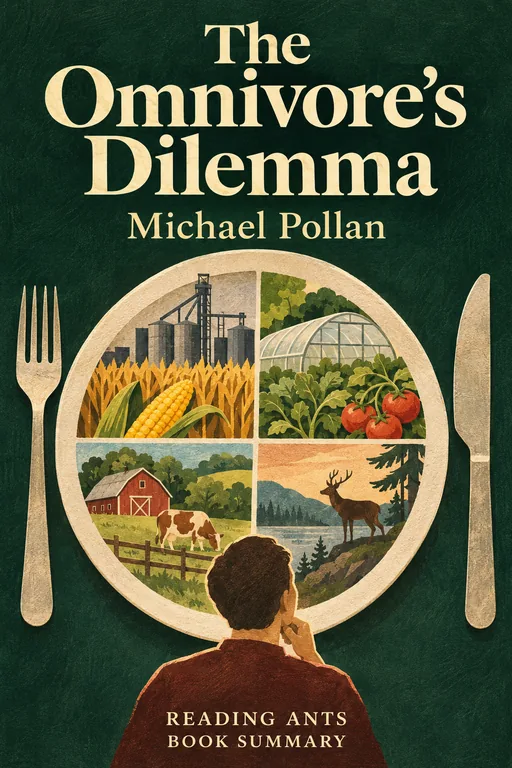
The Omnivore's Dilemma
By following four meals from the soil to the plate, Michael Pollan shows how modern food is produced, and asks what we should eat when we can choose almost anything.
Overview
The Omnivore’s Dilemma: A Natural History of Four Meals is a book by the American journalist and author Michael Pollan, published in 2006. Its title refers to a puzzle that faces creatures that can eat many things, including humans: how to decide what is safe and good to eat. For most of history, culture and tradition answered the question, but in a modern supermarket with thousands of products, we face it again. Pollan investigates by tracing the origin of four meals: one from the industrial food system, one from industrial organic farming, one from a local sustainable farm and one that he hunts and gathers himself. The book was a bestseller and helped shape the modern debate about food.
Full Summary
1. Industrial food: the reign of corn
The idea: In the first part, Pollan follows the industrial food chain by buying a fast-food meal and tracing its ingredients. He finds that much of it can be traced back to corn, which has become the most important crop in America, thanks to government subsidies and the development of hybrid seeds. Corn feeds cattle, is turned into sweeteners and oils and appears in countless processed foods. He visits an Iowa farm and a feedlot, where cattle, whose bodies evolved to eat grass, are fattened on corn, which requires antibiotics and large amounts of fossil fuel.
In real life: Reading labels shows how many foods contain corn-derived ingredients, from sodas to snack bars.
2. Industrial organic: the “pastoral” story
The idea: In the second part, Pollan examines organic food sold in a large supermarket. He visits a big organic farm in California and finds that it follows many of the practices of conventional farming on a large scale, such as growing one crop on huge fields and shipping food over long distances. The pictures on the packages, of small farms with free-roaming animals, are a kind of “supermarket pastoral.” Industrial organic is better than conventional in some ways, but it does not fully match the image people imagine.
In real life: A label like “organic” or “free-range” can mean less than the picture on the box suggests.
3. Beyond organic: a local, sustainable farm
The idea: Pollan next spends a week at Polyface Farm in Virginia, run by Joel Salatin, who raises cattle, chickens, pigs and rabbits in a system where the animals are rotated across pastures and each contributes to the health of the others. Cows graze grass, then chickens follow to eat insects and spread manure, and the land is renewed. The farm sells locally and avoids chemicals. Pollan finds it a model of an ecosystem in which farming works with nature, although it requires hard work and a lot of knowledge.
In real life: Buying food at a farmers’ market can let you meet the people who grow it and ask how it was produced.
4. The personal meal: hunting and gathering
The idea: For the final meal, Pollan decides to prepare a dinner using food he has hunted, gathered or grown himself. He learns to hunt a feral pig in California, searches for wild mushrooms and picks vegetables and fruit from a garden. Along the way, he faces the moral weight of killing an animal and the skill needed to find food. Preparing and sharing the meal with friends gives him a sense of the full cost and meaning of a meal, and of what it means to be thankful.
In real life: Cooking from scratch, even once in a while, can change how we feel about the food we eat.
5. The omnivore’s paradox and ethics
The idea: Throughout, Pollan returns to the ethical question of eating animals. He discusses the arguments of philosophers like Peter Singer, who opposes factory farming, and visits a slaughter operation on a small farm. He concludes that while he is not a vegetarian, we owe it to animals and to ourselves to know how our food is raised, and that the worst abuses of industrial farming are hard to defend. He suggests that paying attention is the first step.
In real life: Asking where our meat comes from, how the animals lived and how they died is a practical way to take responsibility.
6. Eating with attention
The idea: In his conclusion, Pollan argues that Americans have become anxious about eating because they have lost cultural traditions and rely on nutrition fads. He encourages readers to think of meals as a connection to nature, community and place. His advice, later developed in In Defense of Food, is to eat real food, mostly plants, and not too much. He ends with the thought that the way we eat is one of the most powerful ways we participate in the world.
In real life: Eating a meal together at a table, without screens, makes food a shared experience instead of just fuel.
Why It Matters
The Omnivore’s Dilemma was named one of the ten best books of the year by the New York Times and became one of the most influential books about food of its era. It helped spark a growing interest in local food, farmers’ markets, organic farming and animal welfare, and has been widely used in school and university courses.
Pollan’s following books and a related documentary, Food, Inc., extended the conversation. The book has been credited with raising awareness about the effects of industrial agriculture on health, animals and the environment.
Key Takeaways
- Corn is everywhere. Many foods trace back to a single crop.
- Labels can mislead. Organic does not always mean small or local.
- Farms can work with nature. Rotational grazing is one example.
- Cooking and knowing the source matter. They bring responsibility and meaning.
- Eating is a moral act. Our choices affect land, animals and people.
What We Can Learn
The book encourages us to be curious about what is on our plates. A little research into where foods come from can reveal surprising connections and help us make choices that fit our values.
It also teaches that there are trade-offs in any food system. Cheap, abundant food has benefits, but it also has hidden costs, and recognizing these can help us weigh decisions.
Finally, it reminds us that meals can be a source of joy and connection. Taking the time to prepare food and share it with others is a way to enjoy life and honor the work of those who produce it.
Criticism and Counterpoints
Some critics say that Pollan romanticizes small farms and doubts the ability of local, sustainable systems to feed the world’s population, and that he is too hard on modern agriculture, which has lowered the price of food and reduced hunger. Others argue that his suggestions are unaffordable for many people, as the foods he favors tend to be expensive and time-consuming.
Animal rights advocates object that he does not go far enough in questioning meat eating, while some farmers say he misrepresents their practices. Scientists have also questioned a few claims. Still, many readers find the book thought-provoking and lively.
Who Should Read It
This book suits teenagers and adults who are curious about food. It includes descriptions of killing animals that some readers may find upsetting. It is long but readable, and each part can be read separately.
Want the whole book?
A summary is a taste, not the meal. Here is where to find the full book.
You reached the end 🎉
Nicely done. Mark this one as read, and we will suggest what to read next.
Read this next
In Defense of Food
Michael Pollan
Michael Pollan argues that modern nutrition science and the food industry have confused us, and that we eat better by choosing real food, not too much of it, mostly plants, in the traditional ways of eating.
🍎 Health
Silent Spring
Rachel Carson
The careless spraying of powerful chemical pesticides like DDT was poisoning birds, fish, soil, water and people, and humans must learn to live with nature instead of waging war on it.
🔬 Science
Fast Food Nation
Eric Schlosser
Journalist Eric Schlosser traces how the fast food industry transformed American food, work, farming and culture, and reveals the hidden costs of cheap burgers for workers, cattle ranchers, consumers and communities.
⚖️ Politics & Society
Braiding Sweetgrass
Robin Wall Kimmerer
Botanist and Potawatomi writer Robin Wall Kimmerer weaves together Indigenous wisdom, plant science and personal stories to show that people and the Earth can live in a relationship of gratitude and reciprocity.
🔬 Science
The Prince
Niccolo Machiavelli
A Renaissance diplomat advises rulers to judge their actions by results rather than morality, arguing that a successful leader must sometimes be cunning and ruthless to win and keep power.
⚖️ Politics & Society
The Communist Manifesto
Karl Marx and Friedrich Engels
Marx and Engels declare that all history is the history of class struggle, that capitalism has created a working class that will overthrow it, and that communism will end class divisions.
⚖️ Politics & SocietyWant something different?
Pick another topic and we will show you three books to start with.