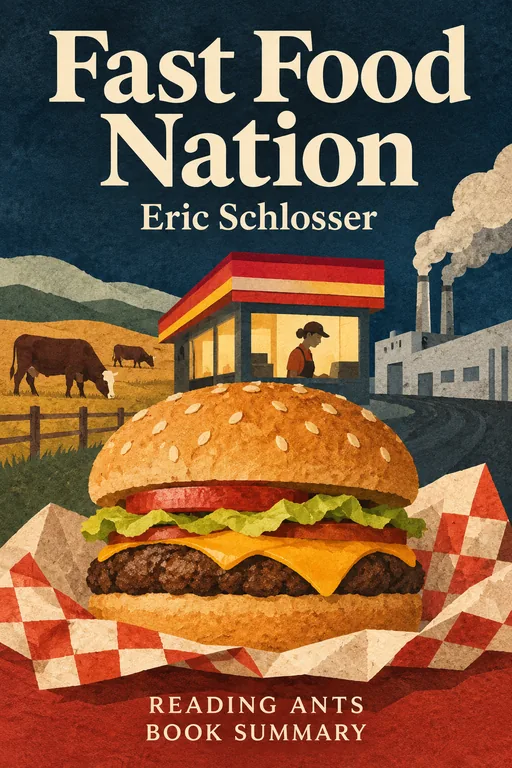
Fast Food Nation
Journalist Eric Schlosser traces how the fast food industry transformed American food, work, farming and culture, and reveals the hidden costs of cheap burgers for workers, cattle ranchers, consumers and communities.
Overview
Fast Food Nation: The Dark Side of the All-American Meal was published in 2001 by Eric Schlosser, who spent years reporting on the industry after first writing about it for Rolling Stone magazine. He visited fast-food restaurants, meatpacking plants, ranches, potato farms and flavor factories, and interviewed owners, workers and officials. The book opens with the history of the industry, starting in Southern California, and then examines its effects. It became a bestseller and, like other works of investigative journalism, started a national discussion. A film loosely based on it appeared in 2006.
Full Summary
1. The birth of the fast food empire
The idea: Schlosser begins in Southern California in the years after the Second World War, where a culture of cars and drive-ins gave rise to a new way of selling food. The McDonald brothers created an assembly-line system for hamburgers, which a salesman named Ray Kroc then turned into a national chain. Other chains followed. The approach emphasized speed, uniformity and low cost, and relied on franchising, in which local owners pay to use a brand. The result, he says, was a restaurant industry built on standardization.
In real life: A burger tastes the same in every town because the whole process is controlled from a central plan.
2. Marketing to children and the school market
The idea: The author describes how the industry targets children, with toys, playgrounds and advertising, in order to build loyalty at a young age. He also shows how fast-food and soft drink companies have entered schools, with contracts to sell food and drinks in cafeterias, and with advertising on school property. He argues that this shapes children’s tastes and habits, and contributes to rising obesity, while schools accept the money because of budget needs.
In real life: A toy in a meal may make a child ask for a certain restaurant.
3. Low-wage work and the franchise system
The idea: Schlosser examines the workforce of fast-food restaurants, mostly teenagers and low-paid workers, who are trained to do simple tasks in a standardized way and are often paid minimum wage with few benefits. Turnover is high. He says that the industry has fought against raising the minimum wage and against unions. He also notes safety risks for young workers.
In real life: A job that is easy to learn can also be easy to replace, which keeps pay low.
4. Flavor and the food factory
The idea: He visits a company that makes flavors, in New Jersey, and describes how chemists create the tastes and smells that make processed foods appealing. The taste of French fries, for instance, now depends on flavorings added after the cooking oil was changed. He argues that much of what we think of as taste is engineered, and that fresh foods are replaced by processed ones that need artificial flavoring.
In real life: A strawberry-flavored product may contain no strawberry at all.
5. Meatpacking, safety and the cost to workers
The idea: One of the most disturbing sections describes the modern meatpacking industry, where, instead of skilled butchers, workers on fast production lines with sharp knives face injury rates that he describes as the highest of any American industry. Many are immigrants who may not know their rights. Schlosser says that the industry moved to rural areas to avoid unions, cut wages and speed up the lines. He also describes the effects on small towns and the cattle ranchers.
In real life: When a line moves faster, the risk of accidents rises.
6. Safety of the food and the way forward
The idea: The final chapters discuss food safety. Because meat from many animals is ground together in huge batches, a single contaminated animal can infect a large amount of product, and outbreaks of illness from bacteria such as E. coli have occurred, with children among the victims. He criticizes the weakness of regulation and the influence of industry on government. A later chapter shows how American fast food spread around the world after the Cold War, along with rising obesity. He closes by arguing that workers, activists and elected officials can rein in the industry’s power, and that reform is possible when people press for it.
In real life: Cooking meat thoroughly lowers the risk, and so does buying from suppliers with strong safety records.
Why It Matters
Fast Food Nation was an influential work that made many readers aware of how their food is produced, and of the people behind it. It prompted discussion of food safety, workers’ rights, nutrition and corporate power, and fed into later debates and some policy changes. Its reporting on slaughterhouses and flavor makers brought the hidden costs of cheap food to a wide audience. Along with the work of other writers, it helped to launch a broader movement on food issues. The book also remains a model of investigative reporting, showing how a single product can reveal larger economic and social patterns.
Key Takeaways
- Convenience has hidden costs. Cheap food involves costs for workers, health and communities.
- Marketing shapes children’s habits. The industry targets the young.
- Work is low-paid and sometimes dangerous. Fast food and meatpacking depend on a vulnerable workforce.
- Taste can be engineered. Flavor chemistry underlies many processed foods.
- Consumers have power. Choices and pressure can drive change.
What We Can Learn
You can use the book to think about where your food comes from, and who produced it. Try cooking more at home, and learn about the sources of what you eat. Be aware of how advertising affects your choices and those of younger children. Support fair treatment of workers, and companies with good safety records. Keep in mind that many people rely on fast food because of cost, time or lack of alternatives, so avoid blaming them. Consider reading more about food policy and what could be done at a community level.
Criticism and Counterpoints
Some critics say that Schlosser paints an overly negative picture of the industry, and that fast food provides convenient and affordable meals to many people, as well as jobs for young workers. Others point out that some of his statistics are dated, and that the industry has since changed, with menu changes and more attention to safety. Free-market commentators argue that consumers choose fast food freely. Some reviewers feel that the book mixes cultural criticism with reporting, and sometimes generalizes from a few examples. Supporters say that the main findings were well documented.
Who Should Read It
This book is for readers interested in food, business and social issues, and for those who want to know what is behind the products they buy. It is engaging and detailed, but includes unpleasant descriptions of slaughterhouses and of illness. Those who are squeamish may want to skip some parts.
Want the whole book?
A summary is a taste, not the meal. Here is where to find the full book.
You reached the end 🎉
Nicely done. Mark this one as read, and we will suggest what to read next.
Read this next
In Defense of Food
Michael Pollan
Michael Pollan argues that modern nutrition science and the food industry have confused us, and that we eat better by choosing real food, not too much of it, mostly plants, in the traditional ways of eating.
🍎 Health
Ultra-Processed People
Chris van Tulleken
Doctor and broadcaster Chris van Tulleken argues that ultra-processed foods are industrial products designed to be eaten in large amounts, that they may harm our health, and that governments should treat them as seriously as other risks.
🍎 Health
Nickel and Dimed
Barbara Ehrenreich
Journalist Barbara Ehrenreich spent months working low-wage jobs in three American cities, to see whether a person could live on such pay, and found that even hard, full-time work often did not cover basic needs.
⚖️ Politics & Society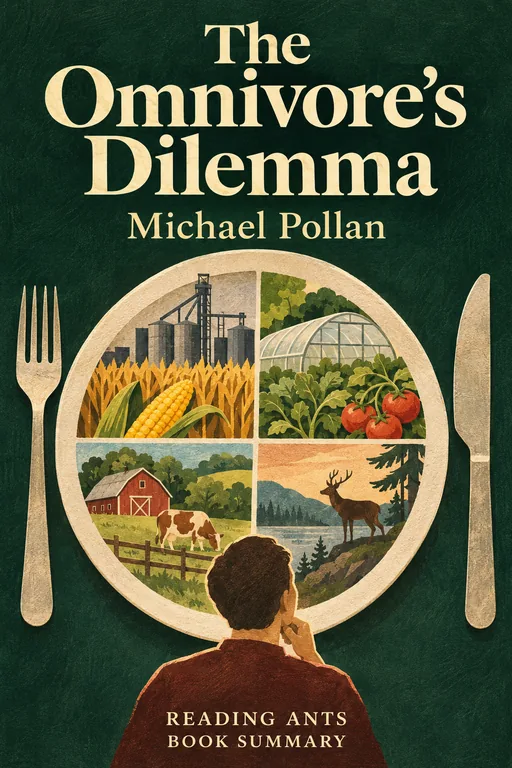
The Omnivore's Dilemma
Michael Pollan
By following four meals from the soil to the plate, Michael Pollan shows how modern food is produced, and asks what we should eat when we can choose almost anything.
⚖️ Politics & Society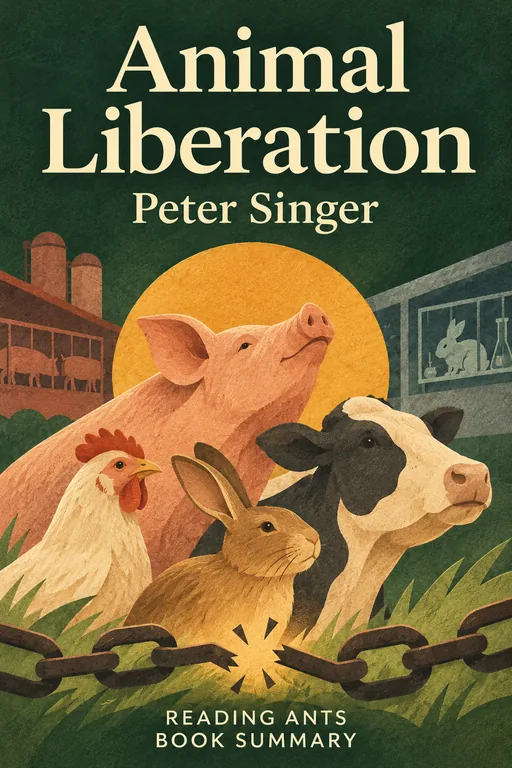
Animal Liberation
Peter Singer
Philosopher Peter Singer argues that the suffering of animals matters morally just as the suffering of humans does, and that the way we treat animals in farms and laboratories is a form of unjustified prejudice that he calls speciesism.
🕊️ Philosophy & Religion
The Prince
Niccolo Machiavelli
A Renaissance diplomat advises rulers to judge their actions by results rather than morality, arguing that a successful leader must sometimes be cunning and ruthless to win and keep power.
⚖️ Politics & SocietyWant something different?
Pick another topic and we will show you three books to start with.