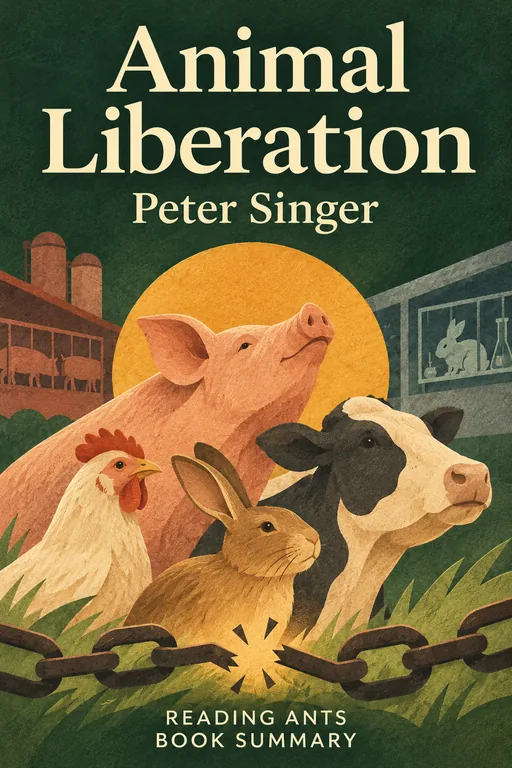
Animal Liberation
Philosopher Peter Singer argues that the suffering of animals matters morally just as the suffering of humans does, and that the way we treat animals in farms and laboratories is a form of unjustified prejudice that he calls speciesism.
Overview
Animal Liberation was published in 1975 by Peter Singer, an Australian philosopher who later taught at Princeton University. It is often seen as the starting point of the modern animal rights movement, even though Singer bases his argument on utilitarian ethics and speaks of the equal consideration of interests, not of rights. The book combines philosophical reasoning with detailed descriptions of how animals are treated in industrial farms and in research. It has been revised several times. Singer wrote it in a calm and logical tone, and appeals to the reader’s sense of fairness.
Full Summary
1. All animals are equal?
The idea: Singer begins with the idea of equality. He says that the basic principle of equality is not that all beings are identical, but that their interests should be given equal consideration. Just as we reject discrimination based on race or sex, we should reject discrimination based on species. The key question, citing the philosopher Jeremy Bentham, is not whether animals can reason or talk, but whether they can suffer. If they can, then their suffering must be taken seriously.
In real life: If we would not treat a dog’s pain as unimportant, we should ask why we treat the pain of a pig as if it did not count.
2. Speciesism
The idea: Singer takes up and popularizes the term “speciesism,” which the psychologist Richard Ryder coined in 1970, for a bias in favor of the interests of one’s own species, and against the interests of members of other species. He compares it to racism and sexism, in that all of them privilege one group because of a feature, such as skin color, sex or species, that is not morally relevant to whether it can suffer. He does not say that humans and animals should be treated identically, since their needs differ, but that similar suffering deserves similar concern.
In real life: A rule that values a being only for belonging to our group is the sort of prejudice that we reject in other contexts.
3. Tools for research
The idea: The chapter on animal experiments describes the use of animals in laboratories, for example in the testing of products and in scientific research. Singer argues that many experiments cause severe pain for little or uncertain benefit, and that the justification often depends on speciesism. He does not say that all research must stop, but asks whether we would be willing to perform the same experiment on a human being with similar mental capacities. If not, he says, we need a good reason to do it to an animal.
In real life: The question “Would this be acceptable if done to a person who could feel the same pain?” helps to test an assumption.
4. Down on the factory farm
The idea: Singer describes the methods of intensive farming, which in the 1970s and since have kept chickens, pigs and calves in confined spaces and in conditions that frustrate their natural behavior, in order to produce meat and eggs cheaply. He argues that the pain caused to billions of animals is out of proportion to the pleasure we get from the products, especially since we can eat other foods. The scale of the suffering, he says, makes this one of the most serious moral problems.
In real life: A cheap meal may have a hidden cost that is not shown on the price tag.
5. Becoming a vegetarian
The idea: The most practical part of the book urges readers to stop eating animals that have been raised in this way, and gives reasons that go beyond animal suffering, including the environmental impact and the inefficient use of food crops. He provides advice on a plant-based diet, and says that changing habits can be done step by step. Singer’s own argument is that we should stop supporting factory farming through what we buy, and he gives practical advice on how to make the change.
In real life: Replacing a few meals a week with plant-based food is a way to start.
6. Our changing attitudes
The idea: A chapter on the history of attitudes toward animals, titled “Man’s Dominion,” traces the roots of speciesism, with attention to religious and philosophical ideas about human superiority. A final chapter, on speciesism today, looks at the defenses and objections that people raise against animal liberation, and at the progress made so far. Singer compares the cause to earlier movements against slavery and the subordination of women, which were once accepted and later seen as wrong. He suggests that the treatment of animals may be another case in which humans will eventually extend their moral concern.
In real life: Ideas that once seemed radical, such as the end of child labor, are now widely accepted.
Why It Matters
Animal Liberation is regarded as one of the most influential works of applied ethics. It inspired the modern animal protection movement, and led many people to become vegetarian or vegan. It also stimulated academic debate about the moral status of animals, and the book is still used in courses. It also helped to bring factory farming and animal experiments into public discussion. Singer’s approach, based on reason and not on sentiment, offered a framework that people with different views could discuss. Singer, who also wrote on global poverty and effective giving, became widely known internationally after the book appeared.
Key Takeaways
- Suffering matters morally. The capacity to feel pain gives a being claims to consideration.
- Species alone is not a reason to disregard interests. Speciesism resembles other prejudices.
- Factory farming causes vast suffering. Its scale is a serious ethical issue.
- Alternatives exist. We can eat and live in ways that cause less harm.
- Moral progress is possible. Concern can expand to new groups.
What We Can Learn
You can use the book to reflect on your own choices, such as what you eat and what products you buy. Learn about how food is produced, and consider small steps, such as eating less meat or choosing products from farms with higher welfare standards. Think about how you would defend your treatment of animals to someone who disagreed. At the same time, respect people with different views, and recognize that diet is shaped by culture, health and budgets. If you wish to change your diet, ask a doctor or dietitian for advice.
Criticism and Counterpoints
Some philosophers argue that animals do not have the same moral status as humans because they lack rationality, language or moral agency, and that Singer’s utilitarian approach is too simple. Others say that his focus on pain and pleasure ignores rights and the intrinsic value of life. Critics who defend traditional farming say that not all animal agriculture is cruel. Some in the animal rights movement criticize him because his approach allows, in theory, for the use of animals if the benefits outweigh the suffering. Singer’s views on other topics, such as euthanasia, have also been controversial.
Who Should Read It
This book is for readers who are interested in ethics, food and animals, and who are willing to consider challenging arguments. It is clearly written, though some passages describing animal suffering are distressing. Those who wish to read the other side may want to supplement it with works that defend the use of animals.
Want the whole book?
A summary is a taste, not the meal. Here is where to find the full book.
You reached the end 🎉
Nicely done. Mark this one as read, and we will suggest what to read next.
Read this next
In Defense of Food
Michael Pollan
Michael Pollan argues that modern nutrition science and the food industry have confused us, and that we eat better by choosing real food, not too much of it, mostly plants, in the traditional ways of eating.
🍎 Health
The Omnivore's Dilemma
Michael Pollan
By following four meals from the soil to the plate, Michael Pollan shows how modern food is produced, and asks what we should eat when we can choose almost anything.
⚖️ Politics & Society
Silent Spring
Rachel Carson
The careless spraying of powerful chemical pesticides like DDT was poisoning birds, fish, soil, water and people, and humans must learn to live with nature instead of waging war on it.
🔬 Science
A Theory of Justice
John Rawls
John Rawls argues that the fairest rules for a society are those we would choose without knowing our own place in it: equal basic liberties, and inequalities only when they help the worst off.
🕊️ Philosophy & Religion
The Art of War
Sun Tzu
The greatest victory is the one won without fighting, achieved through careful planning, knowing both yourself and your opponent, and using deception, flexibility and timing.
🕊️ Philosophy & Religion
Meditations
Marcus Aurelius
The private notebook of a Roman emperor, reminding himself daily to accept what he cannot control, to act with justice and kindness, and to remember that life is short.
🕊️ Philosophy & ReligionWant something different?
Pick another topic and we will show you three books to start with.