 Reading Ants
The New Jim Crow
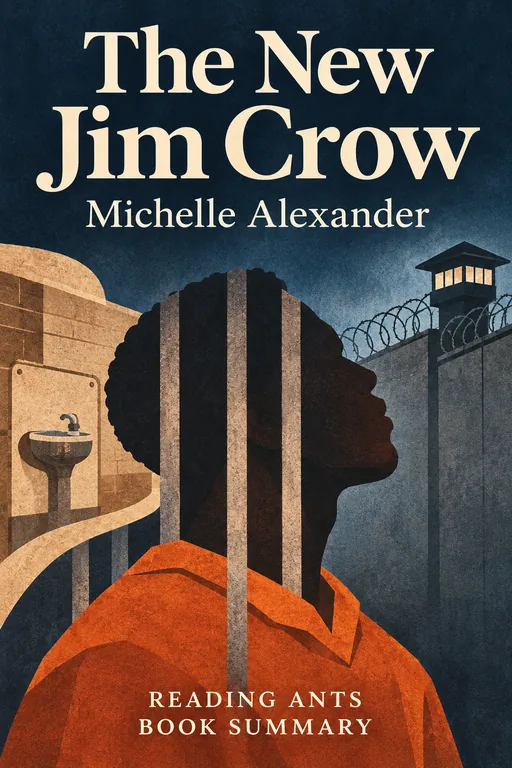
Civil rights lawyer Michelle Alexander argues that the American criminal justice system, especially the War on Drugs, has functioned as a system of racial control that labels many Black men as criminals and strips them of rights, much as Jim Crow laws once did.
Overview
The New Jim Crow: Mass Incarceration in the Age of Colorblindness was published in 2010 by Michelle Alexander, a civil rights lawyer and legal scholar. Alexander says she was once suspicious of the claim that mass incarceration was a new Jim Crow, but changed her mind while working on racial justice advocacy at the ACLU. The book traces the history of racial control in the United States, from slavery and Jim Crow to the present, and argues that mass incarceration is the latest form. It became a bestseller and was widely discussed in the debate about criminal justice reform.
Full Summary
1. From slavery to Jim Crow to a new system
The idea: Alexander begins with a history. After slavery was abolished, new systems arose that kept Black Americans in a lower position, such as the Jim Crow laws of the South, and when the civil rights movement dismantled those laws, a new system arose. She says that racial caste systems adapt. When a form of control becomes illegitimate, society finds another, and she sees mass incarceration as the successor, using the language of crime and not race.
In real life: When one unfair rule is removed, a similar effect can sometimes be achieved by a different rule.
2. The War on Drugs
The idea: The author describes how the War on Drugs, escalated in the 1980s under President Reagan, led to a huge rise in arrests and prison populations. Though studies show that people of different races use illegal drugs at similar rates, enforcement was concentrated in poor communities of color. Police were given financial incentives and wide powers, such as stop-and-search, and courts upheld them. She argues that the war was driven partly by politics that played on racial fears.
In real life: If the same behavior is punished in some neighborhoods and ignored in others, the effect is unequal.
3. How the system works
The idea: Alexander explains the steps of the system: stops and searches carried out with very little oversight; prosecutorial discretion, with harsh mandatory sentences that push people to plead guilty; and limited access to good legal counsel. Most cases end in plea bargains, and trials are rare. She notes that, under the law, race is not mentioned, but discretion at each stage allows bias to operate, and the courts make it hard to prove discrimination.
In real life: A rule that gives individual officials wide choice may allow unfairness to creep in without anyone saying so.
4. The cage and the lasting label
The idea: The consequences, she says, last long after a sentence is served. Having a criminal record can legally exclude a person from voting, jury service, public housing, many jobs and some benefits, as well as from student aid. This creates a permanent underclass of people who are legally discriminated against, a status that she compares to the second-class citizenship under Jim Crow. The “box” on job applications is one example of this.
In real life: A person who has served their time but cannot find work or housing may find it hard to start again.
5. Colorblindness and denial
The idea: Alexander argues that the ideal of colorblindness, the belief that we should not notice race, makes it hard to see the problem, as people say that the system is neutral. Because the targets are described as criminals, many accept the situation, and public sympathy is limited. She also says that the success of a few Black people in public life has been used as evidence that racism is over, and that this diverts attention.
In real life: Saying “I don’t see color” may stop someone from noticing how different groups are treated.
6. A call for a movement
The idea: In the final chapter, Alexander calls for a social movement to end mass incarceration, not just a series of legal reforms. She argues that litigation and small changes will not be enough as long as the underlying racial caste system remains. She urges that all people, regardless of race, be seen as deserving of care and concern, and that the public be educated. The aim is to create a society in which people are not written off.
In real life: Real change often comes from many people deciding together that something is wrong.
Why It Matters
The New Jim Crow has been one of the most influential books on race and criminal justice in the United States. It spent more than a year on the New York Times bestseller list, and was widely used in classes, churches and community groups. It helped to put mass incarceration at the center of the discussion of racial justice, and influenced activists and the wider debate about criminal justice reform. Its phrase has become a common way to describe the issue. The book was the subject of strong praise and criticism, and it continues to shape the way many people think about the justice system.
Key Takeaways
- Racial control can change form. After Jim Crow, mass incarceration became a new mechanism.
- Enforcement is unequal. Similar behavior is treated differently in different communities.
- A record can limit life long after the sentence. Legal exclusions create a lasting underclass.
- Neutral language can hide bias. Colorblindness can make problems hard to see.
- Change needs a movement. Reform requires public will.
What We Can Learn
You can start by learning about how the justice system works in your area, and who is affected. Notice the difference between what the law says and how it is applied. Support fair treatment, second chances and programs that help people who have left prison to find work. Listen to people who have been affected. Compare different arguments, including those of people who disagree with Alexander. And think about how language can shape what we see and what we ignore.
Criticism and Counterpoints
Some scholars argue that Alexander overstates the role of the War on Drugs, since most people in state prisons were convicted of violent crimes and not drug offenses, and that the rise in incarceration also reflects other factors, such as rising crime rates from the 1960s to the 1990s, which affected Black communities. Critics also dispute the comparison with Jim Crow, saying that it overlooks differences. Others say that the book underplays the demand of many Black residents for stronger policing. Supporters reply that the main point about racial disparity and collateral consequences stands. Data have also changed since the book was written.
Who Should Read It
This book is for readers interested in law, race and social justice, including students, community leaders and citizens. It is clearly argued but includes legal detail. Those who want a balanced view should read other works on crime and policing alongside it.
Want the whole book?
A summary is a taste, not the meal. Here is where to find the full book.
You reached the end 🎉
Nicely done. Mark this one as read, and we will suggest what to read next.
Read this next
The Warmth of Other Suns
Isabel Wilkerson
Isabel Wilkerson tells the story of the Great Migration, in which about six million Black Americans left the South for cities in the North and West, through the lives of three people who made the journey.
🏛️ History
Caste: The Origins of Our Discontents
Isabel Wilkerson
Isabel Wilkerson argues that the United States has long been organized by an unspoken caste system, in which a person's place is fixed at birth by race, and she compares it with the caste systems of India and Nazi Germany.
🏛️ History
How to Be an Antiracist
Ibram X. Kendi
Historian Ibram X. Kendi argues that it is not enough to be "not racist," and that people must actively oppose racial inequality in policies and ideas, mixing his argument with the story of how he changed his own views.
⚖️ Politics & Society
Evicted
Matthew Desmond
Sociologist Matthew Desmond lived among poor tenants and landlords in Milwaukee and shows that eviction is not just a result of poverty but a major cause of it, trapping families in a cycle of lost homes, jobs and hope.
⚖️ Politics & Society
The Souls of Black Folk
W. E. B. Du Bois
In fourteen eloquent essays, W. E. B. Du Bois examines the lives, struggles and hopes of Black Americans at the start of the twentieth century, and argues that the great problem of the age is the color line.
⚖️ Politics & Society
The Prince
Niccolo Machiavelli
A Renaissance diplomat advises rulers to judge their actions by results rather than morality, arguing that a successful leader must sometimes be cunning and ruthless to win and keep power.
⚖️ Politics & SocietyWant something different?
Pick another topic and we will show you three books to start with.