 Reading Ants
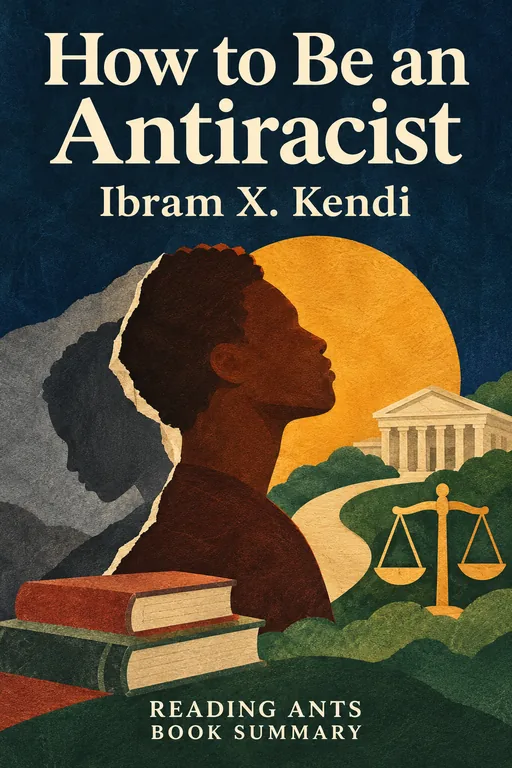
How to Be an Antiracist
Historian Ibram X. Kendi argues that it is not enough to be "not racist," and that people must actively oppose racial inequality in policies and ideas, mixing his argument with the story of how he changed his own views.
Overview
How to Be an Antiracist was published in 2019 by Ibram X. Kendi, a historian and professor who won the National Book Award for an earlier history of racist ideas. In this book, he combines memoir with a framework for thinking about race. Each chapter takes up a concept, such as power, biology, ethnicity or culture, and shows how it relates to racism, using episodes from his own life. He describes how he himself held some racist beliefs, including about other Black people and about himself, and how he came to see them differently.
Full Summary
1. Definitions: racist and antiracist
The idea: Kendi starts by defining terms. A racist policy is any measure that produces or sustains racial inequity, and a racist idea is any idea suggesting that one racial group is inferior or superior to another. Antiracist policies and ideas do the opposite. He says that there is no neutral position: a person is either supporting equity or supporting inequity. He rejects the label “not racist” as a way of avoiding responsibility, and says that “racist” describes what someone is doing at a given moment, not a fixed identity.
In real life: A person who sees someone being treated unfairly and says nothing is in effect supporting it.
2. Dueling ideas: segregationist, assimilationist, antiracist
The idea: The author describes three types of thinking about race. Segregationists believe that some groups are inferior and should be kept apart. Assimilationists believe that a group has cultural or behavioral flaws that need to be fixed, so they urge that group to change in order to be accepted. Antiracists believe that groups are equal, and that the problem lies in policies, not in people. Kendi says that assimilationist ideas can seem friendly, but are racist, since they put the blame on the group.
In real life: Saying that a group would succeed if only they behaved differently locates the problem in the group, not in the conditions.
3. Power, biology and ethnicity
The idea: Several chapters look at how racism links with other systems. Kendi discusses power, saying that racist policies are created by powerful people to benefit their interests, and that racist ideas follow to justify them. He rejects the notion of biological races with different abilities, and notes that ideas about ethnicity and body can create hierarchies within groups. He also describes how, as a teenager, he gave a speech blaming Black youth for their problems, before he began to question that idea.
In real life: A claim that a group is naturally less gifted can excuse a society for not providing equal resources.
4. Culture, behavior and color
The idea: Kendi addresses the idea that some cultures are better than others, and says that cultural differences exist but cannot be ranked. He argues that there are no racial behaviors, and that talk of “Black behavior” is itself a racist idea. He also discusses colorism, the favoring of lighter skin, which he links to his own experience in college. He discusses how Black people can hold racist ideas about other Black people, as he once did, and calls this internalized racism the real “Black on Black crime.”
In real life: Judging a whole group by the worst examples can hide how common good behavior is.
5. Intersections: class, gender, sexuality, space
The idea: Kendi stresses that racism overlaps with other forms of bias, such as those based on class, gender and sexuality, and uses the term intersectionality. He describes how a Black woman, a Black gay man or a poor person of color may face several layers of unfairness, and that an antiracist must also oppose these. He also considers racialized space, such as Black neighborhoods and schools, and how unequal funding and resources rank them.
In real life: A person may face different obstacles at once, which make the problems larger than either alone.
6. Failure, success and survival
The idea: In later chapters, Kendi describes his experiences of failing and changing, including his struggle with cancer, which made him think about survival and hope. He says that the path to being antiracist is a process of learning and unlearning. The final chapters call for people to act, by supporting equitable policies, by confronting racist ideas and by watching how racism overlaps with other forms of bigotry. He ends on a note of hope, comparing racism to a cancer that a society can survive if it is treated seriously.
In real life: Admitting a mistake and changing is part of growth.
Why It Matters
How to Be an Antiracist became a number-one bestseller, especially during the national discussion of race in 2020, and was widely read and discussed. Its definitions, which focus on policy and outcomes more than on feelings and intent, gave a new vocabulary to the debate. The book sparked strong reactions, and was praised for its candor and for the idea of ongoing self-examination, and criticized for its approach. Whatever one thinks of its arguments, it has become a significant part of the conversation about race in the United States. A version for young adults, co-written with Nic Stone, followed.
Key Takeaways
- There is no neutral stance. Inaction can support inequality.
- Focus on policies and outcomes. Ask whether a rule produces equal results.
- Do not blame groups. Differences usually arise from conditions.
- Racism intersects with other biases. Several forms of unfairness can combine.
- Change is possible. People can learn and act differently.
What We Can Learn
You can use the book to ask questions about rules and outcomes in your own school or workplace: are results equal, and if not, why? Notice when you or others explain differences by blaming a group, and consider alternative explanations. Be willing to admit mistaken ideas, as the author does. Listen to people who experience unfairness. And think about practical steps you can take, such as supporting fair policies and speaking up. As the book is controversial, read other views and discuss with others in a respectful way.
Criticism and Counterpoints
Critics, including some who are sympathetic to his goals, raise objections. Some say that the definition of racism is too broad, since it makes any policy with unequal outcomes racist regardless of intent or cause, and that it overlooks other explanations for disparities. Others argue that the binary of racist and antiracist is too rigid, and leaves little room for nuance or for disagreement about solutions. Some scholars point to a lack of detail on policy. Others, including some who agree with his goals, find that the style mixes memoir and argument unevenly. Supporters say that the book offers a clear and practical framework.
Who Should Read It
This book is for readers who want to think about race, justice and personal responsibility, and who are open to challenge. It is accessible and has a personal tone. Those who wish to evaluate its claims should also read critiques and other perspectives.
Want the whole book?
A summary is a taste, not the meal. Here is where to find the full book.
You reached the end 🎉
Nicely done. Mark this one as read, and we will suggest what to read next.
Read this next
The New Jim Crow
Michelle Alexander
Civil rights lawyer Michelle Alexander argues that the American criminal justice system, especially the War on Drugs, has functioned as a system of racial control that labels many Black men as criminals and strips them of rights, much as Jim Crow laws once did.
⚖️ Politics & Society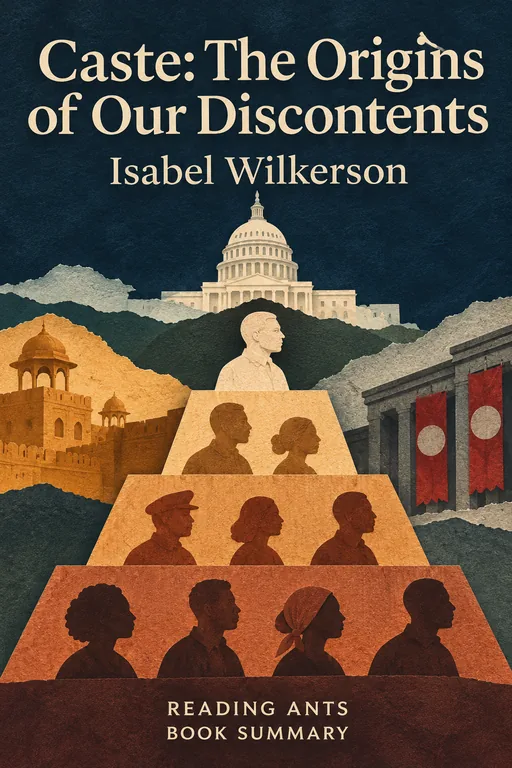
Caste: The Origins of Our Discontents
Isabel Wilkerson
Isabel Wilkerson argues that the United States has long been organized by an unspoken caste system, in which a person's place is fixed at birth by race, and she compares it with the caste systems of India and Nazi Germany.
🏛️ History
The Warmth of Other Suns
Isabel Wilkerson
Isabel Wilkerson tells the story of the Great Migration, in which about six million Black Americans left the South for cities in the North and West, through the lives of three people who made the journey.
🏛️ History
The Souls of Black Folk
W. E. B. Du Bois
In fourteen eloquent essays, W. E. B. Du Bois examines the lives, struggles and hopes of Black Americans at the start of the twentieth century, and argues that the great problem of the age is the color line.
⚖️ Politics & Society
Invisible Women
Caroline Criado Perez
Caroline Criado Perez shows that because most data, designs and decisions treat men as the default human being, the world is often built in ways that ignore or even harm women, and she calls for closing this "gender data gap."
⚖️ Politics & Society
The Prince
Niccolo Machiavelli
A Renaissance diplomat advises rulers to judge their actions by results rather than morality, arguing that a successful leader must sometimes be cunning and ruthless to win and keep power.
⚖️ Politics & SocietyWant something different?
Pick another topic and we will show you three books to start with.