 Reading Ants
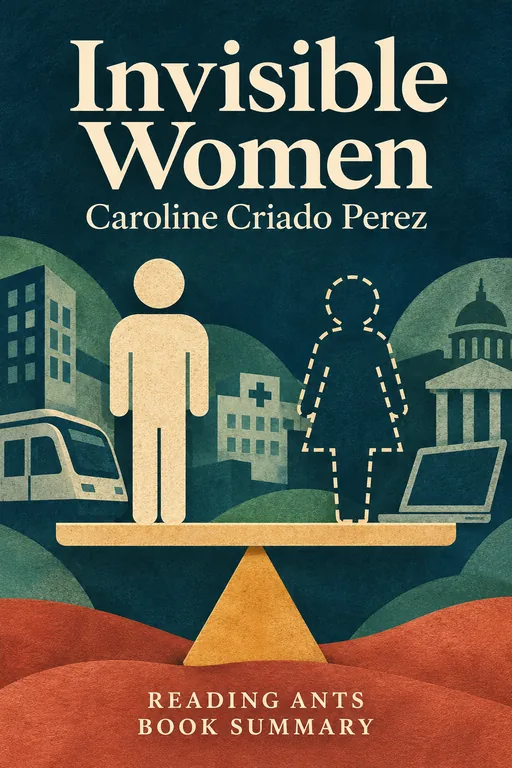
Invisible Women
Caroline Criado Perez shows that because most data, designs and decisions treat men as the default human being, the world is often built in ways that ignore or even harm women, and she calls for closing this "gender data gap."
Overview
Invisible Women: Data Bias in a World Designed for Men was published in 2019 by Caroline Criado Perez, a British writer and campaigner. She had earlier led a successful campaign to put a woman’s face on a Bank of England banknote. In this book, she gathers examples from medicine, transport, technology, workplaces and public policy to argue that the lack of data about women, and the habit of treating men as the norm, leads to bad outcomes. She draws on studies and reports from many countries, and organizes the material in sections on daily life, the workplace, design, the doctor’s office, public life and what happens when things go wrong.
Full Summary
1. The default human
The idea: The author begins by arguing that, for most of history, the male has been treated as the standard for human beings, and that this assumption is often invisible. Data about people is often collected on men, and then applied to everyone. When women are left out, the result is not neutrality but bias. She calls this the gender data gap, and says that it exists partly because those who design and decide are mostly men, and partly because of habit.
In real life: If every sample shirt in a store is made in a men’s size, many people will find that nothing fits.
2. Cities and transport
The idea: Criado Perez shows how public planning is often based on the typical male commuter. For example, transport systems are designed for one trip from home to work, though women often make multiple, shorter trips that include childcare and shopping. In one Swedish town, Karlskoga, officials who reviewed their snow clearing found that clearing main roads before sidewalks and bike paths suited typical male travel patterns; they reversed the order, and the author reports fewer injuries and lower healthcare costs.
In real life: A bus route that only runs at rush hour will not suit someone who works part-time and takes children to school.
3. Work, care and unpaid labor
The idea: The book highlights the huge amount of unpaid work, such as caring for children and the elderly, and housework, which women do around the world, and which is rarely counted in economic statistics. She argues that this hidden work subsidizes the economy, and affects women’s pay and pensions. Workplaces designed around the male career path, with long, continuous hours, may disadvantage those with caring duties, and the effects accumulate over time.
In real life: A person who takes time off to care for a relative may find that it affects promotion and retirement income.
4. Designing for men’s bodies
The idea: Many products and workplaces are designed for the average male body. Criado Perez cites examples such as office temperatures set using a formula based on a male metabolic rate, smartphones that are too large for many women’s hands, protective gear for workers, such as police officers, that does not fit women, and car safety tests that use dummies modeled on male bodies, with “female” dummies often just scaled-down versions of the male one. As a result, women may be more likely to be injured in crashes.
In real life: A tool that does not fit your hand is harder and more dangerous to use.
5. Medicine and the gender gap
The idea: In health care, many clinical trials of drugs have historically used mostly male participants, and the results have been applied to women, though bodies may react differently. Heart attack symptoms in women may be different from those commonly described, which can lead to delayed or missed diagnosis. She says that many medical textbooks and research ignore sex differences, and that this puts women at risk, as dosages and warnings may not suit them.
In real life: A medicine tested on only one group may work differently on another.
6. Public life, disasters and the way forward
The idea: The final parts of the book look at public life, including how resources and political decisions are shaped, and at what happens when things go wrong, in disasters and their aftermath. Criado Perez argues that women’s needs are often overlooked in emergency planning and recovery, and she includes technology such as voice recognition systems that work better for male voices among the places where the data gap shows up. She urges that data should be collected by sex, that more women be involved in design and decision-making, and that policies be tested for gender impact.
In real life: Asking different groups what they need before building a public space can prevent mistakes.
Why It Matters
Invisible Women won the Royal Society Insight Investment Science Book Prize and the Financial Times and McKinsey Business Book of the Year award in 2019, and became a bestseller. It popularized the idea of the gender data gap, and encouraged governments, companies and researchers to think about including women in their data and designs. The book brought together many scattered findings into a clear argument, and supplied a lot of concrete examples, which made the point vivid. It has been used in discussions about policy, engineering, medicine and technology, including artificial intelligence. It also invites readers to ask who is missing from the data in other areas, such as race and disability.
Key Takeaways
- Defaults matter. Treating men as the norm leaves women out.
- Data gaps lead to harm. Missing information produces unsafe or unfair outcomes.
- Unpaid work is real work. It shapes economies and lives.
- Design should include everyone. Test products and policies on diverse users.
- Collect and use sex-disaggregated data. Evidence is the basis for change.
What We Can Learn
Think about the places and products you use, and ask who they were designed for. When you study or work on a project, see whether the people who are affected are included in the data and the decisions. If you have a chance to take part in design or policy, speak up for those who are not in the room. Support efforts to collect better information. Remember that the same questions apply to other groups who are often overlooked. A habit of asking “who is missing?” is a valuable one.
Criticism and Counterpoints
Some reviewers say that the book relies on selected examples, and that some statistics are presented without full context or are drawn from older or limited studies. Others say that the central idea is not new, since feminist scholars have long built on earlier works such as Simone de Beauvoir’s The Second Sex, and some readers have questioned individual claims, for example those about crash test dummies. Some argue that the book overstates the role of deliberate bias, and underestimates the complexity of the reasons for data gaps. Others find that it focuses on Western, and mostly on British and American, contexts. Even so, many experts agree that the central point stands.
Who Should Read It
This book is for readers who are interested in gender, data, design and public policy. It is full of examples and easy to follow, though it can be dense with statistics. It is useful for students, professionals and anyone who makes decisions that affect other people.
Want the whole book?
A summary is a taste, not the meal. Here is where to find the full book.
You reached the end 🎉
Nicely done. Mark this one as read, and we will suggest what to read next.
Read this next

The Feminine Mystique
Betty Friedan
Betty Friedan reveals that many educated American housewives of the 1950s felt unhappy and unfulfilled despite having the life they were told to want, and argues that women's potential should not be limited to home and family.
⚖️ Politics & Society
Lean In
Sheryl Sandberg
Sheryl Sandberg, a top executive in technology, argues that women face both outside barriers and inner doubts that hold back their careers, and she urges them to pursue ambition boldly while calling on society to make work fairer.
💼 Business
A Vindication of the Rights of Woman
Mary Wollstonecraft
Mary Wollstonecraft argues that women are not naturally inferior to men, but appear so because they are denied a proper education, and that society would benefit if women were given the chance to develop their reason and independence.
⚖️ Politics & Society
Weapons of Math Destruction
Cathy O'Neil
Mathematician and former hedge-fund analyst Cathy O'Neil shows how secret, unaccountable algorithms used in schools, workplaces, policing, credit and insurance can quietly reinforce unfairness while looking objective, and she calls them "weapons of math destruction."
💡 Technology
The Signal and the Noise
Nate Silver
Statistician and election forecaster Nate Silver explains why most predictions fail, and shows that better forecasting comes from thinking in probabilities, updating with new evidence and being humble about uncertainty.
🔬 Science
The Prince
Niccolo Machiavelli
A Renaissance diplomat advises rulers to judge their actions by results rather than morality, arguing that a successful leader must sometimes be cunning and ruthless to win and keep power.
⚖️ Politics & SocietyWant something different?
Pick another topic and we will show you three books to start with.