 Reading Ants
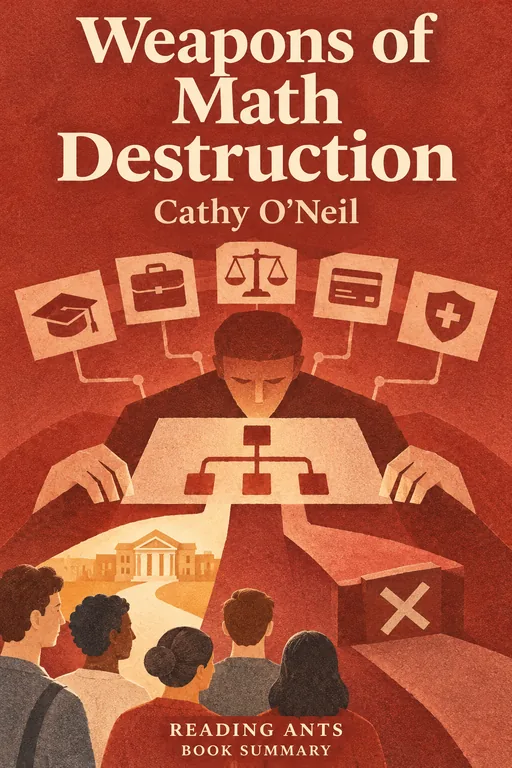
Mathematician and former hedge-fund analyst Cathy O'Neil shows how secret, unaccountable algorithms used in schools, workplaces, policing, credit and insurance can quietly reinforce unfairness while looking objective, and she calls them "weapons of math destruction."
Overview
Weapons of Math Destruction: How Big Data Increases Inequality and Threatens Democracy was published in 2016 by Cathy O’Neil, who has a doctorate in mathematics, worked as a quantitative analyst at a hedge fund during the financial crisis, and later became a data scientist and writer. She says that she left finance because she saw how mathematical models could do harm while carrying an aura of scientific authority. Each chapter looks at a different area of life in which scoring systems sort people, such as education, hiring, justice and lending. The book is angry but clear, and written for general readers.
Full Summary
1. What makes a model a weapon
The idea: O’Neil starts with her own history in finance, where she saw trust in mathematical models contribute to the 2008 crisis. She then defines the problem. A harmful model, she says, has three features: it is opaque, so that the people it scores cannot see or question how it works; it operates at scale, affecting many people; and it does damage, often by punishing the poor and rewarding the already advantaged. A good model, by contrast, is transparent, fair and open to correction.
In real life: If a score decides whether you get a loan and nobody can tell you how it was worked out, you cannot challenge it.
2. Feedback loops that trap people
The idea: The author explains how some models create their own reality. A system that flags certain neighborhoods for extra policing will find more minor crime there, because police are present, and the new data seem to confirm that the neighborhood is dangerous, which sends even more officers. Similarly, a person who is scored as high risk may be denied opportunities, which makes their situation worse and seems to prove the score right. These self-reinforcing loops are especially hard to see from inside.
In real life: A student labeled as a poor bet may get fewer chances, and so fewer successes, which looks like confirmation.
3. Schools, rankings and teacher scores
The idea: O’Neil looks at the use of data in education. College rankings, she says, push universities to chase measurable indicators and spend heavily to climb the lists, which has helped to drive up costs. She also describes systems that rate teachers using students’ test score changes, which can be statistically unreliable for a single classroom, yet have been used to fire teachers. The numbers carried authority although the underlying sample sizes were small and noisy.
In real life: A teacher can be judged by a number that moves up and down largely by chance.
4. Work, hiring and scheduling
The idea: The book turns to jobs. Many employers use software to screen applications, and personality tests that can filter out candidates, including people with mental health conditions, without any human explanation. Scheduling software for low-wage workers adjusts shifts to match demand, which helps the company’s efficiency but makes it very hard for workers to arrange child care, study or a second job. O’Neil argues that these systems treat people as inputs to be optimized.
In real life: A worker told her shifts only days in advance cannot plan her life.
5. Credit, insurance and the poor
The idea: In finance and insurance, she says, data brokers collect huge amounts of information, and companies use it to target or score people. Predatory lenders and for-profit colleges can aim their advertising at the most vulnerable. Using credit scores and other proxies for hiring or insurance pricing can penalize the poor twice. The wealthy are more often dealt with by people, while the poor are processed by machines, and the machines make errors that are hard to correct.
In real life: Someone with a low score because of past hardship may pay more for insurance, which makes recovery harder.
6. Democracy and what to do
The idea: In the last chapters, O’Neil considers politics. Campaigns, she says, can target voters with personalized messages invisible to others, which can undermine a shared public debate. Social media feeds can also shape what people see. She concludes with proposals: that modelers take an ethical oath, as doctors do, that models be audited for fairness, that regulators demand transparency in areas such as lending, insurance and credit scoring, and that outside auditors, not only company insiders, examine important algorithms. Efficiency, she argues, should sometimes give way to human values, and data can help people when it is used openly and fairly.
In real life: Testing a hiring tool to see whether it screens out certain groups unfairly is a practical audit.
Why It Matters
Weapons of Math Destruction was a New York Times bestseller and became one of the key popular books on algorithmic bias. It was longlisted for the National Book Award for nonfiction, and it influenced journalists, researchers and lawmakers who were starting to ask how automated decisions should be regulated. The phrase in its title entered everyday use. Its main contribution was to show that algorithms are not neutral, because they are built by people, trained on past data, and designed for goals that may conflict with fairness. It helped to open a field of work on auditing, accountability and the ethics of data science, and it remains a standard introduction.
Key Takeaways
- Opacity makes harm hard to challenge. People cannot contest a score they cannot see.
- Scale multiplies mistakes. One flawed model can affect millions of people at once.
- Feedback loops lock in disadvantage. Predictions can create the outcomes they predict.
- Models encode human choices. Data and goals reflect the values of their builders.
- Audit and transparency are essential. Fair systems need testing, explanation and appeal.
What We Can Learn
You can use the book to ask better questions whenever a score or ranking is used to make a decision about you or someone else. Who built it, what data does it use, what does it optimize, and can anyone appeal? Be cautious about treating a number as objective just because it is mathematical. If you work with data, think about how errors and bias might harm people, and test for them. Support rules that require explanation and review of automated decisions, and remember that a model is only as fair as the choices behind it.
Criticism and Counterpoints
Some critics say that O’Neil relies on a handful of vivid examples and sometimes blurs different problems together, such as poor data, bad design and deliberate misuse, so that the picture is more one-sided than the evidence supports. Others point out that human decision makers are also biased and opaque, and that well-designed algorithms can reduce inconsistency, which the book gives limited credit for. Some data scientists feel that the label “weapon” is too sweeping, and that a few cases are described without enough technical detail. Supporters reply that the stakes of automated decisions justify strong scrutiny.
Who Should Read It
This book is for anyone who wants to understand how algorithms affect fairness in daily life, including students, teachers, managers and citizens. It is accessible and uses almost no mathematics. Readers who want technical methods for measuring bias may want to turn to more specialized texts afterward.
Want the whole book?
A summary is a taste, not the meal. Here is where to find the full book.
You reached the end 🎉
Nicely done. Mark this one as read, and we will suggest what to read next.
Read this next
The Age of Surveillance Capitalism
Shoshana Zuboff
Harvard professor Shoshana Zuboff argues that large technology companies have created a new kind of capitalism that gathers vast amounts of personal data, turns it into predictions of our behavior and sells them, threatening privacy, autonomy and democracy.
⚖️ Politics & Society
Human Compatible
Stuart Russell
AI pioneer Stuart Russell argues that the standard way of building artificial intelligence, giving machines fixed objectives, is flawed and dangerous, and proposes that we design machines that are uncertain about human preferences and learn them by watching us.
💡 Technology
How to Lie with Statistics
Darrell Huff
Darrell Huff shows, in a light and witty tour of tricks used by advertisers, journalists and others, how numbers, charts and averages can mislead, so that readers can learn to spot the deceit.
🔬 Science
Algorithms to Live By
Brian Christian and Tom Griffiths
Writer Brian Christian and cognitive scientist Tom Griffiths show how ideas from computer science, such as optimal stopping, sorting, caching and scheduling, offer practical guidance for everyday decisions about time, space, choices and other people.
💡 Technology
The Signal and the Noise
Nate Silver
Statistician and election forecaster Nate Silver explains why most predictions fail, and shows that better forecasting comes from thinking in probabilities, updating with new evidence and being humble about uncertainty.
🔬 Science
The Innovators
Walter Isaacson
Walter Isaacson tells the history of the digital revolution through the people who invented the computer, the internet and the web, and argues that innovation is mostly the product of collaboration, not the work of lone geniuses.
💡 TechnologyWant something different?
Pick another topic and we will show you three books to start with.