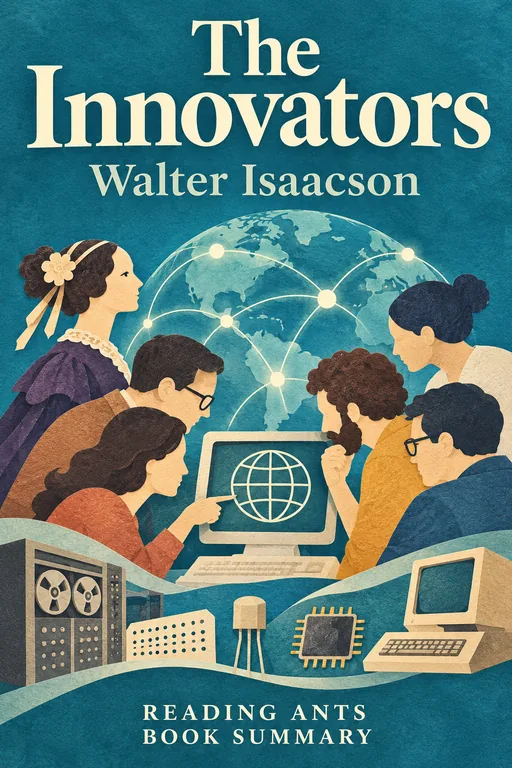
Walter Isaacson tells the history of the digital revolution through the people who invented the computer, the internet and the web, and argues that innovation is mostly the product of collaboration, not the work of lone geniuses.
Overview
The Innovators: How a Group of Hackers, Geniuses, and Geeks Created the Digital Revolution was published in 2014 by Walter Isaacson, who also wrote biographies of Benjamin Franklin, Einstein and Steve Jobs. It was published by Simon & Schuster. It begins with Ada Lovelace, in the nineteenth century, and follows the story through the first electronic computers, the transistor, the microchip, video games, personal computers, the internet and the web, to the early twenty-first century, in twelve chapters. Isaacson says that the key to creativity is teamwork, the connection of people with different skills, and that the myth of the lone inventor is misleading. The book is long, but is organized around memorable people and episodes.
Full Summary
1. Ada Lovelace and the first ideas
The idea: Isaacson begins with Ada Lovelace, the daughter of the poet Lord Byron, who became fascinated with the inventor Charles Babbage’s Analytical Engine, a design for a mechanical general-purpose computer. In the early 1840s she wrote a set of notes on it, which include what many call the first computer program, though historians debate how much of it was her own work. Lovelace saw that such a machine could manipulate symbols, such as music, as well as numbers. She also argued that the engine could not originate anything on its own, a point that Alan Turing later discussed in his paper on machine intelligence. The theme of “poetical science,” combining art and technology, is introduced.
In real life: Seeing that a calculator could be used for more than numbers was a creative leap.
2. The first computers and the programmers
The idea: The next chapters describe the building of the first computers in the 1930s and 1940s, such as ENIAC, which was designed by John Mauchly and J. Presper Eckert at the University of Pennsylvania to calculate artillery firing tables, and the work of Howard Aiken and of Grace Hopper on the Harvard-Navy Mark I. Isaacson stresses the role of women programmers, who were often overlooked, and of mathematician John von Neumann, who is associated with the stored-program design. He also notes the dispute about who invented the computer, including a court ruling that Mauchly and Eckert’s patent was derived from earlier work, which he says shows that many people contributed.
In real life: A big project, such as building a computer, depends on a team of builders and programmers.
3. The transistor and the microchip
The idea: In 1947, at Bell Labs, John Bardeen, Walter Brattain and William Shockley invented the transistor, a small switch that replaced the vacuum tube. Shockley later started a company in California, and eight of his employees, including Robert Noyce and Gordon Moore, left to found Fairchild Semiconductor. Noyce and Moore later founded Intel. Jack Kilby at Texas Instruments and Noyce independently invented the integrated circuit, which put many transistors on a chip. These made computers smaller, cheaper and faster, and launched Silicon Valley.
In real life: Each generation of phones is smaller and more powerful because of the chip.
4. Games, personal computers and software
The idea: Isaacson describes how computers moved from large institutions into homes. Early video games, from the student game Spacewar to Pong from Atari, brought computing to the public. Hobbyists in clubs, such as the Homebrew Computer Club, built their own machines, and Steve Jobs and Steve Wozniak, who attended the club, founded Apple, while Bill Gates and Paul Allen founded Microsoft to write software. He highlights how the Xerox research center developed a graphical interface, building on earlier work by Douglas Engelbart, whose lab created the mouse, and how Apple later adopted these ideas. The personal computer, he says, was the result of a combination of hobbyists, businesses and researchers.
In real life: A game on a screen made many people curious about computers.
5. The internet and the web
The idea: The story of the internet began with a US military research program, ARPANET, and with visionaries such as J. C. R. Licklider, who foresaw interactive computing and a worldwide network, and Vint Cerf and Bob Kahn, who developed the protocols that let networks connect. In 1989, Tim Berners-Lee at CERN proposed the World Wide Web, and he built the first browser and server soon afterward. He wanted the Web to stay free and open. Isaacson shows the web as an example of open, collaborative creation, and of the role of government-funded research.
In real life: Clicking a link to move from one page to another is the idea of Berners-Lee.
6. Wikipedia, Google and the future of collaboration
The idea: The last chapters cover how the web gave rise to Google, with its algorithm for ranking pages, and to Wikipedia, a collaborative encyclopedia. Isaacson says that these examples show the power of crowdsourcing and of combining human and machine intelligence. He returns to Lovelace’s idea of “poetical science,” that the humanities and technology belong together, and suggests that humans and machines will do best by working together, with creativity remaining a human strength. His conclusion is that innovation comes from teams, and from connecting art and science.
In real life: A search engine and a human question together find answers faster than either alone.
Why It Matters
The Innovators was a bestseller, and a major popular history of digital technology. It corrected the idea that inventions come from lone geniuses, drawing attention to teams, women and many less famous contributors. It gave readers a clear narrative of how the modern world of computers and the internet developed, and a model for understanding innovation. The book has been widely read in technology and business circles. It also raised the question of how to encourage collaboration, and of the role of public funding and open standards in the development of technology.
Key Takeaways
- Innovation is collaborative. Teams, not lone geniuses, drive progress.
- Art and science meet. Creativity often combines the humanities and technology.
- Government research mattered. Public funding helped to create the internet.
- Women were central. Early programmers were often overlooked.
- Humans and machines work best together. Each adds something different.
What We Can Learn
You can use the book to look at the technology around you with more curiosity about where it came from and who made it. Notice how teams, with different skills, create better results than individuals. Think about the value of sharing ideas freely, as Berners-Lee did with the web. If you are interested in computers, try learning to program, and think about how it might connect with your other interests, such as music or art. And give credit to the many people behind any achievement.
Criticism and Counterpoints
Some critics say that the book, in trying to cover so much, becomes a series of short sketches, with limited depth on each, and that the narrative is selective, as it focuses on American and British developments, with less about other countries. Others note that Isaacson’s thesis, that innovation is collaborative, is hardly new, and that he still gives space to colorful individuals. In 2015 a revised electronic edition corrected the chapter on software, which had given Bill Gates nearly all the credit for Microsoft’s early success and too little to Paul Allen, whom Isaacson had not interviewed. Still, it is widely admired.
Who Should Read It
This book is for readers who are curious about technology, history and innovation, including teenagers. It is long, but engaging and readable. Those who want details of a specific technology, such as the internet or the microchip, may turn to books focused on those subjects.
Want the whole book?
A summary is a taste, not the meal. Here is where to find the full book.
You reached the end 🎉
Nicely done. Mark this one as read, and we will suggest what to read next.
Read this next
Steve Jobs
Walter Isaacson
The authorized biography of Apple's co-founder follows a brilliant, demanding and often cruel perfectionist whose focus on beautiful design transformed computers, music, phones and animated movies.
💼 Business
Einstein: His Life and Universe
Walter Isaacson
Walter Isaacson's biography follows Albert Einstein from a rebellious schoolboy to the greatest physicist of the twentieth century, and shows how his creativity, nonconformity and imagination, and his flaws as a person, shaped his science and his life.
🔬 Science
The Everything Store
Brad Stone
Brad Stone tells the story of how Jeff Bezos built Amazon from an online bookstore into a giant that sells almost everything, and shows the ambition, the relentless drive and the human costs behind it.
💼 Business
Elon Musk
Walter Isaacson
Walter Isaacson's biography follows Elon Musk from a troubled childhood in South Africa to the leadership of Tesla, SpaceX and other ambitious ventures, and asks whether his risk-taking genius and his rough, impulsive side can be separated.
💼 Business
Chip War
Chris Miller
Chris Miller tells the story of how tiny computer chips became the foundation of modern life and military power, and why their supply, concentrated in a few places and companies, has become a major issue between the United States and China.
💰 Money & Economics
The Second Machine Age
Erik Brynjolfsson and Andrew McAfee
MIT economists Erik Brynjolfsson and Andrew McAfee argue that digital technologies such as computers, robots and artificial intelligence are bringing a second machine age, which will bring enormous benefits but also growing inequality, and they say that we must adapt our skills and institutions.
💡 TechnologyWant something different?
Pick another topic and we will show you three books to start with.