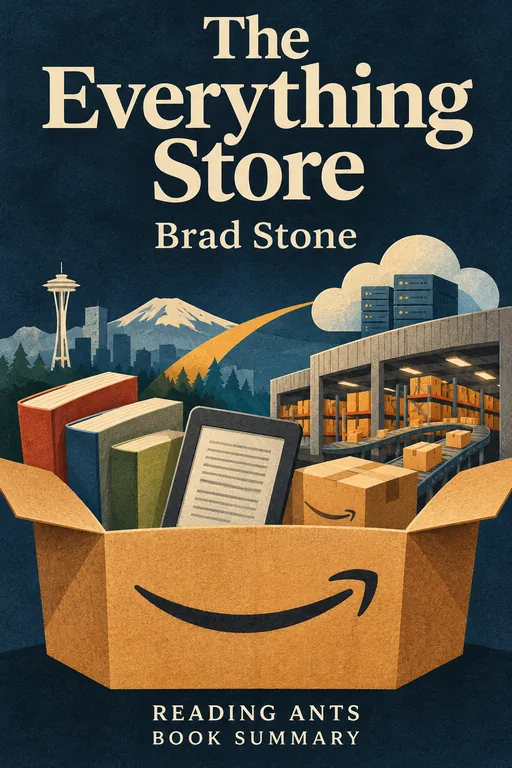
The Everything Store
Brad Stone tells the story of how Jeff Bezos built Amazon from an online bookstore into a giant that sells almost everything, and shows the ambition, the relentless drive and the human costs behind it.
Overview
The Everything Store was written by Brad Stone, a technology journalist, and published in 2013. Stone spoke with many current and former Amazon executives and employees, as well as Bezos’s family and friends, but Bezos himself took only a limited part in the project. The story starts in the mid-1990s, when Bezos left a career in finance and began selling books online from the Seattle area. It follows the company through the dot-com boom and crash, the growth of its warehouses and websites, and its moves into e-readers and cloud computing. The book is a portrait of an unusual leader, and of a company culture driven by data, speed and a long-term view.
Full Summary
1. A leap from Wall Street
The idea: Jeff Bezos worked at a New York investment firm and saw the rapid growth of the internet. He decided to start an online store and chose books as a first product, since there were far more titles than any physical shop could hold. He moved west and started the company in the Seattle area, with a small team, working at first out of his garage.
From the book: Stone describes Bezos’s way of making the decision, which he called a regret minimization framework: imagining himself at age eighty and asking which choice he would regret more.
In real life: A student deciding whether to try for a difficult project might ask how they will feel about it years later if they do not try.
2. Get big fast, and think long term
The idea: In the early years, Amazon’s strategy was to grow quickly, even if it lost money, in order to win customers and to build a lead. Bezos explained to investors that he was building a company for the long term, and that he would accept low profits in order to invest in the future. This was unusual, and it brought skeptics, especially after the dot-com bubble burst.
In real life: A farmer who plants trees knows that the fruit will come in years, not weeks, and plans accordingly.
3. Obsess over the customer
The idea: Stone describes how Amazon focused on low prices, wide selection and fast delivery, and how it kept the customer at the center of decisions. The company tested ideas with data, measured everything, and made changes to its website often. Bezos pushed workers to find ways to lower costs and pass the savings on to customers, which helped to earn loyalty.
From the book: The book discusses features such as the paid membership program, Prime, which offered faster shipping and made shopping at Amazon easier and more attractive.
In real life: A restaurant that notices which dishes people leave unfinished and fixes them is learning from its customers.
4. A demanding culture
The idea: Stone shows that Amazon’s culture is intense. Bezos asks hard questions, expects high standards and is known for angry outbursts when he is not satisfied. Many employees say they were inspired, and others say they were exhausted or treated harshly. The book also looks at conditions in warehouses, where workers faced pressure and monitoring of their speed. Bezos also urged his staff to stay focused on customers rather than on rivals.
In real life: A sports coach who pushes players hard may win many games, but may also lose some of the team.
5. Beyond books: new businesses
The idea: Amazon expanded into music, electronics, toys and other products, and invited outside sellers to use its site. It built its own e-reader, the Kindle, and it built Amazon Web Services, a platform for renting computing and storage to other companies, which grew into a major business. Stone shows that Bezos was willing to try many bets, accepting that some would fail.
In real life: A school canteen that starts by selling snacks and later adds a lunch service is using its first success as a base.
6. Fierce competition and the price of power
The idea: The final part of the book deals with Amazon’s growing strength, and its ruthless methods against rivals and suppliers. Stone describes its battles with publishers and with a competitor that sold diapers online, against which Amazon cut prices below cost until that company agreed to be bought. Stone also shows how critics began to ask whether Amazon had too much power over retailers, writers and small businesses.
In real life: When one store becomes so large that others cannot compete, customers may enjoy low prices at first but find fewer choices later.
Why It Matters
The Everything Store was one of the most detailed accounts of how Amazon grew into one of the most powerful companies in the world. It helps readers understand a firm that touches the daily lives of millions, from shopping to books to cloud services. The book was widely praised and became a bestseller, and it won the Financial Times Business Book of the Year award in 2013. It matters for how it shows both the creativity and the harshness of a business built on constant growth, and for raising questions that remain important: how much power a company should have, and how workers and small sellers should be treated. Stone later wrote a follow-up book about the company’s later years, which shows how the story continued after 2013.
Key Takeaways
- Think long term. Bezos accepted years of low profit to build something lasting.
- Customers first. Low prices, choice and convenience drove the growth.
- Data guides decisions. Constant measuring and testing shaped the company.
- Ambition has a cost. A relentless culture can bring both great results and burnout.
- Success invites scrutiny. The bigger a company grows, the more questions arise about its power.
What We Can Learn
You can take a few ideas from this story. One is to look further ahead than most people do, and to be patient with a good idea. Another is to listen to the people you serve and use real evidence to improve. At the same time, you can ask what kind of workplace or team you want to build, and what you would not do, even if it brought success. The story also encourages you to be curious about the companies you use every day. Knowing how they work helps you to make informed choices as a customer, as a worker and as a citizen.
Criticism and Counterpoints
Because Bezos took only a limited part in the project, some critics say that the book gives an incomplete picture of his thoughts. Others say that it relies heavily on accounts from current and former employees, some of whom may have been unhappy. Bezos’s wife, MacKenzie, posted a one-star review on Amazon’s own site claiming that the book contained many factual inaccuracies, though she pointed to only one. Some readers feel that the book is too admiring of the company’s success, while others find it too critical of its workplace. The book was published in 2013 and so does not cover later events, which have changed Amazon and its leader’s role.
Who Should Read It
This book is for readers interested in business, technology, online shopping and the lives of founders. It is written like a story and is easy to follow. Those who want a deep look at the company’s current state need a more recent source, and readers who prefer a brief summary may find it long.
Want the whole book?
A summary is a taste, not the meal. Here is where to find the full book.
You reached the end 🎉
Nicely done. Mark this one as read, and we will suggest what to read next.
Read this next
Elon Musk
Walter Isaacson
Walter Isaacson's biography follows Elon Musk from a troubled childhood in South Africa to the leadership of Tesla, SpaceX and other ambitious ventures, and asks whether his risk-taking genius and his rough, impulsive side can be separated.
💼 Business
Creativity, Inc.
Ed Catmull with Amy Wallace
Ed Catmull, a co-founder of Pixar, explains how the studio built a culture of honest feedback and trust, so that creative people could make great films, and why leaders must protect that culture from fear.
💼 Business
Steve Jobs
Walter Isaacson
The authorized biography of Apple's co-founder follows a brilliant, demanding and often cruel perfectionist whose focus on beautiful design transformed computers, music, phones and animated movies.
💼 Business
Zero to One
Peter Thiel with Blake Masters
The most valuable companies create something new from nothing, and Peter Thiel argues that this means aiming for a monopoly in a small, specific market rather than competing with everyone in a crowded one.
💼 Business
The Innovator's Dilemma
Clayton M. Christensen
Great companies often fail not because they manage badly, but because they do everything right: they listen to their best customers and invest in the best products, and so they miss the cheaper, simpler technology that eventually replaces them.
💼 Business
The Lean Startup
Eric Ries
Startups succeed not by following a detailed plan but by quickly testing their ideas with real customers, learning from the results and changing direction when needed.
💼 BusinessWant something different?
Pick another topic and we will show you three books to start with.