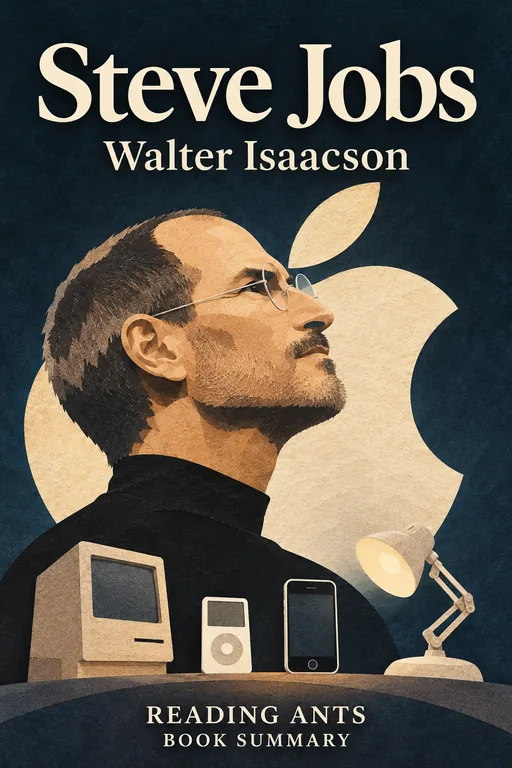
Steve Jobs
The authorized biography of Apple's co-founder follows a brilliant, demanding and often cruel perfectionist whose focus on beautiful design transformed computers, music, phones and animated movies.
Overview
Steve Jobs, by Walter Isaacson, was published in 2011, only weeks after Jobs died. Isaacson, who has also written biographies of Albert Einstein, Benjamin Franklin and Leonardo da Vinci, conducted more than forty interviews with Jobs over two years, as well as many with family, friends, rivals and colleagues. Jobs, who rarely cooperated with writers, asked Isaacson to do it and, unusually, did not ask to control what went into the book. The result is a detailed picture of a man who was inspiring and impossible, visionary and unkind, and who changed several industries.
Full Summary
1. A restless beginning
The idea: Jobs was born in 1955 to a young unmarried couple and adopted by Paul and Clara Jobs of California. His adoptive father, a mechanic, taught him to care about the beauty of things that no one sees, such as the back of a cabinet. As a young man, Jobs dropped out of Reed College but stayed to take classes that interested him, including calligraphy, traveled to India and experimented with Zen Buddhism and counterculture ideas. These influences gave him a lasting taste for simplicity.
In real life: Paying attention to small details that most people never notice can be a mark of real craftsmanship.
2. Apple and the Macintosh
The idea: In 1976, Jobs and his friend Steve Wozniak started Apple. Wozniak was the engineer; Jobs was the driving force who saw that ordinary people would want computers. The Apple II was a big success, and Apple became a major company. Jobs then led the team that built the Macintosh, which helped bring a mouse and a graphical screen to ordinary users at a lower price than Apple’s earlier Lisa computer. He pushed his team relentlessly, and was both loved and feared.
In real life: A product succeeds when someone cares enough to make it feel easy for everyone, not just experts.
3. The reality distortion field
The idea: Isaacson describes what colleagues called Jobs’s “reality distortion field,” his ability to persuade people that the impossible was possible. He could bend facts, set impossible deadlines and convince engineers to deliver. It could inspire extraordinary effort, but it also meant that Jobs could ignore facts he did not like, and sometimes people were hurt or exhausted.
From the book: Stories from Apple’s early days show employees who were told something could not be done, and then did it anyway, because Jobs would not accept no.
In real life: High expectations can raise a team’s performance, but they can also burn people out if they are unfair.
4. Pushed out, then reborn
The idea: In 1985, after clashes with the company’s leaders, Jobs lost his executive duties at Apple and then resigned. He started NeXT, a computer company that was not very successful, and bought a small computer-animation unit from Lucasfilm and turned it into Pixar. Pixar produced Toy Story, the first fully computer-animated feature film, in 1995. During this period, Jobs matured, learned to work with creative people and married Laurene Powell.
In real life: A setback can teach lessons that success never does.
5. The return
The idea: Apple, close to failing, agreed to buy NeXT in late 1996 and completed the deal in 1997, bringing Jobs back. He cut the company’s confusing range of products down to a small number, and worked with designer Jony Ive on the colorful iMac. Then came a series of products that changed everyday life: the iPod and iTunes for music, the iPhone for communication and the iPad for tablets. Jobs insisted on controlling both hardware and software, so that everything worked together smoothly.
In real life: Doing a few things extremely well is often better than doing many things adequately.
6. Focus, simplicity and design
The idea: Jobs believed in saying no to most things, so that he could focus on the few that mattered. He wanted products to be simple and to feel natural, and he had an almost obsessive interest in how they looked and felt, even inside. He believed that technology should be combined with the humanities, and that the best products come from the crossing of art and engineering.
In real life: A clean design is the result of many difficult decisions about what to leave out.
7. The cost of being Steve
The idea: Isaacson does not hide the dark side of Jobs. He could be cruel, insulting employees, taking credit for others’ ideas and being cold to people close to him. He denied at first that he was the father of his first daughter, Lisa, though he later built a relationship with her. He was diagnosed with a pancreatic tumor in 2003, delayed surgery for months while trying alternative treatments, and died in October 2011, at the age of 56.
In real life: Great achievements do not excuse unkindness, and learning from someone’s talent doesn’t mean copying their faults.
Why It Matters
Steve Jobs was a worldwide bestseller and one of the best-selling biographies in recent years, and it inspired the 2015 film Steve Jobs, with a screenplay by Aaron Sorkin. It gave readers the first deep look at the man behind products used by billions of people.
The book also shaped how a generation thought about design, leadership and innovation, and it is cited in talks about how to build creative companies. At the same time, it gave critics an example for debates about whether genius excuses bad behavior. Because it appeared only weeks after Jobs died, many readers treated it as a final record of the man behind the devices they use every day.
Key Takeaways
- Design is how it works, not just how it looks. Jobs treated beauty and function as one.
- Focus means saying no. Cutting products helped save Apple.
- Integration can create magic. Controlling hardware and software made things work smoothly.
- Failure can teach. Being pushed out of Apple made Jobs a better leader.
- Talent is not an excuse for cruelty. His harshness had real costs.
What We Can Learn
Jobs’s life shows the power of caring about quality. Whether you are writing an essay, building a model or cooking dinner, small details that most people won’t notice can lift the work.
It also shows the value of focus. Many people try to do too many things. Choosing a few goals, and letting the rest go, can make progress faster and clearer.
At the same time, the book is a warning. Jobs’s brilliance came with a price paid by the people around him. We can admire the work and still choose to treat people with respect and kindness.
Criticism and Counterpoints
Some critics say that Isaacson was too admiring and too close to his subject, and that the book accepts Jobs’s own version of events or gives him too much credit for the work of his teams, including designers and engineers like Jony Ive and Steve Wozniak. Others feel that the book is too forgiving of his bad behavior.
A few readers also find the book long, with details about product meetings, and some argue that it overlooks business and political issues, such as Apple’s labor practices overseas. Jobs’s family has also said that some descriptions in the book do not match their memories. Even so, it remains the main portrait of him.
Who Should Read It
This biography suits teenagers and adults interested in technology, design, business or leadership. It is long, but it reads like a story. Readers who want only the highlights might start with the chapters on the Macintosh, the return to Apple and the iPhone.
Want the whole book?
A summary is a taste, not the meal. Here is where to find the full book.
You reached the end 🎉
Nicely done. Mark this one as read, and we will suggest what to read next.
Read this next
Shoe Dog
Phil Knight
The founder of Nike tells how a young runner with a borrowed idea and almost no money built a small shoe-importing business, through crisis after crisis, into one of the most famous brands in the world.
💼 Business
Creativity, Inc.
Ed Catmull with Amy Wallace
Ed Catmull, a co-founder of Pixar, explains how the studio built a culture of honest feedback and trust, so that creative people could make great films, and why leaders must protect that culture from fear.
💼 Business
The Innovators
Walter Isaacson
Walter Isaacson tells the history of the digital revolution through the people who invented the computer, the internet and the web, and argues that innovation is mostly the product of collaboration, not the work of lone geniuses.
💡 Technology
Elon Musk
Walter Isaacson
Walter Isaacson's biography follows Elon Musk from a troubled childhood in South Africa to the leadership of Tesla, SpaceX and other ambitious ventures, and asks whether his risk-taking genius and his rough, impulsive side can be separated.
💼 Business
The Lean Startup
Eric Ries
Startups succeed not by following a detailed plan but by quickly testing their ideas with real customers, learning from the results and changing direction when needed.
💼 Business
Good to Great
Jim Collins
Collins argues that sustained corporate improvement comes from disciplined leaders, carefully chosen people, a focused economic concept and cumulative execution rather than dramatic transformation programs.
💼 BusinessWant something different?
Pick another topic and we will show you three books to start with.