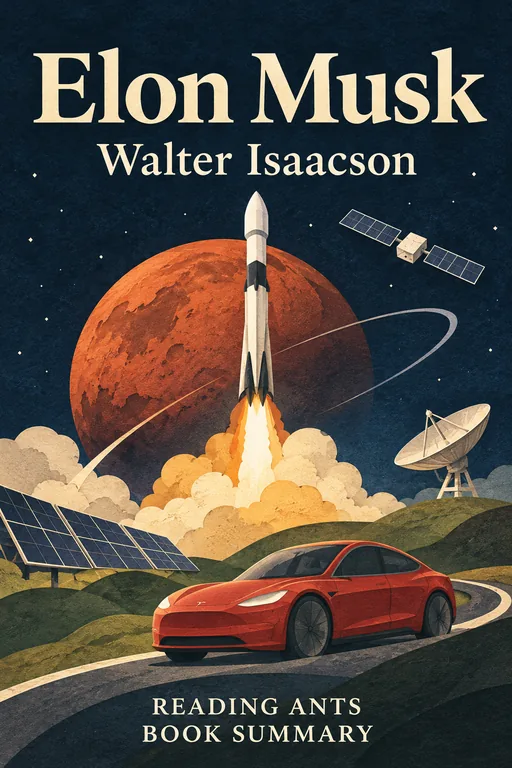
Elon Musk
Walter Isaacson's biography follows Elon Musk from a troubled childhood in South Africa to the leadership of Tesla, SpaceX and other ambitious ventures, and asks whether his risk-taking genius and his rough, impulsive side can be separated.
Overview
Elon Musk is a biography by Walter Isaacson, published in 2023. Isaacson, who also wrote books on Steve Jobs, Albert Einstein and Leonardo da Vinci, spent about two years following Musk and talking with him, his family and many colleagues. The book, which describes events up to its publication, covers Musk’s life from his birth in 1971 through his work on electric cars, reusable rockets, satellites, artificial intelligence and social media. It is a portrait of a very driven person, who has made bold bets, and who is both admired and criticized. Isaacson tries to show the full picture, including the harsh parts.
Full Summary
1. A hard childhood shapes a driven person
The idea: Elon Musk is born in Pretoria, South Africa, in 1971. He is a bookish, intense child who loves science fiction and computers. His parents separate when he is young, and he spends much of his childhood with his father, a strong-willed engineer who treats him harshly. Isaacson describes how Elon is bullied at school, and how those years leave deep marks on him. He teaches himself to program as a child, and creates a simple video game, Blastar, at about twelve. He leaves for Canada at about seventeen or eighteen, on the way to the United States.
In real life: Many people who work very hard are partly driven by something that happened to them when they were young. Knowing this does not excuse their behavior, but it can help us understand it.
2. From the internet to PayPal
The idea: Musk studies in North America and chooses the internet over graduate school. With his brother Kimbal, he founds Zip2, a company that makes online city guides, with maps and business directories, for newspapers, and they sell it for a large sum. He then co-founds X.com, an online financial company that merges with Confinity to become PayPal, which is sold in 2002 and makes him wealthy. Isaacson shows that his style is already visible: huge goals, long hours, and sharp conflicts with others about who is in charge. He puts most of his money into his next ventures.
In real life: Someone who sells a first small business often learns the most from the mistakes made along the way, and uses that knowledge for the next, bigger idea.
3. Rockets and cars on the edge of failure
The idea: With his fortune, Musk starts SpaceX in 2002, with the dream of making space travel cheaper and eventually settling Mars. He also invests in Tesla and becomes its leader. The early years are frightening. SpaceX’s first rockets fail on their first launches, and Tesla struggles to make its first cars. By 2008, both companies are close to running out of money. Isaacson describes how the fourth launch of the Falcon 1 rocket finally reaches orbit, and how a contract from NASA helps to save SpaceX. Tesla secures funding at the last moment.
In real life: A student who fails a first exam, studies the mistakes and tries again is using the same pattern of learning through failure, on a smaller scale.
4. Pushing the limits of speed
The idea: Musk is known for his demanding methods. He applies a five-step algorithm: question every requirement, delete unnecessary parts, simplify and optimize, speed up the cycle time, and only then automate. The order matters. He walks the factory floor, makes quick decisions and sometimes fires people who disagree with him or seem too slow. Isaacson describes the trouble Tesla has in building the Model 3, a period that Musk himself called “production hell.” SpaceX learns to land and reuse its rockets, which changes the economics of launches. A satellite internet network, Starlink, follows.
In real life: Asking “do we really need this step?” can save time in a school project or a household chore, as long as people are not worn out by the pace.
5. Moods, relationships and the cost of intensity
The idea: Isaacson spends many pages on Musk’s inner life. He describes mood swings, which people close to him call “demon mode,” when he becomes angry and obsessed. He has several children and relationships, and the book describes how work often takes first place. Friends and colleagues describe him as funny, generous with ideas and capable of great loyalty, but also as cold or cruel in some moments.
In real life: A person can be inspiring and hurtful in the same week. When we work with such a person, it helps to set clear limits and to notice how our own treatment of others compares.
6. Twitter and a changed public image
The idea: In 2022 Musk buys the social media service Twitter for about forty-four billion dollars, after first trying to back out of the deal. He cuts a large part of the staff, changes its rules and renames it X. Isaacson shows how this move brings him praise from those who want fewer limits on speech, and anger from those who think he has made the site worse. His public persona becomes more controversial, and Isaacson asks how much of it comes from the same traits that drive his successes.
In real life: A bold decision can look brilliant to some people and reckless to others. Judging it fairly means looking at the results over time, and not just at the first reaction.
Why It Matters
Elon Musk is one of the most influential and discussed business figures of his era. His companies helped to push electric cars into the mainstream, to change the cost of spaceflight and to build large networks of satellites, and his purchase of a major social network made him part of the public debate. Isaacson’s book is important because it is the result of close access to its subject, and it gives readers a detailed look at how he makes decisions and treats other people. It is also a case study of the link between ambition and character. For readers who want to understand modern technology, and the people who control it, the book offers a thorough account, even though history will keep judging the results.
Key Takeaways
- Big goals attract talent. A mission that seems nearly impossible can draw ambitious people.
- Question every requirement. Challenging rules and deleting parts can speed up work.
- Risk is part of progress. Musk repeatedly bets everything, and some bets nearly end in disaster.
- Childhood shapes character. Isaacson links Musk’s drive and his harshness to early experiences.
- Genius and flaws can be connected. The same traits that bring success may cause harm to others.
What We Can Learn
The book invites us to think carefully about how we judge success. You can learn from Musk’s habit of asking “why does this rule exist?” and of testing quickly instead of waiting for a perfect plan. You can also learn from his persistence when things go wrong. At the same time, the book is a warning. Treating people harshly and acting on every impulse can bring pain and mistakes, and not every strong leader is a good example to follow. A good approach is to take the useful ideas, such as clear goals and fast learning, while keeping the kindness and honesty that Musk often lacks.
Criticism and Counterpoints
Some reviewers said that Isaacson was too close to his subject and too willing to tell the story the way Musk saw it, particularly in the sections on recent events, which were still unfolding. Others felt that the book was too long or did not examine enough the safety, working conditions and the effects of his decisions on his employees. Critics also point out that the book reports statements from Musk and others that were hard to check. Because the story continues, the biography can only provide a snapshot, and later developments may change how it is read.
Who Should Read It
This book is for readers interested in technology, business and the lives of influential people. It is long, but well paced and full of stories. Those who want a brief overview may find it too detailed, and readers who dislike strong language or accounts of harsh workplaces may find parts of it uncomfortable.
Want the whole book?
A summary is a taste, not the meal. Here is where to find the full book.
You reached the end 🎉
Nicely done. Mark this one as read, and we will suggest what to read next.
Read this next
Steve Jobs
Walter Isaacson
The authorized biography of Apple's co-founder follows a brilliant, demanding and often cruel perfectionist whose focus on beautiful design transformed computers, music, phones and animated movies.
💼 Business
The Everything Store
Brad Stone
Brad Stone tells the story of how Jeff Bezos built Amazon from an online bookstore into a giant that sells almost everything, and shows the ambition, the relentless drive and the human costs behind it.
💼 Business
Creativity, Inc.
Ed Catmull with Amy Wallace
Ed Catmull, a co-founder of Pixar, explains how the studio built a culture of honest feedback and trust, so that creative people could make great films, and why leaders must protect that culture from fear.
💼 Business
Zero to One
Peter Thiel with Blake Masters
The most valuable companies create something new from nothing, and Peter Thiel argues that this means aiming for a monopoly in a small, specific market rather than competing with everyone in a crowded one.
💼 Business
The Innovators
Walter Isaacson
Walter Isaacson tells the history of the digital revolution through the people who invented the computer, the internet and the web, and argues that innovation is mostly the product of collaboration, not the work of lone geniuses.
💡 Technology
The Lean Startup
Eric Ries
Startups succeed not by following a detailed plan but by quickly testing their ideas with real customers, learning from the results and changing direction when needed.
💼 BusinessWant something different?
Pick another topic and we will show you three books to start with.