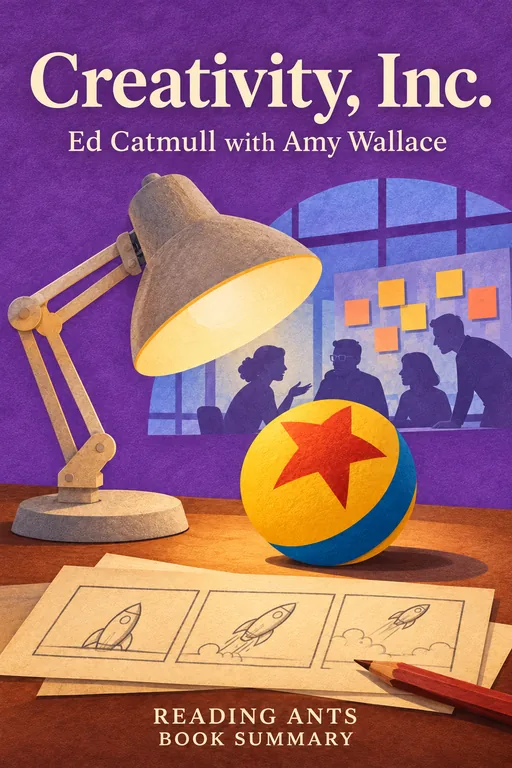
Ed Catmull, a co-founder of Pixar, explains how the studio built a culture of honest feedback and trust, so that creative people could make great films, and why leaders must protect that culture from fear.
Overview
Creativity, Inc. was published in 2014. Its author, Ed Catmull, is a computer scientist who spent decades helping to create computer animation, and he became president of Pixar Animation Studios and, later, of Disney Animation. The book is partly a memoir, from his childhood dream of making animated films to the creation of Toy Story, and partly a guide to managing creative work. Catmull argues that good ideas are fragile, that problems are often hidden, and that a leader’s job is to create an environment in which people feel safe to speak truthfully and to take risks.
Full Summary
1. A dream of animation and a computer in the way
The idea: Catmull grew up loving Disney films and wanting to be an animator, but he did not find a path into animation, so he turned to science and studied computer graphics. He later joined a computer group at Lucasfilm, and then, in 1986, the group was bought by Steve Jobs and became Pixar. Catmull describes how a team of engineers and artists, who loved both art and technology, slowly made progress toward a feature-length computer-animated film.
In real life: Many creative careers begin at a place where two interests meet, such as art and coding, or music and math.
2. Toy Story and the lesson of early failure
The idea: Pixar’s first feature, Toy Story, released in 1995, was the first full-length film made entirely with computer animation, and it was a huge success. But Catmull says that the film was not good in its early versions. He uses the phrase “ugly babies” for the first drafts of any creative work: they are awkward and incomplete, and they need protection and time to grow.
In real life: Your first draft of an essay or a drawing may be rough. That does not mean it is bad, only that it has not yet been improved.
3. The Braintrust and honest feedback
The idea: One of the most important tools at Pixar is the Braintrust, a group of film-makers who watch each other’s work in progress and give frank notes. Catmull says that the group works because its members are candid, but have no authority over the director. The director decides what to use, so the notes are help, not orders. He says that candor must be paired with respect, and that people must be willing to hear what they do not want to hear.
In real life: A group of friends who read each other’s stories and give honest advice, but leave each writer in charge, is using the same idea.
4. The near loss of Toy Story 2
The idea: Catmull tells a story about a serious technical accident during the making of Toy Story 2, in which a large amount of the film’s computer files were deleted by mistake. The backups had also failed, but a technical director, Galyn Susman, who was working from home after having a child, had a copy on her home computer, which allowed nearly all of the lost work to be recovered. The sequel had first been planned as a cheaper film made directly for home video, but the studio decided that it should be made as well as the first film, and the team reworked the story. Finishing it on a tight schedule demanded very long hours that took a toll on the staff, and many of them suffered from repetitive strain injuries. Catmull uses the story to show why quality must matter at every step, and why leaders must look after the people who make the work.
In real life: Keeping a second copy of an important school project is a small habit that can save a lot of trouble.
5. Fear of failure, and keeping the culture alive
The idea: Catmull argues that failure is a natural part of doing something new, and that the real danger is when fear of failure makes people stop taking risks. He discusses how a successful company can become complacent, and describes practices that Pixar uses to keep learning, such as reviewing each film after it is finished, and making sure that staff can raise concerns freely.
In real life: A student who is afraid of making a mistake in class may stop asking questions, and so learn less.
6. Disney and the challenge of keeping the magic
The idea: After Disney bought Pixar in 2006, Catmull and John Lasseter were asked to lead the Disney Animation studio too. Catmull describes how they brought some of Pixar’s ways of working, including candid reviews and trust in directors, to a studio that had lost some of its confidence. He describes the effort as one of helping the studio’s own artists regain their confidence, and not of copying Pixar.
In real life: When you join a new club or school, you can share what has worked for you, but still need to learn how things work there.
Why It Matters
Creativity, Inc. is widely read in the worlds of business, design and education. It matters because it takes a successful and admired company and explains its methods in clear language. Many leaders have used its ideas about candor, trust and the protection of early ideas in their own organizations. The book also helps to correct the myth that creative success comes from a single genius. Catmull shows that it depends on a system, with the right people, honest feedback and attention to the culture. It also reflects the story of animation itself, from hand-drawn film to computers, and celebrates the combination of technology and art that made Pixar’s films possible. For many readers, it is both a business book and a humane view of work.
Key Takeaways
- Protect early ideas. First drafts are fragile, and they need time to improve.
- Be candid, with respect. Honest feedback helps most when it is given to help, not to control.
- People matter more than ideas. A strong team can fix a weak idea, but a weak team can ruin a strong one.
- Failure is part of learning. Fear of mistakes can stop good work from happening.
- Keep looking for hidden problems. Leaders must create ways to learn what is going wrong.
What We Can Learn
When you show work in progress to a friend or teacher, ask for specific and honest comments, and thank them for them. When someone shows you theirs, try to help the person to improve it, and not to take over. Pay attention to the culture of any group you join. Does it make people feel safe to say, “I am not sure”? If you lead, you can help by admitting your own mistakes first. Finally, remember that making something good takes patience. Be willing to be bad at the start, and to keep making it better.
Criticism and Counterpoints
Some critics say that the book gives a very positive picture of Pixar, which may leave out conflicts, and that its lessons come from a unique studio that had unusual success and resources. Others point out that the book was written before later events at the company, including public reports in 2017 about inappropriate conduct by a senior creative leader, which show that no culture is perfect. Some readers find the management advice general or obvious. The book is best read as the account of one thoughtful leader, and not as a guaranteed recipe.
Who Should Read It
This book is for anyone who works in a creative or team setting, including teachers, designers, writers, engineers and managers. It is also a good read for fans of animation. Readers who want only film history may find the management parts long, and those who want strict research may prefer another type of book.
Want the whole book?
A summary is a taste, not the meal. Here is where to find the full book.
You reached the end 🎉
Nicely done. Mark this one as read, and we will suggest what to read next.
Read this next
The Ride of a Lifetime
Robert Iger
Robert Iger, who led the Walt Disney Company for fifteen years, tells how he rose from a junior job in television to the top of a global entertainment giant and shares the leadership lessons he learned along the way.
💼 Business
Steve Jobs
Walter Isaacson
The authorized biography of Apple's co-founder follows a brilliant, demanding and often cruel perfectionist whose focus on beautiful design transformed computers, music, phones and animated movies.
💼 Business
Radical Candor
Kim Scott
Kim Scott argues that the best bosses and colleagues combine two habits, caring personally about people and challenging them directly, and she shows how to give honest feedback without being cruel or being fake.
💼 Business
No Rules Rules
Reed Hastings and Erin Meyer
Netflix co-founder Reed Hastings and the business professor Erin Meyer explain how Netflix built a company on very talented people, blunt honesty and very few rules, and why they think that freedom brings both speed and responsibility.
💼 Business
The Lean Startup
Eric Ries
Startups succeed not by following a detailed plan but by quickly testing their ideas with real customers, learning from the results and changing direction when needed.
💼 Business
Good to Great
Jim Collins
Collins argues that sustained corporate improvement comes from disciplined leaders, carefully chosen people, a focused economic concept and cumulative execution rather than dramatic transformation programs.
💼 BusinessWant something different?
Pick another topic and we will show you three books to start with.