 Reading Ants
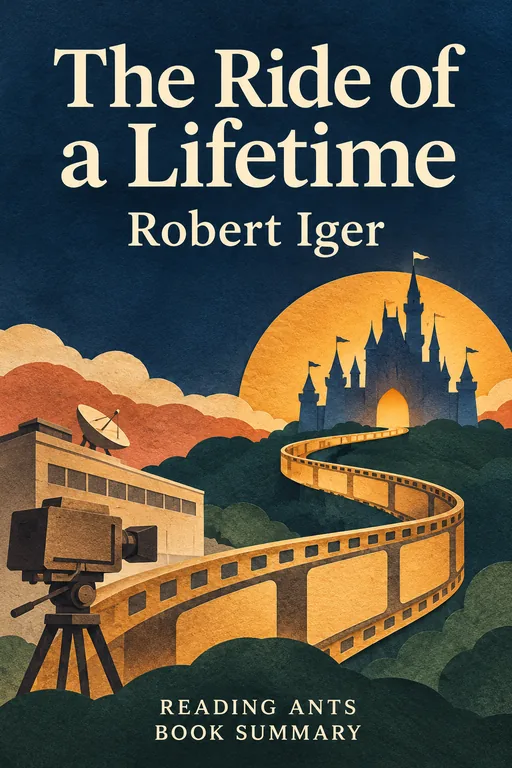
Robert Iger, who led the Walt Disney Company for fifteen years, tells how he rose from a junior job in television to the top of a global entertainment giant and shares the leadership lessons he learned along the way.
Overview
The Ride of a Lifetime is a memoir and leadership book by Robert Iger, published in 2019. Iger started as a low-level worker at the television network ABC in the 1970s and later became the head of Disney, a role he held from 2005. The book follows his career, from early jobs to the big deals that changed the company, and it ends with his thoughts on how to lead. His tone is warm and professional. He mixes personal anecdotes with plain advice about courage, curiosity and treating people fairly, and he explains how he made some of the most important decisions of his career.
Full Summary
1. Starting at the bottom
The idea: Iger describes how he began his working life in television. After a short spell as a local weatherman in his student years, he joined ABC in 1974 in a very ordinary job working on television sets, and he worked his way up through the network, including a period in ABC Sports under Roone Arledge. After the network was bought in 1985 by the smaller Capital Cities company, he was impressed by its leaders, Tom Murphy and Dan Burke, who valued decency, competence and giving people room to run their own jobs. After he handled the network’s coverage of the 1988 Winter Olympics in Calgary well, the Capital Cities leaders later gave him, when a post opened, the job of president of ABC Entertainment, even though he had little experience in entertainment. He says that in the new role he learned to admit what he did not know, to ask questions, and to trust his instincts, and he describes backing the unusual show Twin Peaks.
From the book: He describes learning how shows are made through menial tasks, and he recalls a childhood on Long Island, where his father pushed him toward hard work and self-reliance.
In real life: A new employee who offers to help on the unglamorous jobs often learns the most about how a business runs.
2. Learning from the old Disney
The idea: ABC’s owner, Capital Cities/ABC, was bought by Disney in the mid-1990s, and Iger found himself working under Michael Eisner, the long-time Disney boss, who asked him to sign a multi-year contract to help the two companies fit together. Iger found Disney more centralized than ABC. He later became Disney’s president and Eisner’s second-in-command, in 2000. Iger describes how clashes at the top, such as the troubled hiring of Michael Ovitz, who did not last, damaged trust and morale, and how Eisner grew more pessimistic as technology and the media world changed. In the long process of choosing a successor, Iger concluded that he should talk about the future and not criticize Eisner’s past, and the board named him chief executive in 2005. His first tasks were to repair strained relationships: with Roy Disney, who had fought the board, and with Pixar, and to loosen the company’s centralized strategic planning.
In real life: A new captain who takes over a team after a tense period often has to start by listening, and fixing relationships.
3. Buying Pixar
The idea: One of Iger’s first big moves was to repair the relationship with Pixar, the animation studio that had made hits with Disney but whose partnership with it had become tense, with public disputes between Eisner and Steve Jobs. Iger reconnected with Jobs and the Pixar leaders, and Disney bought Pixar in 2006, partly in order to revive Disney’s own animation. Iger says that the key was respect: he reassured Pixar’s creative people that the point of the purchase was to protect their culture, not to change it.
From the book: The book describes how he built a close relationship with Jobs, who became Disney’s largest shareholder after the deal.
In real life: When a bigger group merges with a smaller one, success depends on whether the smaller group’s strengths are valued, not erased.
4. Marvel, Lucasfilm and Fox
The idea: After Pixar, Iger led Disney’s purchase of Marvel in 2009 and of Lucasfilm, the company of Star Wars, in 2012. He wanted Disney to own great stories and characters that audiences love. On Marvel, he describes winning the trust of its reclusive chief executive, Ike Perlmutter, with the help of an introduction from a former Disney executive, David Maisel, and of Jobs, who spoke up for Disney’s respect for Marvel’s culture. Later, he led a much larger purchase of most of the entertainment businesses of Rupert Murdoch’s 21st Century Fox, in a deal that was completed in 2019. He describes a contest with a rival bidder, Comcast, and a raised offer made in order to win it. The book explains why he believed in these deals and how he dealt with the backlash and the task of fitting new companies into Disney.
In real life: A bakery that has a loyal customer base might partner with another that makes something different, if both can keep their special character.
5. Betting on technology
The idea: Iger says that he saw that technology, especially streaming over the internet, would change how people watched television and films. He told the board early on that his priorities were high-quality branded content, technology, and expansion into large markets such as China and India. He describes weighing whether to buy or build technology, and walking away from a possible Twitter deal over concerns about the brand. Disney invested in the streaming company BAMTech, and he pushed Disney to create its own streaming services, even though it meant giving up some income from traditional methods, such as licensing programs to others. The Disney+ service was unveiled in detail in April 2019. He also says that in the late 1990s he was asked to explore a Disney park in China, and the Shanghai resort opened in 2016.
In real life: Staying with an old method because it still brings money today can be risky if customers are already beginning to move elsewhere.
6. Principles of leadership
The idea: In the final part, Iger lists the qualities that he believes a leader needs. They include optimism, courage, focus, decisiveness, curiosity, fairness, thoughtfulness and authenticity. He says that a leader sets the tone of the whole organization. Optimism, for example, does not mean ignoring problems, but believing that they can be solved, which keeps teams motivated. He also stresses integrity and the importance of being honest even when it is uncomfortable.
In real life: A teacher who stays calm and hopeful when a class has a hard day helps the students to keep going.
Why It Matters
The Ride of a Lifetime was widely read and gave readers a rare inside view of a company that shapes the stories of children and families around the world. Its importance comes from the scale of what Iger did at Disney: the purchases of Pixar, Marvel, Lucasfilm and Fox helped to make Disney a leader in global entertainment, and the move into streaming reflected the change in how people watch films and shows. The book is also valued as a leadership guide by someone who held one of the most visible jobs in business. Its lessons about respect, creativity and facing change are useful in many settings. Iger returned to lead Disney again in 2022, and the book is often read as a record of his first period in charge.
Key Takeaways
- Start with respect. Valuing the people and cultures you work with makes partnerships work.
- Be curious. Leaders who keep learning see change coming.
- Take bold, thoughtful risks. Big opportunities involve uncertainty, but waiting can be riskier.
- Optimism is a choice. A leader’s attitude spreads to a team.
- Integrity is lasting. Honesty and fairness build trust that lasts longer than any one deal.
What We Can Learn
You do not need to run a company to use these lessons. Show respect to people who are new to a group, and ask about their strengths. Try to stay curious about changes in the world that may affect your work or your studies, and test new methods before they become urgent. When you face a problem, practice being realistic and hopeful at once. Also notice that Iger took a long time to reach the top. Patience, preparation and a good reputation for being fair and hardworking can open doors, even when the path is not clear at the beginning.
Criticism and Counterpoints
Some readers may feel that the book is a polished account by a very successful executive, and that it dwells more on achievements than on personal failure or on difficult decisions that hurt people. Critics of Disney’s deals also say that they concentrated a great deal of entertainment in one company, which raises questions about competition and about the variety of stories told. Some readers may find the tone self-congratulatory, and the leadership lessons familiar. The book is also an insider’s version, and others involved in the same events might remember them differently.
Who Should Read It
This book is for people interested in leadership, media, film and the business of storytelling. It is easy to read and has many behind-the-scenes stories. Readers who want a critical or investigative look at Disney, or detailed financial analysis, will need other sources.
Want the whole book?
A summary is a taste, not the meal. Here is where to find the full book.
You reached the end 🎉
Nicely done. Mark this one as read, and we will suggest what to read next.
Read this next
Creativity, Inc.
Ed Catmull with Amy Wallace
Ed Catmull, a co-founder of Pixar, explains how the studio built a culture of honest feedback and trust, so that creative people could make great films, and why leaders must protect that culture from fear.
💼 Business
Shoe Dog
Phil Knight
The founder of Nike tells how a young runner with a borrowed idea and almost no money built a small shoe-importing business, through crisis after crisis, into one of the most famous brands in the world.
💼 Business
Steve Jobs
Walter Isaacson
The authorized biography of Apple's co-founder follows a brilliant, demanding and often cruel perfectionist whose focus on beautiful design transformed computers, music, phones and animated movies.
💼 Business
The Everything Store
Brad Stone
Brad Stone tells the story of how Jeff Bezos built Amazon from an online bookstore into a giant that sells almost everything, and shows the ambition, the relentless drive and the human costs behind it.
💼 Business
Good to Great
Jim Collins
Collins argues that sustained corporate improvement comes from disciplined leaders, carefully chosen people, a focused economic concept and cumulative execution rather than dramatic transformation programs.
💼 Business
The Lean Startup
Eric Ries
Startups succeed not by following a detailed plan but by quickly testing their ideas with real customers, learning from the results and changing direction when needed.
💼 BusinessWant something different?
Pick another topic and we will show you three books to start with.