Einstein: His Life and Universe
Walter Isaacson's biography follows Albert Einstein from a rebellious schoolboy to the greatest physicist of the twentieth century, and shows how his creativity, nonconformity and imagination, and his flaws as a person, shaped his science and his life.
Overview
Einstein: His Life and Universe was published in 2007 by Walter Isaacson, who also wrote biographies of Benjamin Franklin and Steve Jobs. It was one of the first major biographies to draw on the personal papers opened to researchers in 2006. Isaacson explains Einstein’s theories in clear terms, and tells the story of his private life, his politics and his struggles. The book shows Einstein as a human being who was playful and stubborn, a pacifist who signed a letter that helped start the American atomic-bomb program.
Full Summary
1. A curious child
The idea: Einstein was born in 1879 in Ulm, Germany, and grew up in Munich, in a Jewish family that ran an electrical business. He was a late talker, and a legend developed that he was a poor student, though in fact he excelled in mathematics and physics. As a child, he was fascinated by a compass given to him by his father, and by the mystery of invisible forces. He disliked rote learning, and clashed with authoritarian teachers, which fostered his skepticism of authority.
In real life: A child who asks “why” about a compass needle may be on the path to a big discovery.
2. The patent clerk and the miracle year
The idea: After finishing his studies in Zurich, Einstein could not find an academic job, and took a post as a clerk at the patent office in Bern, where he worked on his physics in his spare time. In 1905, at the age of twenty-six, he published four groundbreaking papers: on the photoelectric effect, which helped to found quantum theory; on Brownian motion, which supported the existence of atoms; on special relativity; and on the equivalence of mass and energy, which gave the famous equation. It is called his miracle year.
In real life: Great ideas can come from someone working outside the usual institutions.
3. General relativity and fame
The idea: Over the next ten years, Einstein struggled to extend relativity to include gravity, with help from his friend, the mathematician Marcel Grossmann. In 1915, he completed the general theory, which describes gravity as the curvature of space-time. In 1919, observations of a solar eclipse confirmed his prediction of how starlight bends around the Sun, and he became world-famous overnight. Isaacson describes how his imagination, with thought experiments, guided the work.
In real life: A prediction that is later confirmed turns an idea into a respected theory.
4. A complicated private life
The idea: The biography is frank about Einstein’s personal life. His first wife, Mileva Maric, was a fellow physics student, and their marriage ended in divorce, after he had an affair, and he treated her with coldness. He and Mileva had a daughter, Lieserl, born a year before their marriage, whose fate is uncertain, and two sons, with one of whom, Eduard, he had a painful relationship, as Eduard suffered from schizophrenia. He later married his cousin Elsa. Isaacson shows that his commitment to science sometimes made him distant.
In real life: A person can be brilliant in one area and flawed in another.
5. Politics, pacifism and the bomb
The idea: Einstein was a pacifist, a supporter of civil rights and a Zionist. When the Nazis came to power in 1933, he was visiting the United States and decided not to go back to Germany. He settled in Princeton, New Jersey. In 1939, persuaded by the physicist Leo Szilard, he signed a letter to President Roosevelt warning that Germany might build an atomic bomb. He did not work on the Manhattan Project, having been denied a security clearance because of his pacifist views, and later regretted the letter, but remained engaged with arguments for arms control and world government.
In real life: A famous scientist may feel responsible for how his ideas are used.
6. The unfinished quest and the later years
The idea: In his later decades, Einstein spent his time searching for a unified field theory that would combine gravity and electromagnetism, and he was skeptical of quantum mechanics, saying that God does not play dice, which isolated him from many colleagues. He did not succeed. He died in 1955, at age seventy-six, in Princeton. Isaacson concludes that Einstein’s nonconformity, curiosity and reverence for the beauty of nature were the key to his genius, and a model for others.
In real life: Even great minds can spend years on a problem that they do not solve.
Why It Matters
Isaacson’s biography is widely regarded as the best modern life of Einstein for the general reader. It made use of newly available material, and Isaacson consulted physicists such as Murray Gell-Mann, Brian Greene and Lawrence Krauss to get the science right. The book offers a balanced picture of the scientist and the man, avoiding both idolatry and debunking. It also explains complex physics through accessible stories, and links Einstein’s character, rebelliousness and love of freedom, to his achievements. It remains a good place to begin for anyone interested in the history of twentieth-century science, including teenagers with an early curiosity about physics.
Key Takeaways
- Curiosity and nonconformity drove Einstein. He questioned assumptions.
- Imagination guides science. Thought experiments led to relativity.
- Brilliance has flaws. His personal life was complicated.
- Scientists have responsibilities. The bomb letter shows the tension.
- Not every quest succeeds. His long search for a unified theory ended without an answer.
What We Can Learn
You can use Einstein’s example to value curiosity and to ask questions that others take for granted. Try a thought experiment of your own, such as imagining what it would be like to ride on a beam of light. Be willing to challenge authority respectfully, and to think independently. At the same time, recognize that success in one field does not excuse failures in how we treat others. Think about how your own work may affect others. And allow yourself time to play with ideas.
Criticism and Counterpoints
Some reviewers say that Isaacson is too admiring, and that his picture of Einstein is smoothed. A physicist reviewing the book in Physics Today praised the life story but found the explanations of Einstein’s scientific ideas vague, and regretted the absence of mathematical formulas. A historian of science argued that Isaacson leans too heavily on one explanation, that Einstein was a born rebel, and applies it to everything from relativity to politics. Still, most reviews were positive, and the book is generally seen as a thorough and readable biography.
Who Should Read It
This book is for readers who are interested in science, history and biography, including teenagers. It is long, but readable. Those who want a short introduction can start with Einstein’s own Relativity, or with a shorter life.
Want the whole book?
A summary is a taste, not the meal. Here is where to find the full book.
You reached the end 🎉
Nicely done. Mark this one as read, and we will suggest what to read next.
Read this next
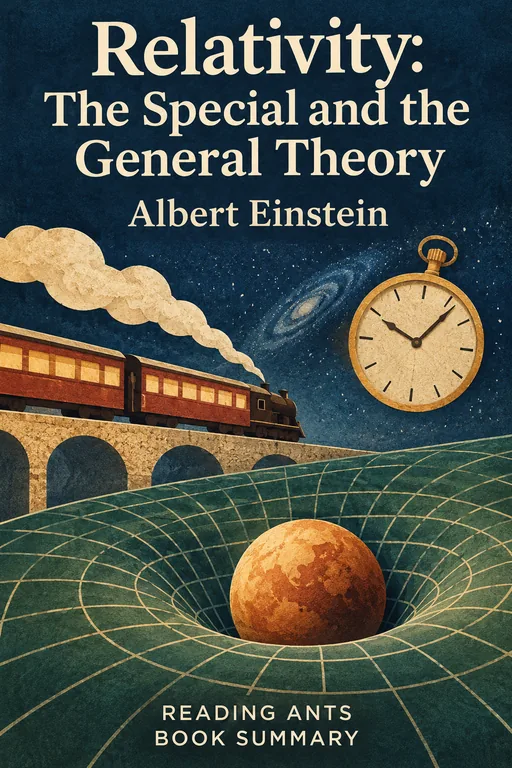
Relativity: The Special and the General Theory
Albert Einstein
Albert Einstein himself explains, for readers without advanced mathematics, how his special and general theories of relativity change our understanding of space, time, motion and gravity.
🔬 ScienceLeonardo da Vinci
Walter Isaacson
Walter Isaacson uses Leonardo da Vinci's surviving notebooks to show how a curious, restless man, born outside the usual paths of education, became both a master painter and a pioneer of science, and what we can learn from his habits of mind.
👤 Real Lives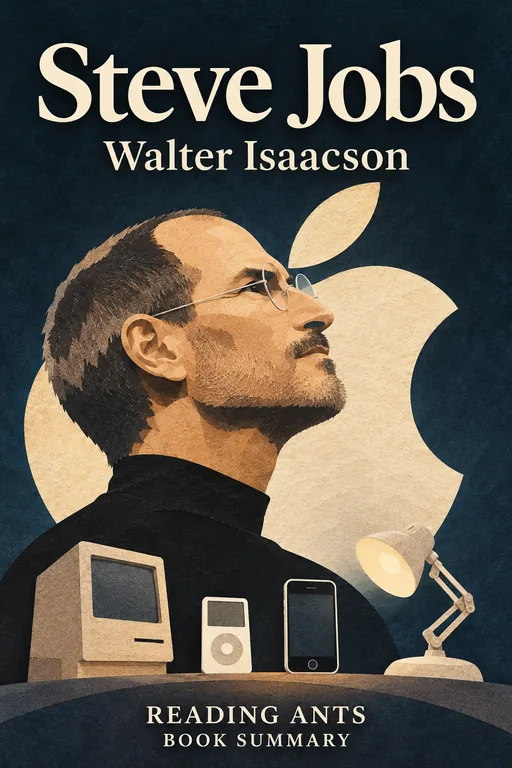
Steve Jobs
Walter Isaacson
The authorized biography of Apple's co-founder follows a brilliant, demanding and often cruel perfectionist whose focus on beautiful design transformed computers, music, phones and animated movies.
💼 Business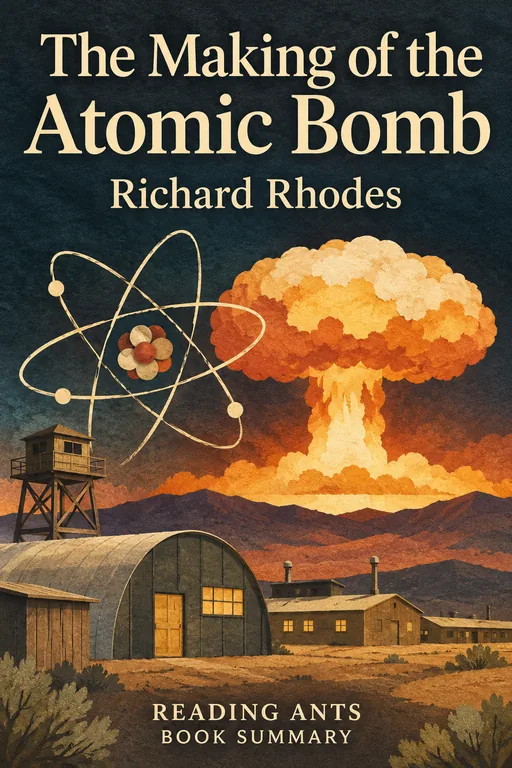
The Making of the Atomic Bomb
Richard Rhodes
Richard Rhodes tells the full story of nuclear weapons, from the physics discoveries of the late nineteenth century to the secret wartime project that built the first bombs and the explosions over Hiroshima and Nagasaki in 1945.
🏛️ History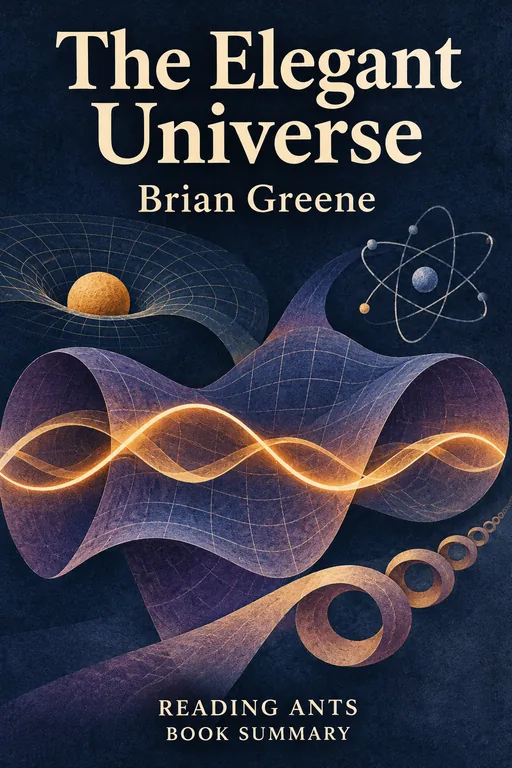
The Elegant Universe
Brian Greene
Physicist Brian Greene explains in plain language how string theory tries to unite Einstein's relativity and quantum mechanics by picturing the smallest things in nature as tiny vibrating strings in a universe with extra dimensions.
🔬 Science
A Brief History of Time
Stephen Hawking
One of the world's greatest physicists explains, with almost no math, what we know about the origin, structure and fate of the universe, from the Big Bang to black holes and the nature of time itself.
🔬 ScienceWant something different?
Pick another topic and we will show you three books to start with.