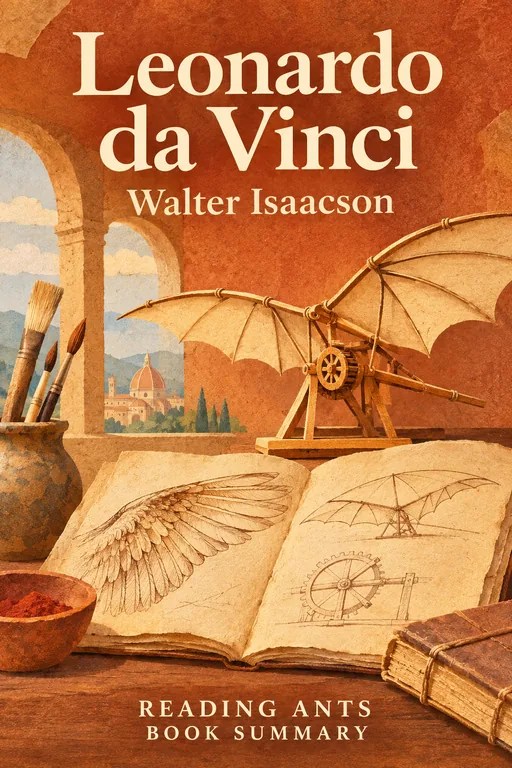
Leonardo da Vinci
Walter Isaacson uses Leonardo da Vinci's surviving notebooks to show how a curious, restless man, born outside the usual paths of education, became both a master painter and a pioneer of science, and what we can learn from his habits of mind.
Overview
Leonardo da Vinci was published in 2017 by Walter Isaacson, who has also written biographies of Steve Jobs, Albert Einstein and Benjamin Franklin. Isaacson says that the key to Leonardo’s genius was not just talent but a deep curiosity, which led him to study everything from the flight of birds to the way light falls on a face. Roughly seven thousand pages of Leonardo’s notebooks survive, full of drawings, lists and questions, and Isaacson draws on them extensively. The book follows Leonardo’s life in chronological order and also draws lessons from his example.
Full Summary
A Boy from Vinci
Leonardo was born in 1452 in a village near Vinci, in Tuscany, the illegitimate son of a notary and a young woman of a lower social class. He did not follow his father into the notary’s profession, and he did not receive a formal education in Latin and mathematics, though he trained in a workshop and later studied mathematics. Instead, he taught himself, including some Latin as an adult, and he was fascinated by the natural world. He was left-handed, and in his notebooks he wrote from right to left, in mirror script.
Apprentice in Florence
As a teenager, Leonardo was sent to Florence, to the workshop of the artist Verrocchio, where he learned painting, sculpture and metalwork. He helped paint an angel in a work by his master, and the story goes that it was so well done that it outshone the rest. He joined the guild of painters, and began to work on his own. In these years, he developed his fascination with the details of nature, and his habit of testing everything by observation and experiment.
Milan: Court Artist and Engineer
In about 1482, Leonardo went to Milan to work for the duke, Ludovico Sforza. He offered his services as a military engineer, and also as an artist and a creator of courtly entertainments. In Milan he painted The Last Supper, a mural on the wall of a convent, which shows the moment when Jesus says that one of his followers will betray him. In Milan he also met the mathematician Luca Pacioli, with whom he collaborated. He also worked on a huge horse sculpture, which was never completed, and made countless studies of anatomy, light, machines and plants.
Science and Art Together
Leonardo dissected bodies to understand how muscles and bones work, and drew the results with astonishing accuracy. He studied the flow of water, the flight of birds and the effects of light and shadow, and wrote of his findings in his notebooks. Most of this scientific work stayed unpublished, which limited its influence on other thinkers. Isaacson shows how these studies fed his painting, for instance in the way that he captured the smile and the eyes of a face, and his famous drawing of a man inside a circle and a square, known as the Vitruvian Man.
The Mona Lisa and the Later Years
After returning to Florence in the early 1500s, Leonardo began the portrait now known as the Mona Lisa, and kept working on it for years, carrying it with him on later travels. His student and companion Francesco Melzi later stayed with him in France, and Salai, a young assistant, was a long-time member of his household. He moved between Florence, Milan and Rome, and worked on many projects, some unfinished, since he was a perfectionist who often lost interest. He was sometimes accused of procrastination. His notebooks show how he continued to explore subjects such as geometry, engineering and the natural world.
France and the End
In his sixties, Leonardo accepted an invitation from the king of France, Francis I, and moved to a manor house near the royal residence at Amboise. There he lived in comfort, continued to draw and was treated as a revered master. He died in 1519, at the age of sixty-seven. Isaacson concludes with an assessment of the lessons that we can draw: stay curious, observe closely, pay attention to details, connect different fields, write things down and keep a childlike sense of wonder.
Why It Matters
Isaacson’s book brought the life and mind of Leonardo to a large audience, and it is often cited as a good introduction to him. It emphasizes that Leonardo’s achievements came from a combination of art and science, which was unusual even in his time, and from a childlike curiosity that he kept throughout life. For modern readers, it offers a model of lifelong learning and creative thinking. The book also appeared at a time of renewed attention to Leonardo, including the sale of a painting attributed to him for a record price. As a study of how genius works, it speaks to teachers, students and anyone who wishes to cultivate creativity.
Key Takeaways
- Be curious about everything. Leonardo asked questions about the smallest details.
- Observe carefully. He trusted his own eyes and experiments.
- Connect art and science. His painting benefited from his studies of anatomy and light.
- Keep notebooks. Writing and drawing helped him to think.
- Curiosity has costs. Leonardo’s endless curiosity produced remarkable work, but he also left many projects unfinished, which Isaacson treats as a flaw as well as a mark of genius.
What We Can Learn
You can start a notebook of your own, and write down questions that interest you, such as why the sky is blue or how a bird stays in the air. Practice looking at an ordinary object for a long time, and draw it. Seek out connections between different subjects, such as music and math. When you cannot finish a project, ask what you learned from it. And remember that, though Leonardo was exceptional, he developed his abilities by effort and attention, which are open to everyone.
Criticism and Counterpoints
Some reviewers say that Isaacson, who is not a specialist in the Renaissance, draws on many of the same sources as earlier biographies and offers few new findings. Others feel that the attempt to link Leonardo’s art to his science is sometimes forced, for example in explaining the Mona Lisa’s smile through his dissection of lips, and that the book is sometimes uncritical in its admiration. There are also uncertainties about the attribution and dating of a number of works. Despite this, many readers find it a clear and engaging introduction.
Who Should Read It
This book is for readers who want an accessible biography of Leonardo, and an introduction to his ideas and drawings. It is long and richly illustrated in print editions. Those who want an expert account of Renaissance art history may prefer scholarly studies, but it is a pleasing and inspiring read for the general public.
Want the whole book?
A summary is a taste, not the meal. Here is where to find the full book.
You reached the end 🎉
Nicely done. Mark this one as read, and we will suggest what to read next.
Read this next
Steve Jobs
Walter Isaacson
The authorized biography of Apple's co-founder follows a brilliant, demanding and often cruel perfectionist whose focus on beautiful design transformed computers, music, phones and animated movies.
💼 Business
Elon Musk
Walter Isaacson
Walter Isaacson's biography follows Elon Musk from a troubled childhood in South Africa to the leadership of Tesla, SpaceX and other ambitious ventures, and asks whether his risk-taking genius and his rough, impulsive side can be separated.
💼 Business
The Autobiography of Benjamin Franklin
Benjamin Franklin
Benjamin Franklin tells the story of his rise from a poor Boston boy to a successful printer, inventor and public leader in Philadelphia, and shares his methods of self-improvement.
👤 Real Lives
A Short History of Nearly Everything
Bill Bryson
Bill Bryson sets out to understand how we know what we know about the universe, the Earth and life, and tells the story through the odd, brilliant and sometimes unlucky people who figured it out.
🏛️ History
The Innovators
Walter Isaacson
Walter Isaacson tells the history of the digital revolution through the people who invented the computer, the internet and the web, and argues that innovation is mostly the product of collaboration, not the work of lone geniuses.
💡 Technology
Man's Search for Meaning
Viktor E. Frankl
A psychiatrist who survived the Nazi concentration camps explains that even in the worst suffering, people can choose their attitude, and that finding a reason to live is what gives us the strength to endure.
👤 Real LivesWant something different?
Pick another topic and we will show you three books to start with.