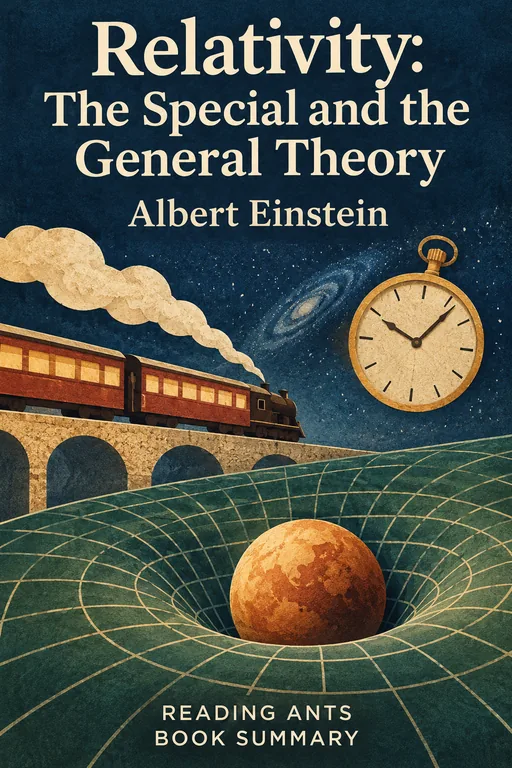
Relativity: The Special and the General Theory
Original title: Über die spezielle und die allgemeine Relativitätstheorie
Albert Einstein himself explains, for readers without advanced mathematics, how his special and general theories of relativity change our understanding of space, time, motion and gravity.
Overview
Relativity: The Special and the General Theory: A Popular Exposition was written by Albert Einstein in 1916 and published in German in 1917, and in English a few years later. Einstein had published the special theory in 1905 and the general theory in 1915, and wanted to make the ideas accessible to educated readers who were not physicists. The book is in three parts, which cover the special theory, the general theory and some considerations about the universe as a whole. It uses simple examples, such as trains and embankments, and requires only school mathematics.
Full Summary
1. Space, time and the problem of motion
The idea: Einstein begins with ideas about geometry and about how we describe the position and motion of an object. To say where something is, we need a reference body, such as the ground. A man walking along a train, for example, moves relative to the train, and at another speed relative to the embankment. Classical physics assumed that there is a simple rule for adding speeds, and an absolute time that is the same for everybody. He shows that this must be examined.
In real life: A passenger on a moving train appears still to a person on the train, and in motion to someone on the platform.
2. The speed of light and the relativity of simultaneity
The idea: The central fact of the special theory is that the speed of light in empty space is the same for all observers, regardless of their motion. This seems to conflict with the rule for adding speeds. Einstein resolves it by questioning the idea of simultaneity: two events that are simultaneous for one observer, such as two lightning strikes, need not be for another observer moving relative to the first. Time is not absolute but depends on the observer.
In real life: Two people in motion relative to each other may disagree about which of two flashes happened first.
3. Length, time and mass change with speed
The idea: From these ideas follow results: a moving clock runs slow compared with one at rest, a moving rod is shorter in the direction of motion, and the faster an object moves, the more energy is needed to speed it up, so that nothing with mass can reach the speed of light. These effects are tiny at everyday speeds, but large near the speed of light. He also presents the famous link between mass and energy, which is that they are equivalent.
In real life: Astronauts on a fast spacecraft would age a little more slowly than people on Earth.
4. The general theory: gravity and acceleration
The idea: The second part extends the theory to accelerating motion and gravity. Einstein uses the thought experiment of a person in a closed box, who cannot tell whether the box is resting on the Earth and pulled by gravity, or being accelerated through space. This principle of equivalence suggests that gravity and acceleration are closely related. He concludes that gravity affects light, and that the geometry of space is changed by matter.
In real life: The feeling of being pushed back in your seat when a car accelerates resembles the feeling of gravity.
5. Curved space and tests of the theory
The idea: In the general theory, the presence of mass curves space-time, so that the geometry is not the flat Euclidean geometry of school, but a curved one. Einstein describes three tests: the small change in the orbit of Mercury, which Newton’s theory could not fully explain, the bending of starlight passing near the Sun, which was observed during a solar eclipse in 1919, and the shift in the spectrum of light from heavy stars. The Mercury anomaly was already known and the new theory accounted for it; the bending of starlight was first confirmed by two British eclipse expeditions in 1919, and the shift in the spectral lines was confirmed some years later.
In real life: Starlight appears slightly displaced when its path grazes the Sun.
6. The universe as a whole
The idea: The final part considers what the theory implies for the universe. Einstein suggests that space may be finite but unbounded, like the surface of a sphere, which has no edge but a limited area. He uses analogies of two-dimensional beings living on a surface, to help the reader imagine a curved three-dimensional space. He opens the part by pointing out that Newton’s theory struggles with an infinite universe full of stars, and then offers the finite-but-unbounded picture as a possibility. In appendices, he describes the experimental confirmation of the theory, and in a later appendix he notes that the expanding universe, discovered afterward, changed the cosmological picture.
In real life: An ant on a globe can walk forever without reaching an edge.
Why It Matters
Relativity is among the most influential science books ever written, and the best-known account of the theory by its creator for the general public. It helped to make Einstein’s ideas known, and the theory of relativity became a cornerstone of modern physics, with practical effects such as the correction needed in GPS systems. The book is also a model of how to present science clearly. Though some of the language is dated, it remains in print and is read by students and by anyone curious about the origins of modern physics. Einstein’s explanations show how thought experiments can reveal hidden assumptions.
Key Takeaways
- The speed of light is constant. It is the same for all observers.
- Time and space are relative. They depend on motion.
- Gravity is geometry. Mass curves space-time.
- Theories are tested by observation. The bending of starlight confirmed Einstein.
- Thought experiments reveal ideas. Simple examples can show deep truths.
What We Can Learn
You can use the book as an example of how to think clearly about a hard problem, by questioning assumptions that seem obvious. Try the train examples with a friend, and see how the results surprise you. Notice how a theory makes predictions that can be tested, and how it changes if they fail. If you find the book difficult, read a modern guide alongside it. And enjoy the idea that nature can be understood by patient reasoning and imagination.
Criticism and Counterpoints
Some readers find the book dated in language, with its references to the physics of the time, and note that the explanations of the general theory are brief, so that without mathematics it is hard to grasp. Physicists point out that later developments, such as the expansion of the universe, black holes and the quantum theory, go beyond the book, and that Einstein later changed his view of the cosmological constant. Others say that the popular analogies can mislead. Still, as a clear first-hand account, it has lasting value.
Who Should Read It
This book is for readers who want to meet the theory in the words of its author, and who are willing to think carefully. It is short, though not easy. Those who prefer a modern and more illustrated approach may start with a recent popular book and then read Einstein.
Want the whole book?
A summary is a taste, not the meal. Here is where to find the full book.
You reached the end 🎉
Nicely done. Mark this one as read, and we will suggest what to read next.
Read this next
The Elegant Universe
Brian Greene
Physicist Brian Greene explains in plain language how string theory tries to unite Einstein's relativity and quantum mechanics by picturing the smallest things in nature as tiny vibrating strings in a universe with extra dimensions.
🔬 Science
Seven Brief Lessons on Physics
Carlo Rovelli
Italian physicist Carlo Rovelli gives seven short, poetic lessons on the biggest ideas in modern physics, from Einstein's relativity to quantum theory, the structure of the cosmos, particles, gravity, heat and time, and our place in it all.
🔬 ScienceEinstein: His Life and Universe
Walter Isaacson
Walter Isaacson's biography follows Albert Einstein from a rebellious schoolboy to the greatest physicist of the twentieth century, and shows how his creativity, nonconformity and imagination, and his flaws as a person, shaped his science and his life.
🔬 Science
A Brief History of Time
Stephen Hawking
One of the world's greatest physicists explains, with almost no math, what we know about the origin, structure and fate of the universe, from the Big Bang to black holes and the nature of time itself.
🔬 Science
Principia Mathematica (Mathematical Principles of Natural Philosophy)
Isaac Newton
Isaac Newton lays out the laws of motion and the law of universal gravitation, and shows by mathematics that the same force that makes objects fall on Earth also keeps the Moon and planets in their orbits.
🔬 Science
On the Origin of Species
Charles Darwin
All living things are related and have slowly changed over immense periods of time, shaped by natural selection, the process by which individuals better suited to their environment survive and pass on their traits.
🔬 ScienceWant something different?
Pick another topic and we will show you three books to start with.