 Reading Ants
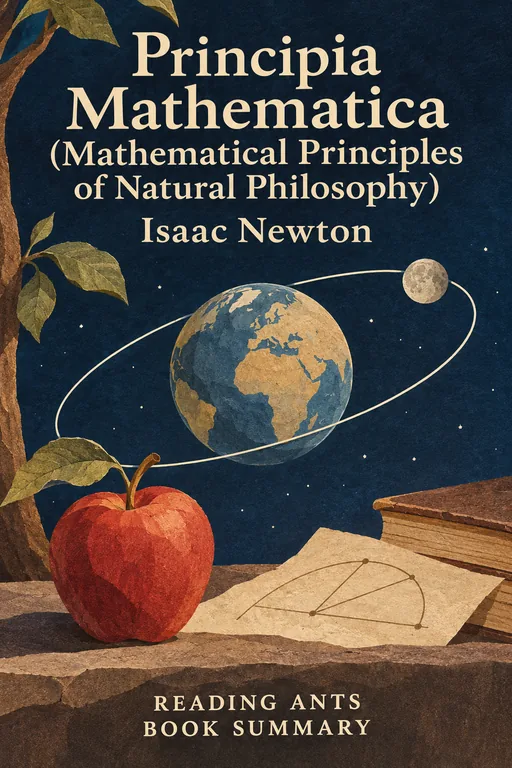
Principia Mathematica (Mathematical Principles of Natural Philosophy)
Original title: Philosophiæ Naturalis Principia Mathematica
Isaac Newton lays out the laws of motion and the law of universal gravitation, and shows by mathematics that the same force that makes objects fall on Earth also keeps the Moon and planets in their orbits.
Overview
The Principia, full title Philosophiae Naturalis Principia Mathematica, was published in Latin in 1687 by Isaac Newton, an English mathematician and natural philosopher at Cambridge University. It was prompted by a question from the astronomer Edmond Halley, who encouraged Newton and paid for the printing. The book has three parts, called books. The first two deal with the motion of bodies, in free space and in resisting media, and the third applies it to the system of the world. It is written in the style of geometry, with definitions, axioms and proofs, and is among the most important scientific works ever written.
Full Summary
1. Definitions and the three laws of motion
The idea: Newton starts with definitions of terms such as mass, momentum and force, and then states three laws. The first says that an object stays at rest or moves in a straight line at constant speed unless a force acts on it, which is inertia. The second says that the change in motion is proportional to the force applied, which links force, mass and acceleration. The third says that to every action there is an equal and opposite reaction. These laws became the foundation of classical mechanics.
In real life: A ball rolling on smooth ice keeps going until something stops it.
2. Absolute space and time
The idea: In a famous passage, Newton distinguishes absolute space and time, which exist independently of anything, from the relative measures that we use. He argues for the reality of absolute motion using the example of a bucket of water that spins, in which the water climbs the sides, showing an effect that does not depend on motion relative to the surroundings. This view was later challenged by Einstein, but it was the framework of physics for two centuries.
In real life: A spinning merry-go-round makes you feel pushed outward, as though space itself matters.
3. Motion under central forces, and Kepler’s laws
The idea: In Book One, Newton develops mathematics to study how bodies move when attracted toward a center. He shows that, if a force pulls a body toward a point, the body sweeps out equal areas in equal times, which is one of Kepler’s laws. He also proves that an inverse-square force, which weakens with the square of the distance, makes bodies move in ellipses, as the planets do. This links the theory to observations by astronomers such as Kepler and Tycho Brahe.
In real life: A skater who pulls in her arms spins faster, and the same type of rule governs planets.
4. Universal gravitation
The idea: In Book Three, Newton states that the same force of gravity acts between all pieces of matter in the universe, and is proportional to the product of their masses and inversely proportional to the square of the distance between them. He shows that this explains the orbit of the Moon, the motion of the planets and moons, the paths of comets and the tides. The unity of earthly and heavenly physics was a revolutionary idea.
In real life: The force that pulls a falling apple is the one that holds the Moon in orbit.
5. Explaining the world: tides, comets and the shape of the Earth
The idea: Newton applies the theory to many phenomena. He explains the tides as the result of the Moon’s and Sun’s gravitational pull on the oceans. He predicts that the Earth is slightly flattened at the poles, because of its rotation, which was later confirmed. He treats the orbits of comets, and works out the relative amounts of matter in the Sun, Jupiter, Saturn and the Earth by comparing the orbit of Venus around the Sun with the orbits of satellites around Jupiter and Saturn and of the Moon around the Earth. His success in explaining such diverse facts with a few principles made his system convincing.
In real life: High tides come twice a day because of the pull of the Moon.
6. The rules of reasoning and the method
The idea: Newton includes rules of reasoning in philosophy, which state that we should admit no more causes than are true and sufficient to explain phenomena, that the same effects have the same causes and that qualities found in all bodies we can test are to be taken as universal. He also famously says that he does not make up hypotheses about the cause of gravity, but is content to describe how it acts. This emphasis on evidence and mathematics shaped modern science.
In real life: A scientist prefers a simple explanation that fits the facts over a complicated one.
Why It Matters
The Principia is regarded as one of the greatest works in the history of science, and the foundation of classical physics. It showed that the universe obeys mathematical laws that can be discovered by reason and observation, and gave rise to the idea of a clockwork universe. Its methods and results were used for engineering, navigation and astronomy for centuries, and are still used today for most everyday calculations and for space missions. The book changed how people understood their place in nature, and inspired the Enlightenment. Though Einstein’s relativity and quantum theory later refined the picture, Newton’s laws remain a central part of science education.
Key Takeaways
- Three laws govern motion. Inertia, force and acceleration, and action and reaction.
- Gravity is universal. The same law applies on Earth and in the heavens.
- Mathematics describes nature. Physical laws can be written precisely.
- Simple principles explain many facts. Tides, orbits and comets follow the same rules.
- Evidence guides theory. Newton insisted on testing explanations against observation.
What We Can Learn
You can use Newton’s example to see how a few simple principles can explain many things. Try observing things around you, such as a ball thrown in the air, and describing them with the laws of motion. Notice that scientific theories are improved over time, and that Newton’s work was later refined, as part of the normal development of knowledge. If you are interested, read a modern guide to the Principia alongside excerpts. And remember that curiosity and careful thought can reveal order in nature.
Criticism and Counterpoints
Some scholars note that the book is very difficult to read, since it uses classical geometry, and that most readers learn Newton’s results through later textbooks. His concept of absolute space and time was criticized by Leibniz and others, and later replaced by Einstein’s relativity, and quantum mechanics showed that his laws fail at very small scales. Newton also faced criticism for the idea of action at a distance, which had no explanation. Historians also point out that he spent much time on alchemy and theology, which complicates the image of the pure scientist. His priority dispute with Leibniz over calculus was bitter.
Who Should Read It
This book is for students of science and history, and for those who want to meet one of the great works of science. It is extremely demanding, and most people read selections or a commentary. Those who want the main ideas can read a good modern summary.
Want the whole book?
A summary is a taste, not the meal. Here is where to find the full book.
You reached the end 🎉
Nicely done. Mark this one as read, and we will suggest what to read next.
Read this next
Relativity: The Special and the General Theory
Albert Einstein
Albert Einstein himself explains, for readers without advanced mathematics, how his special and general theories of relativity change our understanding of space, time, motion and gravity.
🔬 Science
The Elegant Universe
Brian Greene
Physicist Brian Greene explains in plain language how string theory tries to unite Einstein's relativity and quantum mechanics by picturing the smallest things in nature as tiny vibrating strings in a universe with extra dimensions.
🔬 Science
The Voyage of the Beagle
Charles Darwin
Charles Darwin's lively journal of his five-year voyage around the world on HMS Beagle records the animals, plants, rocks and peoples that he saw, and the observations that led him toward the theory of evolution.
🔬 Science
The Double Helix
James D. Watson
James Watson gives a personal, frank and controversial account of how he and Francis Crick worked out the double-helix structure of DNA in 1953, and of the rivalry, luck and ambition that went with it.
🔬 Science
Einstein: His Life and Universe
Walter Isaacson
Walter Isaacson's biography follows Albert Einstein from a rebellious schoolboy to the greatest physicist of the twentieth century, and shows how his creativity, nonconformity and imagination, and his flaws as a person, shaped his science and his life.
🔬 Science
A Brief History of Time
Stephen Hawking
One of the world's greatest physicists explains, with almost no math, what we know about the origin, structure and fate of the universe, from the Big Bang to black holes and the nature of time itself.
🔬 ScienceWant something different?
Pick another topic and we will show you three books to start with.