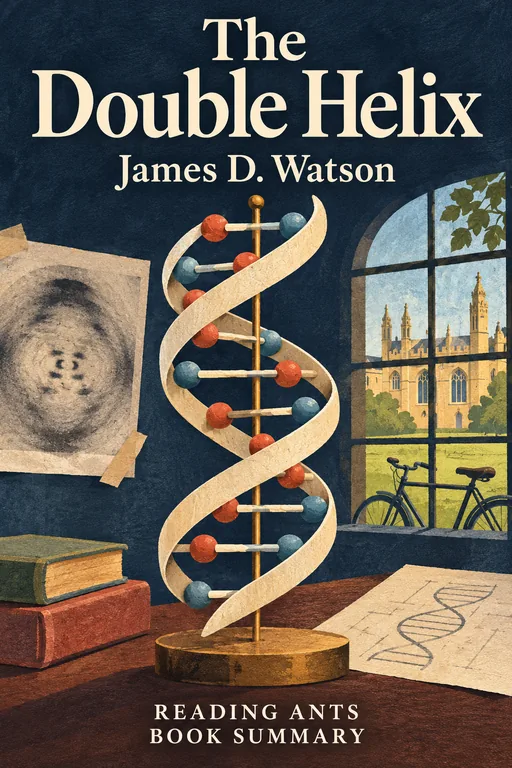
The Double Helix
James Watson gives a personal, frank and controversial account of how he and Francis Crick worked out the double-helix structure of DNA in 1953, and of the rivalry, luck and ambition that went with it.
Overview
The Double Helix: A Personal Account of the Discovery of the Structure of DNA was published in 1968 by James D. Watson, an American biologist who was twenty-four years old when the discovery was made. Together with Francis Crick, he proposed the structure of DNA, the molecule that carries genetic information, at the Cavendish Laboratory in Cambridge, England. They were awarded the Nobel Prize in 1962 with Maurice Wilkins. The book is written in a lively, informal style, like a novel, and gives a candid picture of scientists as ambitious human beings. It caused a stir, since several colleagues objected to how they were portrayed.
Full Summary
1. Arriving in Cambridge
The idea: Watson tells how he came to Cambridge as a young postdoctoral researcher, hoping to find the secret of the gene. He meets Francis Crick, a physicist turned biologist, who is brilliant, talkative and about a dozen years older. The two quickly form a partnership. They share a conviction that the structure of DNA is the key to understanding heredity, and that knowing it would explain how genes copy themselves.
In real life: Two people with the same obsession can spur each other on.
2. The rivals and the collaborators
The idea: Watson describes the world of the scientists working on DNA. At King’s College in London, Maurice Wilkins and Rosalind Franklin used X-ray photographs to study the molecule, and their relationship was tense. In the United States, the famous chemist Linus Pauling was working on a structure and was seen as a rival. Watson and Crick, who had no X-ray data on DNA of their own, wanted to build models, using data from others, and feared that Pauling would get there first.
In real life: A race can make friends of some and rivals of others.
3. Early mistakes
The idea: In late 1951, Watson and Crick built a first model of DNA, a triple helix with the phosphate groups on the inside, and showed it to the King’s College group. Franklin pointed out that it was wrong, as the placement of the phosphate groups did not fit the amount of water that DNA holds. The failure embarrassed them, and their boss told them to stop working on DNA. For a time they were officially stopped, but they continued to think about it, and to read the data.
In real life: Presenting a flawed idea too early can be embarrassing but can also lead to learning.
4. The clues: photographs and base pairing
The idea: Several pieces of information proved crucial. An X-ray photograph of DNA taken by Rosalind Franklin and her student Raymond Gosling showed a pattern that pointed to a helix, and Watson saw it, with Wilkins showing it to him, without Franklin’s knowledge. Crick also learned of data from a report that fixed key measurements. And the biochemist Erwin Chargaff had found that the amounts of the bases adenine and thymine are equal, and likewise guanine and cytosine, a clue to pairing.
In real life: A discovery often depends on pieces of data from different people.
5. The model falls into place
The idea: In early 1953, Watson, playing with cardboard cutouts of the bases, realized that adenine pairs with thymine and guanine with cytosine through hydrogen bonds, and that the pairs have the same shape, so that they fit inside a double helix with the backbones outside. The two strands run in opposite directions. The structure immediately suggested how DNA could copy itself, as each strand could serve as a template for a new one. Crick and Watson built a full metal model.
In real life: A simple pattern, such as matching shapes, can explain something very deep.
6. Announcement and aftermath
The idea: Watson and Crick wrote a short paper in the journal Nature in April 1953, published together with papers by Wilkins and Franklin and their colleagues. Their paper ended with a modest remark that the specific pairing suggested a copying mechanism. In the book, Watson describes the excitement and the relief, and the congratulations from colleagues. He ends with an epilogue that praises Franklin, whom he had often criticized, for her intelligence, and that notes her early death in 1958.
In real life: Sometimes credit is given late, and fairness may require us to correct the record.
Why It Matters
The Double Helix is one of the most famous science memoirs, and it changed how the public sees science, by showing the competition and human flaws behind a great discovery. The discovery of the structure of DNA opened the way to modern genetics, biotechnology and medicine, including genetic engineering, DNA fingerprinting and the sequencing of the human genome. The book also began a lasting debate about credit, particularly regarding Rosalind Franklin, whose data were essential, and who did not live to share in the Nobel Prize. It is widely read in science courses, and is a lively introduction to how research is done.
Key Takeaways
- Structure explains function. The shape of DNA revealed how heredity works.
- Science is a human endeavor. Rivalry and ambition play a role.
- Collaboration and data sharing matter. The model depended on others’ work.
- Credit and fairness are important. Franklin’s contribution was not fully recognized.
- Good luck helps prepared minds. The discovery combined insight with chance.
What We Can Learn
You can use the book to see how scientific discoveries are made: through questions, mistakes, models and sudden insight. Notice the importance of sharing data, and of giving credit to those whose work you use. Be aware that a lively story may be told from one person’s side, and look for other accounts, including those of Franklin’s friends and biographers. Consider how your own team treats the contributions of each member. And let the story inspire curiosity about biology and the molecules of life.
Criticism and Counterpoints
Many critics say that Watson treats Rosalind Franklin unfairly, depicting her in a dismissive and sexist way, and downplaying her contribution, and that the use of her data without her knowledge raises ethical questions. Others, including some colleagues, felt that the book misrepresented them, and that it is a one-sided and self-serving story. Historians point out that the account is told from memory and in a style that dramatizes events. Watson’s later controversial statements have also affected how the book is viewed. Still, as a document of its time, it remains a lively read.
Who Should Read It
This book is for readers interested in science, history and human stories of discovery. It is short and entertaining. It is best read alongside other accounts, such as biographies of Rosalind Franklin, to get a fuller and fairer picture.
Want the whole book?
A summary is a taste, not the meal. Here is where to find the full book.
You reached the end 🎉
Nicely done. Mark this one as read, and we will suggest what to read next.
Read this next
The Gene: An Intimate History
Siddhartha Mukherjee
Physician and writer Siddhartha Mukherjee tells the story of the gene, from Mendel's pea plants to gene editing, weaving in the history of his own family's experience with mental illness and asking what mastery over heredity means.
🔬 Science
The Blind Watchmaker
Richard Dawkins
Richard Dawkins argues that the complex, designed-looking features of living things are the result of natural selection acting cumulatively over vast time, a process with no foresight, which he calls a blind watchmaker.
🔬 Science
Lab Girl
Hope Jahren
Geobiologist Hope Jahren interweaves the story of her life as a scientist, with its struggles and her deep friendship with her lab partner Bill, with lyrical chapters on how plants live, grow and survive.
🔬 Science
Your Inner Fish
Neil Shubin
Paleontologist Neil Shubin shows, through the discovery of a fossil fish with the beginnings of limbs, that the human body carries traces of its ancient ancestors, so that our hands, heads and even hiccups can be explained by evolution.
🔬 Science
The Right Stuff
Tom Wolfe
Tom Wolfe tells the story of the test pilots who pushed the limits of flight in the 1940s and 1950s, and the seven astronauts who became America's first space heroes, in a vivid style that explores what it takes to have "the right stuff."
🔬 Science
A Brief History of Time
Stephen Hawking
One of the world's greatest physicists explains, with almost no math, what we know about the origin, structure and fate of the universe, from the Big Bang to black holes and the nature of time itself.
🔬 ScienceWant something different?
Pick another topic and we will show you three books to start with.