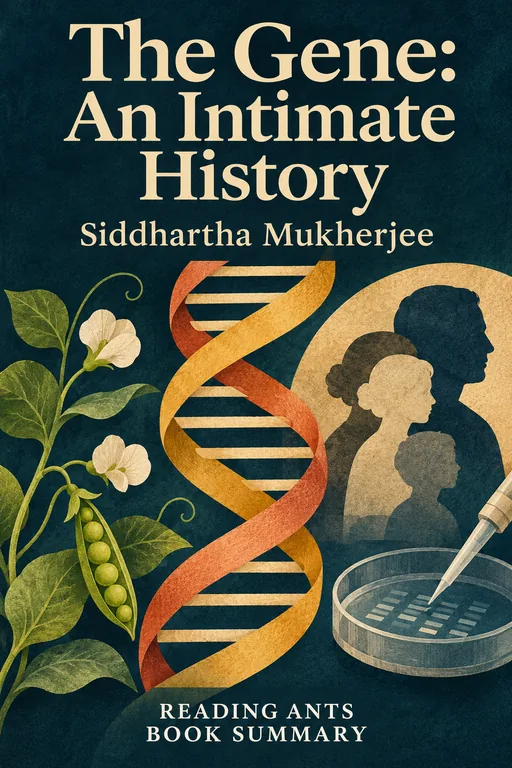
The Gene: An Intimate History
Physician and writer Siddhartha Mukherjee tells the story of the gene, from Mendel's pea plants to gene editing, weaving in the history of his own family's experience with mental illness and asking what mastery over heredity means.
Overview
The Gene: An Intimate History was published in 2016 by Siddhartha Mukherjee, an oncologist and professor at Columbia University who won the Pulitzer Prize for his earlier book on cancer, The Emperor of All Maladies. Part of his motive was personal: some of his relatives suffered from schizophrenia and bipolar illness, and he wondered how much their fate was written in their genes. The book follows the science from early ideas about heredity, through Mendel in the mid-nineteenth century, to the early twenty-first century, and ends with a look at the future of genetic technology. It was a bestseller, and a PBS documentary series followed in 2020.
Full Summary
1. Mendel and the idea of heredity
The idea: Mukherjee begins with Gregor Mendel, a monk in a monastery in what is now the Czech Republic, who, in the 1850s and 1860s, crossbred pea plants and counted the results. He found that traits such as height and color are passed on in discrete units, and appear in predictable ratios, with some traits dominant and others recessive. His work was published in 1866 and ignored for decades, until it was rediscovered around 1900. This was the first step toward the idea of the gene.
In real life: Two brown-eyed parents may have a blue-eyed child, since traits can be carried without showing.
2. Darwin, eugenics and a dark chapter
The idea: The author describes how Darwin’s theory of evolution raised questions about inheritance, and how Francis Galton, Darwin’s cousin, started the eugenics movement, which aimed to improve the human race by breeding. In the early twentieth century, ideas about “unfit” people led to laws of forced sterilization in the United States and to the policies of Nazi Germany, which ended in genocide. Mukherjee shows how bad science and prejudice were combined, and why we must be vigilant.
In real life: Claims that some people are born “inferior” have been used to justify cruelty.
3. DNA: the molecule of heredity
The idea: The story moves to the twentieth century, when scientists such as Thomas Hunt Morgan, with his fruit flies, showed that genes are carried on chromosomes. Experiments by Oswald Avery in the 1940s showed that DNA is the carrier of genetic information, and in 1953 Watson and Crick, using data from Franklin and Wilkins, revealed its double-helix structure. The code, in which sequences of bases specify proteins, was then cracked. Mukherjee describes this as a conceptual leap, that heredity is information.
In real life: A recipe written in letters tells a cell how to make the proteins that it needs.
4. Reading and writing genes
The idea: In the 1970s, scientists learned how to cut and paste DNA, creating recombinant DNA and starting the age of genetic engineering. The ethical worries led to a meeting in 1975, in which scientists proposed rules. Soon after, genes could be cloned and sequenced. The Human Genome Project, begun in 1990, produced a draft of the human genome by 2000. Mukherjee discusses what we have learned, and that most of the genome does not code for proteins.
In real life: Reading a genome is like reading a very long book, in which most of the pages are not yet understood.
5. Genes, identity and illness
The idea: Mukherjee looks at how genes shape who we are, and the limits of that influence. Some conditions, such as Huntington’s disease, are caused by a single gene, while many traits and conditions, such as height and schizophrenia, involve many genes and the environment. He tells how, in his own family, relatives suffered from mental illness, and he asks whether the risk is inherited. He shows that genes give tendencies, not destiny, and that chance and surroundings also matter.
In real life: A family history of a disease raises the risk, but does not make it certain.
6. The future: gene therapy and editing
The idea: In the last part, the author explores new possibilities, such as gene therapy to treat disease, genetic testing of embryos and the gene-editing tool CRISPR, which can change DNA precisely. He raises questions about how far we should go: should we remove disease genes, and what about enhancing traits? The first cases of gene-edited babies, announced in 2018, came after the book. He urges thoughtful public debate, and humility, remembering the lessons of the past.
In real life: A power to rewrite the code of life brings both hope and responsibility.
Why It Matters
The Gene became a bestseller and helped many readers to grasp the history and importance of genetics, as well as its ethical questions. It is praised for its storytelling and for linking science with human lives. The book appeared as gene-editing technology made the questions urgent, and contributed to public discussion of how to use it. It won the 2017 Phi Beta Kappa Award in Science and was shortlisted for the Wellcome Book Prize that year. Mukherjee’s blend of science, history and personal narrative also made it a model for modern science writing, and it reached a wide audience of readers who wanted to understand what their own genes might mean.
Key Takeaways
- Genes are units of heredity. They carry information that shapes traits.
- DNA is the code. Its sequence specifies proteins.
- Genes are not destiny. Environment and chance matter too.
- History warns us. Eugenics shows the dangers of misusing genetics.
- New tools bring choices. Gene editing needs careful ethical thought.
What We Can Learn
You can use the book to understand what a gene is, and why family history matters for health, while remembering that genes are not a verdict. Be skeptical of claims that explain human worth or behavior by genes alone. Learn about the history of eugenics, so that you can recognize its echoes. Take part in discussions about genetic technologies, which will affect your generation. And, if you have concerns about your family’s health, speak to a doctor or genetic counselor, not to a book.
Criticism and Counterpoints
As a popular history, the book simplifies complex topics, and genetics is changing quickly with new research, so some of what it says is already being refined. It is also long, and it interweaves personal history with the science. The most public criticism came after an excerpt in The New Yorker in 2016, in which Mukherjee stressed epigenetic factors. Several geneticists argued that these play only a minor role, and Mukherjee acknowledged that he had left out key areas of the science, though he said he had not meant to mislead. Nonetheless, it is widely seen as a thoughtful and well-written overview.
Who Should Read It
This book is for readers interested in biology, medicine and history, and for those who want to understand the debates about gene editing. It is long and rich, though not too technical. Those who prefer a shorter introduction might start with a briefer guide to genetics.
Want the whole book?
A summary is a taste, not the meal. Here is where to find the full book.
You reached the end 🎉
Nicely done. Mark this one as read, and we will suggest what to read next.
Read this next
The Double Helix
James D. Watson
James Watson gives a personal, frank and controversial account of how he and Francis Crick worked out the double-helix structure of DNA in 1953, and of the rivalry, luck and ambition that went with it.
🔬 Science
The Blind Watchmaker
Richard Dawkins
Richard Dawkins argues that the complex, designed-looking features of living things are the result of natural selection acting cumulatively over vast time, a process with no foresight, which he calls a blind watchmaker.
🔬 Science
Your Inner Fish
Neil Shubin
Paleontologist Neil Shubin shows, through the discovery of a fossil fish with the beginnings of limbs, that the human body carries traces of its ancient ancestors, so that our hands, heads and even hiccups can be explained by evolution.
🔬 Science
The Emperor of All Maladies
Siddhartha Mukherjee
Physician Siddhartha Mukherjee tells the history of cancer from ancient times to the present, showing how doctors and researchers have fought a disease that is, at its heart, a distortion of our own cells.
🔬 Science
The Body: A Guide for Occupants
Bill Bryson
Bill Bryson takes a funny and amazed tour of the human body, from the skin to the brain, and the history of those who have studied it, to show how remarkable, complicated and fragile our bodies are.
🔬 Science
A Brief History of Time
Stephen Hawking
One of the world's greatest physicists explains, with almost no math, what we know about the origin, structure and fate of the universe, from the Big Bang to black holes and the nature of time itself.
🔬 ScienceWant something different?
Pick another topic and we will show you three books to start with.