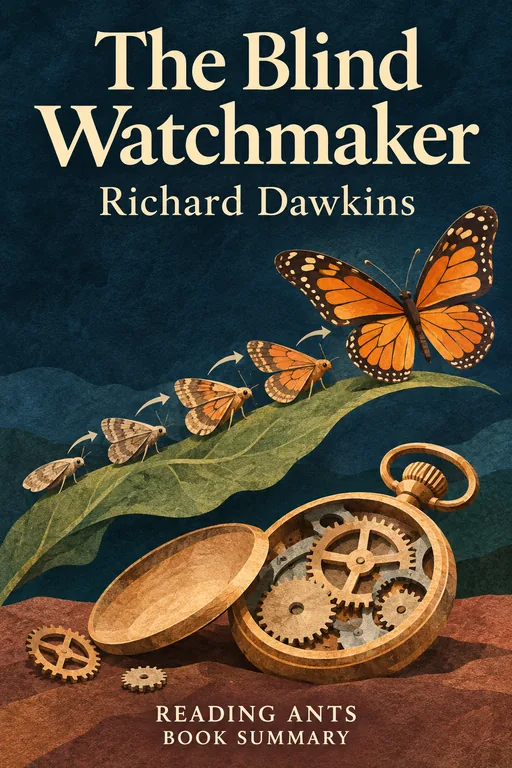
The Blind Watchmaker
Richard Dawkins argues that the complex, designed-looking features of living things are the result of natural selection acting cumulatively over vast time, a process with no foresight, which he calls a blind watchmaker.
Overview
The Blind Watchmaker: Why the Evidence of Evolution Reveals a Universe Without Design was published in 1986 by Richard Dawkins, a British evolutionary biologist and author of The Selfish Gene. The title answers a famous argument by the English theologian William Paley, who said that if you found a watch on the ground, you would infer a watchmaker, and that the complexity of living things similarly implies a designer. Dawkins accepts that living things look designed, but says that Darwin showed how they can arise without a designer. The book explains how, with analogies, examples and a computer simulation.
Full Summary
1. The appearance of design
The idea: Dawkins begins with the wonder of living things: the eye, the wing, the echolocation of bats. They seem so well-adapted to their purposes that they look designed, and, in an important sense, they are “designed” to survive. The question, he says, is how complex order can come from simple beginnings. He praises Paley for stating the problem with sincerity and good scholarship, but says that Paley’s answer, a designer, is wrong: the only watchmaker in nature is natural selection, which has no foresight.
In real life: A beautifully crafted tool suggests a maker, but a river valley also looks shaped for flowing water, without anyone designing it.
2. Cumulative selection
The idea: The central idea of the book is the difference between single-step selection, which is pure chance, and cumulative selection, in which small improvements are kept and built upon. He illustrates it with a computer program, often called the weasel program, that tries to evolve a short line of Shakespeare from random letters. If it has to get all right at once, it would take longer than the age of the universe, but if each correct letter is kept and the rest are varied, the target is reached in a short time. Evolution works by cumulative selection.
In real life: Writing an essay by revising draft after draft produces better results than writing it once at random.
3. Biomorphs: the power of small steps
The idea: Dawkins describes a program that he wrote, which draws branching shapes called biomorphs, from a few “genes.” At each generation, the user selects one offspring to breed, and over time, surprisingly complex forms evolve, such as insects and trees. This shows how a simple rule of random variation and selection can generate forms that no one planned. He notes that the “watchmaker” in nature is blind: it has no goal or foresight, and only the survival of the fittest copies.
In real life: Breeders of dogs and roses make big changes by choosing parents over many generations.
4. Answering the doubters: the eye and the wing
The idea: Critics ask how complex organs, such as the eye, could arise, since half an eye is no use. Dawkins replies that half an eye is better than none, and that a series of intermediate stages can be found in living animals, from light-sensitive patches to the cup eye to the lens eye. He similarly explains wings and other organs as gradual developments, in which every step offers some advantage.
In real life: A rough map is better than no map, and each improvement helps a little more.
5. Punctuations, gradualism and the history of life
The idea: The author discusses debates among biologists about the pace of evolution, such as the theory of punctuated equilibrium proposed by Niles Eldredge and Stephen Jay Gould. Dawkins argues that the differences have been exaggerated, and that evolution is gradual, though the speed may vary. He also treats the history of life and the tree of descent, including how molecular evidence from DNA and proteins can help to reveal family relationships between species, and he explains why rival theories, such as that of Lamarck, fail.
In real life: A river may flow quickly in some places and slowly in others, but it is the same river.
6. Origins, replicators and why it matters
The idea: In the middle of the book, Dawkins discusses how the whole process might have begun, with the arrival of simple self-copying molecules, which he calls replicators, in the early Earth. He also takes up the idea that a creator might at least have set up the first replicators, which he calls a self-defeating argument, since a designer able to do that would itself be highly complex and would need explaining. He holds that natural selection is the only known explanation that can account for organized complexity without invoking prior complexity. He had already said in the first chapter that Darwin made it possible to be an intellectually fulfilled atheist, a statement that he expands in later works.
In real life: Once a copying process starts, even very small differences can accumulate.
Why It Matters
The Blind Watchmaker is regarded as a classic of popular science writing, and has been one of the most persuasive presentations of evolution by natural selection for general readers. It won the Los Angeles Times Book Prize for Current Interest and the Heinemann Award, and it has been widely read in debates about evolution and design. The book clarified the logic of cumulative selection, and its analogies, such as the weasel program and biomorphs, are often cited. It also strengthened the public profile of Dawkins as a defender of science and secular views. Along with his later works, it has been a subject of lively discussion between scientists and religious thinkers.
Key Takeaways
- Design can come from selection. Natural selection can produce complex adaptation without a designer.
- Cumulative selection is powerful. Small improvements add up.
- Complex organs evolve in steps. Intermediate forms are useful.
- The watchmaker is blind. Evolution has no foresight or goals.
- Evidence supports evolution. Fossils, genes and comparisons agree.
What We Can Learn
You can use the book to understand how evolution works, and to see why the idea that something is too complex to have arisen by chance is not an argument against it. Try the idea of cumulative selection in daily life: improve something a little at a time, keeping what works. Distinguish between luck and gradual improvement. Be willing to examine your own assumptions, and look at evidence. And note that the question of whether science excludes belief in God is one on which thoughtful people disagree, and that the book is only one view.
Criticism and Counterpoints
Some biologists say that Dawkins puts too much stress on natural selection and on genes as the unit of selection, and not enough on other factors such as drift, development and the environment. Philosophers and theologians argue that his conclusion about the lack of design goes beyond science, and that evolution does not rule out belief in a creator. The weasel program has been criticized as unrealistic, since it has a fixed target, which evolution lacks, though Dawkins himself pointed that out. Intelligent-design supporters contest the explanation of complexity. Still, the main scientific claims are widely accepted.
Who Should Read It
This book is for readers interested in evolution, biology and the relationship between science and belief. It is clear and lively, though it contains some technical parts. Those who want a more neutral view may also read the works of other biologists, and of religious scholars who accept evolution.
Want the whole book?
A summary is a taste, not the meal. Here is where to find the full book.
You reached the end 🎉
Nicely done. Mark this one as read, and we will suggest what to read next.
Read this next
The God Delusion
Richard Dawkins
Richard Dawkins argues that a supernatural creator almost certainly does not exist, that religion is not needed for morality or meaning, and that faith can do harm, in a book that became one of the best-known statements of the New Atheism.
🔬 Science
Your Inner Fish
Neil Shubin
Paleontologist Neil Shubin shows, through the discovery of a fossil fish with the beginnings of limbs, that the human body carries traces of its ancient ancestors, so that our hands, heads and even hiccups can be explained by evolution.
🔬 Science
The Gene: An Intimate History
Siddhartha Mukherjee
Physician and writer Siddhartha Mukherjee tells the story of the gene, from Mendel's pea plants to gene editing, weaving in the history of his own family's experience with mental illness and asking what mastery over heredity means.
🔬 Science
The Voyage of the Beagle
Charles Darwin
Charles Darwin's lively journal of his five-year voyage around the world on HMS Beagle records the animals, plants, rocks and peoples that he saw, and the observations that led him toward the theory of evolution.
🔬 Science
The Selfish Gene
Richard Dawkins
Evolution is best understood from the point of view of genes, which act as if they were "selfish," using bodies as survival machines to make more copies of themselves, and this explains both competition and surprising acts of cooperation in nature.
🔬 Science
A Brief History of Time
Stephen Hawking
One of the world's greatest physicists explains, with almost no math, what we know about the origin, structure and fate of the universe, from the Big Bang to black holes and the nature of time itself.
🔬 ScienceWant something different?
Pick another topic and we will show you three books to start with.