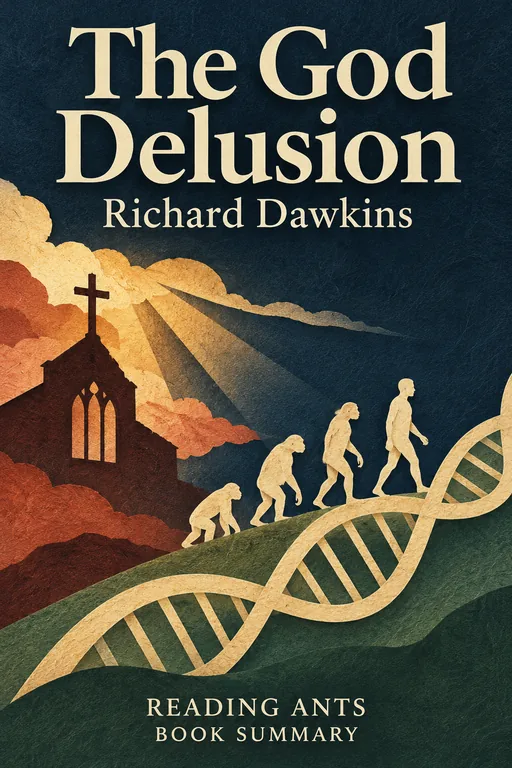
The God Delusion
Richard Dawkins argues that a supernatural creator almost certainly does not exist, that religion is not needed for morality or meaning, and that faith can do harm, in a book that became one of the best-known statements of the New Atheism.
Overview
The God Delusion was published in 2006 by Richard Dawkins, an evolutionary biologist who held the post of Professor for the Public Understanding of Science at Oxford. He wrote it as a direct challenge to religion, in a period in which a number of authors, including Sam Harris, Christopher Hitchens and Daniel Dennett, published similar works. Dawkins argues for atheism on scientific and philosophical grounds, and criticizes the effects of religion in society. The book sold very widely, and was widely praised and widely condemned. It is written in a forceful and often witty style.
Full Summary
1. A deeply religious non-believer
The idea: Dawkins starts by distinguishing the supernatural religion that he criticizes from the awe that scientists feel at the universe, which he finds deeply moving and which he calls “Einsteinian religion.” He then defines the God hypothesis, the belief in a supernatural intelligence that designed the universe, as a scientific hypothesis that can be examined like any other. He says that agnosticism is not an equal compromise, since probabilities can be assessed.
In real life: Feeling wonder at the night sky does not require belief in a supernatural being.
2. The arguments for God’s existence
The idea: The author goes through traditional arguments for God, such as those of Thomas Aquinas, and finds them unconvincing. The argument from design, he says, is the most serious, but is answered by Darwin’s theory of natural selection. He also presents his “Ultimate Boeing 747” argument: a designer complex enough to create the universe would itself need an explanation, and so the hypothesis does not solve the problem. He says that God is probably a very improbable thing.
In real life: Saying that a complicated thing needs a creator just raises the question of who created the creator.
3. The roots of religion and morality
The idea: Dawkins considers why religion is so widespread. He suggests that it may be a by-product of other traits, such as the tendency of children to believe what adults tell them, and of humans to see agency in nature. He also proposes that religious ideas spread as “memes,” which are cultural units that copy themselves. On morality, he argues that we do not need God to be good, and that our sense of right and wrong comes from evolution and culture, so that people are generally moral in similar ways, religious or not.
In real life: Most people feel that cruelty is wrong, whatever their beliefs.
4. The Good Book and the changing moral zeitgeist
The idea: The author criticizes the Bible and other holy books for containing cruel stories and commands, such as the near-sacrifice of Isaac and the slaughter of a rival people in the book of Joshua, and says that those who say they get their morality from scripture in fact choose which parts to follow, based on a moral standard that is independent of it. He argues that moral progress, such as the end of slavery, has come from changing attitudes in society, which he calls the moral Zeitgeist, and not from scripture.
In real life: People who read old texts selectively use their own judgment about what is acceptable.
5. The harm of religion and indoctrination
The idea: Dawkins argues that religion can do harm, citing religious violence, such as terrorism and conflicts between faith groups, and oppressive practices, such as discrimination against women and gay people in some traditions. He is especially critical of what he regards as the indoctrination of children, saying that labeling a child as belonging to a religion, such as “Catholic child,” is a form of abuse, and that teaching children to fear hell can do lasting mental harm. He suggests that children should be taught to think critically.
In real life: Teaching children to question may be more valuable than teaching them what to believe.
6. Consolation, meaning and the case for a scientific outlook
The idea: In the last chapters, Dawkins answers the objection that religion gives comfort and meaning. He says that comfort is not evidence of truth, and that the universe revealed by science offers wonder and meaning without needing a creator. He also urges atheists to be open about their views and to support one another, an idea he calls consciousness-raising and introduces early in the book. He says that a life without belief can be rich, and that it is better to know the truth.
In real life: Finding purpose through relationships and work needs no supernatural belief.
Why It Matters
The God Delusion became an international best seller, and a landmark of the New Atheism movement. It prompted a worldwide debate about religion and science, and led to many responses, from believers and non-believers, including works by theologians who argued that Dawkins misrepresents religion. It also encouraged many people to speak openly about their lack of belief. Whether admired or criticized, it changed the public conversation about religion. Dawkins also founded a foundation to promote reason and science, and the book is still one of the first titles that people mention, for or against, when the subject of atheism comes up in public debate.
Key Takeaways
- The God hypothesis can be examined. It is a claim about reality.
- Complexity does not prove a designer. Natural selection explains design.
- Morality does not require religion. Ethics can come from evolution and culture.
- Religion has costs. It can lead to harm and indoctrination.
- Science offers wonder. The natural world inspires awe without the supernatural.
What We Can Learn
You can use the book to think about what you believe and why, and to examine your reasons. If you are a believer, reading a strong critic may help you to understand and test your beliefs; if you are not, it can show how arguments are made. Whatever you think, treat people of different views with respect, and be careful about generalizing. Look for the best versions of opposing arguments, not just the worst. And ask what evidence would change your mind. Discuss questions of faith with family and teachers in a calm way.
Criticism and Counterpoints
Many critics, including philosophers and theologians, say that Dawkins attacks a caricature of religion, ignoring sophisticated theology, and that his arguments, such as the “Ultimate Boeing 747,” do not address classical ideas of God as a necessary being. Others say that he treats religion as a scientific hypothesis, when it is about meaning and practice, and that he overlooks the good done by religious communities, such as charity. Some atheists felt that his tone was needlessly harsh. The claim that religion indoctrinates children has been called one-sided. Some critics say that he exaggerates the link between religion and violence.
Who Should Read It
This book is for readers who want to engage with arguments about religion and atheism, whether to agree or to disagree. It is forceful and may offend some believers. Those seeking a balanced view should also read thoughtful religious responses and works that explore the compatibility of science and faith.
Want the whole book?
A summary is a taste, not the meal. Here is where to find the full book.
You reached the end 🎉
Nicely done. Mark this one as read, and we will suggest what to read next.
Read this next

The Blind Watchmaker
Richard Dawkins
Richard Dawkins argues that the complex, designed-looking features of living things are the result of natural selection acting cumulatively over vast time, a process with no foresight, which he calls a blind watchmaker.
🔬 Science
Mere Christianity
C. S. Lewis
C. S. Lewis, the author of the Narnia stories, explains and defends the central beliefs that most Christians share, using reason, plain language and vivid examples.
🕊️ Philosophy & Religion
The Demon-Haunted World
Carl Sagan
Carl Sagan defends science as a candle in the dark against superstition and pseudoscience, and offers a "baloney detection kit" of tools for thinking critically and for testing claims.
🔬 Science
The Righteous Mind
Jonathan Haidt
Jonathan Haidt argues that moral judgments come mainly from intuition and emotion, not reason, that people's moral instincts rest on several foundations that differ across political groups, and that understanding this can help us to disagree without hating each other.
🧩 Mind & Psychology
The Screwtape Letters
C. S. Lewis
In a series of letters from an experienced devil to his nephew, a junior tempter, C. S. Lewis humorously reveals how everyday temptations can lead an ordinary person away from goodness, and by contrast shows what a good life looks like.
🕊️ Philosophy & Religion
A Brief History of Time
Stephen Hawking
One of the world's greatest physicists explains, with almost no math, what we know about the origin, structure and fate of the universe, from the Big Bang to black holes and the nature of time itself.
🔬 ScienceWant something different?
Pick another topic and we will show you three books to start with.