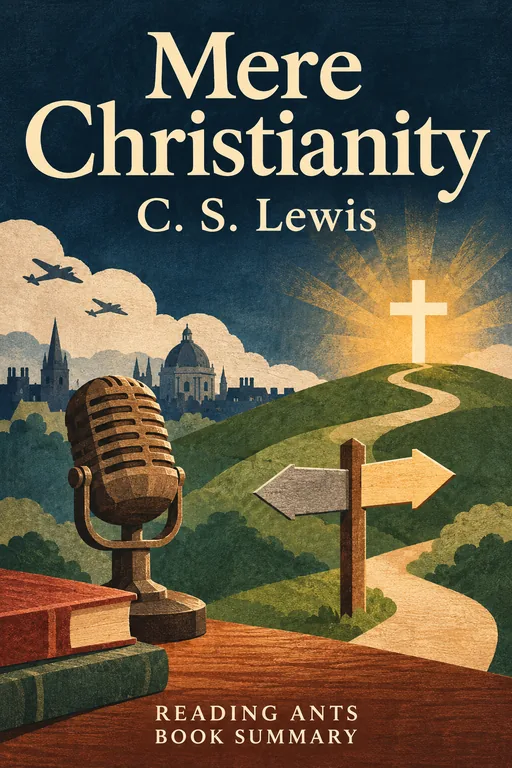
C. S. Lewis, the author of the Narnia stories, explains and defends the central beliefs that most Christians share, using reason, plain language and vivid examples.
Overview
Mere Christianity was published in 1952, and is based on a series of radio talks that Lewis gave for the BBC in Britain during the Second World War. The talks were meant to explain the basics of the Christian faith to ordinary listeners at a time of crisis. Lewis, a scholar of English literature who taught at Oxford and later at Cambridge, had been an atheist as a young man and had converted to Christianity as an adult. The book has four parts: right and wrong as a clue to the meaning of the universe, what Christians believe, Christian behavior, and a final part called Beyond Personality, which takes the first steps into the Christian idea of God. “Mere” Christianity means the common core of the faith, not a particular denomination.
Full Summary
1. The moral law and what it suggests
The idea: Lewis begins with an observation: people everywhere quarrel by appealing to a standard of right and wrong that they expect others to know, and that they often fail to keep themselves. He calls this the Law of Human Nature, and argues that it is not mere instinct or social custom, since we can judge between instincts and customs by it. It looks like a rule that comes from outside humanity. He takes it as a clue that the universe has a mind behind it that cares about right behavior.
In real life: When someone says, “That’s not fair,” they appeal to a standard that they expect others to share.
2. Rival conceptions of God, and the Christian claim
The idea: Lewis then discusses different views of the universe, including the view that there is no God, and the view of a God who is beyond good and evil. He argues that the moral law suggests a God who is good, and that we all fall short of it. He then turns to Christianity, which says that humans have fallen away from God, and that Jesus is God become man. He presents an argument that Jesus must be either a liar, a lunatic or the Lord, since a great moral teacher would not have made the claims that he did.
In real life: If someone claims to be a king, you cannot just call him a nice person; he is either right or very wrong.
3. The way Christians understand salvation
The idea: In the second book, Lewis explains the Christian view that Jesus’s death and resurrection make it possible for people to be changed, and to share in the life of God. He says that theories of how this works, which are called atonement, are less important than the fact that it does. He uses comparisons, such as that of a debt paid for someone else, and says that the idea is that humans cannot save themselves, but need help. He insists that Christianity is not just a set of ideas, but an invitation to a new life.
In real life: A swimmer in trouble needs a rescuer, not just advice.
4. Christian behavior: virtues and sins
The idea: The third book looks at the practice of the faith. Lewis discusses the traditional virtues, such as prudence, justice, temperance and courage, and the Christian virtues of faith, hope and charity. He gives a famous discussion of pride, which he calls the great sin, the root of competition and the desire to be superior. He also writes about sexual morality, forgiveness and the idea that Christians should love their neighbors as themselves, even when they do not like them.
In real life: Being kind to someone you do not like, in actions, can gradually change how you feel.
5. Faith and the hard work of change
The idea: Lewis discusses faith in two senses. In the first, it is the art of holding on to what your reason has accepted even when your moods change, and he says this habit can be trained, for example by daily prayer and reading. In the higher sense, faith comes after a person has tried hard to be good, has failed, and has found that nothing can be earned from God by effort alone. Later, in the last book, he argues that Christian life is a process of being remade, using a parable that he borrows from George MacDonald: a house that God rebuilds. We may think that God is only fixing a few leaks, but he is actually building a palace. Becoming a “new man” is not easy and needs God’s help, but it is meant to lead to a life full of joy.
In real life: A musician who has to unlearn bad habits may feel worse before improving.
6. Beyond personality: becoming new people
The idea: The last book considers the Christian understanding of God as three persons in one, and how humans can be drawn into this life. Lewis uses analogies, such as one about dimensions, to make a hard idea more understandable. He suggests that the purpose of life is to become sons and daughters of God in a real sense, and that Christianity offers this change as the next step for humanity. He ends with the idea of becoming a “new man,” in which the self gives up its own demands and receives a new life, so that goodness is the result of a changed nature and not mere self-improvement.
In real life: Learning a language or an instrument can feel like becoming a new person, as skill becomes part of you.
Why It Matters
Mere Christianity is one of the most widely read books on Christianity in the English language, and has been called a modern classic of apologetics, the defense of the faith. It has influenced millions of readers, including many who were not religious and who found Lewis’s reasoning clear and engaging. Several well-known figures have said that it played a role in their conversion. The book also helped to foster understanding between Christians of different denominations by focusing on what they share. Its style, which mixes logic, imagination and humor, is a model of how to write about difficult topics for a general public.
Key Takeaways
- Moral intuition points beyond itself. The sense of right and wrong suggests a source.
- Christianity makes a unique claim. Jesus is either who he said he was or not.
- Pride is the root of many evils. Humility is central.
- Change is a process. Becoming a better person is a long task.
- Core beliefs unite. There is a common faith beyond the differences.
What We Can Learn
Whether or not you share Lewis’s faith, you can learn from his method: start with common experience, reason step by step and use images to make ideas clear. Notice your own sense of fairness and how you and others use it. Think about pride in your own life, and where comparing yourself to others harms your attitude. If you are a believer, the book may help you to articulate your beliefs; if you are not, it can help you to understand the viewpoint of those who are. Read it critically, and discuss it with others.
Criticism and Counterpoints
Critics say that Lewis’s argument from the moral law is not decisive, since evolutionary and cultural explanations may account for our moral sense. His trilemma, that Jesus was a liar, a lunatic or Lord, has been criticized by scholars who argue that it ignores the possibility that the Gospels are legendary or that Jesus’s claims were different from those reported. Some find his views on gender and sexuality outdated. Theologians of other traditions say that it is too simple, or that “mere Christianity” does not exist apart from particular churches. Others note that it was written for a wartime British audience. Nonetheless, many readers find it helpful.
Who Should Read It
This book is for people who want a clear and thoughtful statement of Christian belief, whether they are believers, seekers or critics. It is easy to read, and each part can be taken separately. Those who want a scholarly treatment of theology, or a defense of a specific denomination, should look elsewhere.
Want the whole book?
A summary is a taste, not the meal. Here is where to find the full book.
You reached the end 🎉
Nicely done. Mark this one as read, and we will suggest what to read next.
Read this next
The Screwtape Letters
C. S. Lewis
In a series of letters from an experienced devil to his nephew, a junior tempter, C. S. Lewis humorously reveals how everyday temptations can lead an ordinary person away from goodness, and by contrast shows what a good life looks like.
🕊️ Philosophy & Religion
The Purpose Driven Life
Rick Warren
Pastor Rick Warren presents a forty-day program, based on Christian faith, to help readers discover that their lives have a purpose planned by God, built around worship, community, growth, service and sharing their faith.
🕊️ Philosophy & Religion
Confessions
Augustine of Hippo
Augustine, a bishop in Roman North Africa, tells the story of his restless youth and his conversion to Christianity, in a long prayer addressed to God that is also a deep inquiry into memory, time and the human heart.
🕊️ Philosophy & Religion
Man's Search for Meaning
Viktor E. Frankl
A psychiatrist who survived the Nazi concentration camps explains that even in the worst suffering, people can choose their attitude, and that finding a reason to live is what gives us the strength to endure.
👤 Real Lives
The Lion, the Witch and the Wardrobe
C. S. Lewis
Four children step through a wardrobe into the magical land of Narnia, where a wicked witch has made it always winter, and with the help of the great lion Aslan they fight to set the land free.
🧸 Children's Books
The Art of War
Sun Tzu
The greatest victory is the one won without fighting, achieved through careful planning, knowing both yourself and your opponent, and using deception, flexibility and timing.
🕊️ Philosophy & ReligionWant something different?
Pick another topic and we will show you three books to start with.