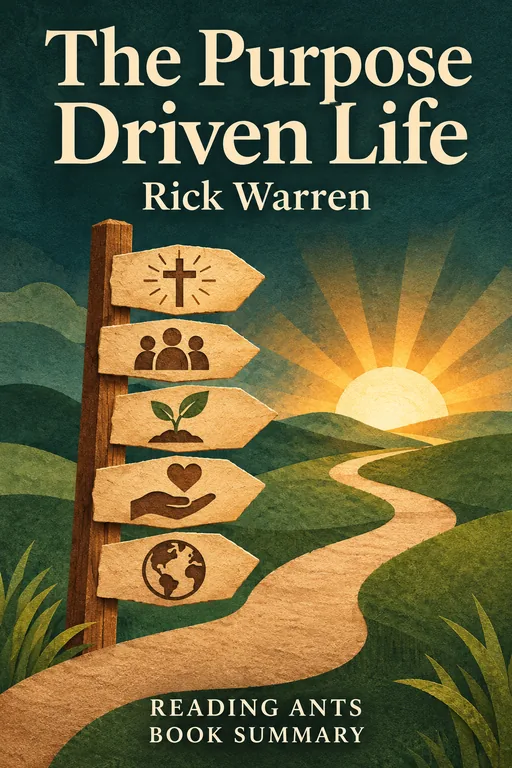
Pastor Rick Warren presents a forty-day program, based on Christian faith, to help readers discover that their lives have a purpose planned by God, built around worship, community, growth, service and sharing their faith.
Overview
The Purpose Driven Life: What on Earth Am I Here For? was published in 2002 by Rick Warren, the founding pastor of Saddleback Church in California. It became one of the best-selling nonfiction books in history, with tens of millions of copies sold. The book is divided into forty short chapters, each to be read on a single day, grouped in six sections. Warren writes in plain, conversational language and uses many Bible quotations. His starting point is that life is not about us, but about God, and that finding meaning begins with understanding God’s purposes.
Full Summary
1. It starts with God
The idea: Warren opens by saying that the search for meaning begins with the recognition that we are not here by accident. Our lives, he says, are part of a larger plan, and our purpose is found not by looking inward but by looking to the one who made us. He warns that purpose is not about fulfilling personal ambitions or finding self-esteem, though these may be by-products. The opening line of the first chapter, “It’s not about you,” challenges the habit of putting oneself at the center.
In real life: A person who works only for personal success may feel empty, while one who serves a cause larger than himself may feel fulfilled.
2. Planned for God’s pleasure: worship
The idea: The first purpose is worship. Warren says that we were created to bring joy to God, and that worship is not limited to church services, but includes how we live, with gratitude, trust and obedience. He urges readers to enjoy God, to be thankful in hard times, and to make their work and daily lives an offering. He suggests that a person who lives to please God can find peace.
In real life: Doing everyday tasks with thanks, such as cooking a meal for family, can feel like an act of devotion.
3. Formed for God’s family: fellowship
The idea: The second purpose is fellowship, which means belonging to a community of believers. Warren argues that faith is not meant to be lived alone, and that the church is a family in which people support each other, share burdens and hold each other accountable. He encourages readers to join a small group, to practice honesty and to build relationships based on love, forgiveness and humility.
In real life: A group of friends who check on each other helps everyone to keep going in hard times.
4. Created to become like Christ: discipleship
The idea: The third purpose is spiritual growth, or becoming more like Jesus in character. Warren says that this is a lifelong process, which involves reading the Bible, praying, facing temptation and dealing with trials, which he sees as tools for shaping us. He suggests that character develops through habits and choices, and that difficulties are used to build patience and trust.
In real life: A hard experience, such as losing a job, may lead to growth in patience and humility.
5. Shaped for serving God: ministry
The idea: The fourth purpose is service. Warren says that each person has been given unique gifts, abilities, passions, personality and experiences, which he summarizes by the word SHAPE, and that these are meant to be used to serve others. He encourages readers to discover their gifts and to use them in their communities, in small acts of kindness and in service at church. He argues that service gives dignity and fulfillment.
In real life: A person who loves to cook might provide meals for neighbors in need.
6. Made for a mission: sharing faith
The idea: The final purpose is mission, sharing with others the message of the Christian faith, through example and words. Warren says that each Christian is called to be a witness, and to see the people around them with compassion. He suggests being sensitive and respectful, and telling one’s own story. He concludes by calling readers to a life that makes a difference, and that is lived for something larger than oneself.
In real life: A person who offers kindness to a coworker, and is open about what matters to them, may influence that person’s life.
Why It Matters
The Purpose Driven Life has been among the best-selling books of the twenty-first century, and has been read by many millions of people. It has been used by churches and small groups across the world, in campaigns where entire congregations read it together. The book’s success reflected a widespread desire for meaning, and its clear structure and warm tone made it accessible. It has also influenced the way many churches approach teaching and community. Warren later said that he would give away most of his income and stop taking a salary from his church, which attracted attention. Its popularity makes it an important part of contemporary religious culture.
Key Takeaways
- Life has a purpose beyond the self. Meaning is found in relation to God.
- We need community. Faith is lived with others.
- Growth takes time. Character is shaped through experience.
- Everyone has gifts. Use them to serve others.
- Share what you believe. Mission is part of faith.
What We Can Learn
Whatever your beliefs, you can reflect on the question of purpose. Ask what you want your life to be for, beyond comfort and success. Consider what talents and experiences you have that can help others. Think about the communities that you belong to, and how you can contribute. Make time for quiet reflection, gratitude and service. If you are a Christian, the book offers a structure for daily reflection; if you are of another faith or none, you may find its emphasis on service and community useful, while disagreeing with some of its theology.
Criticism and Counterpoints
Some Christian critics say that the book is shallow, offering a simplified message with a selection of Bible verses taken from various translations and paraphrases, and that it gives the references mostly in endnotes, which makes the context hard to see. Others say that it emphasizes self-improvement more than the cross and doctrine. Others criticize its commercial success and the “megachurch” culture associated with its author. Non-religious readers object that it assumes a particular theology, and that it claims that purpose can only be found in God. Some say that the forty-day format and its slogans reduce complicated questions to formulas. Supporters point out that many readers have said that it changed their lives.
Who Should Read It
This book is for readers who are exploring Christian faith, or who want a daily structure for reflection on purpose. The chapters are short, and the style is simple. Those who are not Christian, or who prefer a more philosophical approach, may find it less suitable.
Want the whole book?
A summary is a taste, not the meal. Here is where to find the full book.
You reached the end 🎉
Nicely done. Mark this one as read, and we will suggest what to read next.
Read this next
Mere Christianity
C. S. Lewis
C. S. Lewis, the author of the Narnia stories, explains and defends the central beliefs that most Christians share, using reason, plain language and vivid examples.
🕊️ Philosophy & Religion
The Screwtape Letters
C. S. Lewis
In a series of letters from an experienced devil to his nephew, a junior tempter, C. S. Lewis humorously reveals how everyday temptations can lead an ordinary person away from goodness, and by contrast shows what a good life looks like.
🕊️ Philosophy & Religion
Man's Search for Meaning
Viktor E. Frankl
A psychiatrist who survived the Nazi concentration camps explains that even in the worst suffering, people can choose their attitude, and that finding a reason to live is what gives us the strength to endure.
👤 Real Lives
The Power of Now
Eckhart Tolle
Eckhart Tolle teaches that much of our suffering comes from living in thoughts about the past and future, and that peace is found by paying full attention to the present moment.
🌱 Self-Improvement
When Things Fall Apart
Pema Chodron
Buddhist nun Pema Chodron teaches that when life falls apart, the way forward is not to run from pain or to fix everything, but to stay with the uncertainty, to soften and to meet our fear and sorrow with kindness.
🕊️ Philosophy & Religion
The Art of War
Sun Tzu
The greatest victory is the one won without fighting, achieved through careful planning, knowing both yourself and your opponent, and using deception, flexibility and timing.
🕊️ Philosophy & ReligionWant something different?
Pick another topic and we will show you three books to start with.